
Lieferung heute & morgen

Qualitätsgarantie

Willkommens-Angebote freischalten: KOSTENLOSE Lieferung | Bis zu 80 % RABATT | Kostenlose 30-Tage-JoyPlus-Testphase
App herunterladen
Dark cabinets, cluttered drawers, or poorly lit kitchen countertops are a daily annoyance. A rechargeable LED cabinet light with a motion sensor promises a simple, wire-free solution. However, the market is flooded with products whose real-world performance often falls short of their advertising claims. Before you make a purchase, it's crucial to understand the typical weaknesses that often only become apparent after a few weeks of use.
As your Joybuy Product Recommendation Officer, I'm here to help you separate the good from the bad. In this guide, we'll focus on the critical technical features and show you how to avoid a bad purchase.
Many products look identical at first glance, but the differences are in the details. Pay close attention to these three points to avoid disappointment:
To make an informed decision, you should focus on objective, technical parameters. These determine the functionality and longevity of your cabinet lighting.
The battery capacity, specified in milliampere-hours (mAh), is the most important indicator of runtime. A light for a frequently used kitchen cabinet needs a higher capacity (e.g., 1000 mAh or more) than a light for a rarely opened storage closet. Also, pay attention to the charging port. A modern USB light strip with a USB-C port generally offers faster charging times and more convenient handling than outdated Micro-USB ports.
A good LED strip with a motion sensor uses a precise PIR sensor. Important features include a detection angle of about 120 degrees and a range of 2 to 5 metres. Some models also offer the ability to switch between different modes (e.g., Always-On, Auto Mode, Off). This gives you the flexibility to adapt the light to your needs and conserve the battery.
The light colour is measured in Kelvin (K) and has a major impact on atmosphere and functionality.
Brightness is specified in lumens (lm). For most cabinet applications, values between 100 and 300 lumens per strip are sufficient.
Here are some recommendations tailored to specific use cases that take the aforementioned criteria into account.

Why This Fits Their Persona: Ideal for users who want to illuminate several smaller areas like drawers, shoe cabinets, or nightstands. The 2-pack offers great value for getting started.
The 800mAh battery is appropriately sized for its compact form and 21 LEDs. The simple adhesive mounting is reliable for lightweight strips like this and requires no drilling.
Offers three selectable colour temperatures (Warm, Neutral, and Cool White), which allows for flexible adaptation to different environments—a rare feature in this price range.
Why This Fits Their Persona: Suitable for illuminating larger areas like kitchen countertops, long closets, or pantries. The higher light output and larger battery are designed for daily, intensive use.
With an 1100mAh battery, it counteracts the pitfall of short runtimes. The capacity is sufficient to power the 41 LEDs over a longer period with frequent activation.
The 30 cm length ensures more even light distribution over larger surfaces. Like the smaller model, it offers three colour temperatures for maximum flexibility.
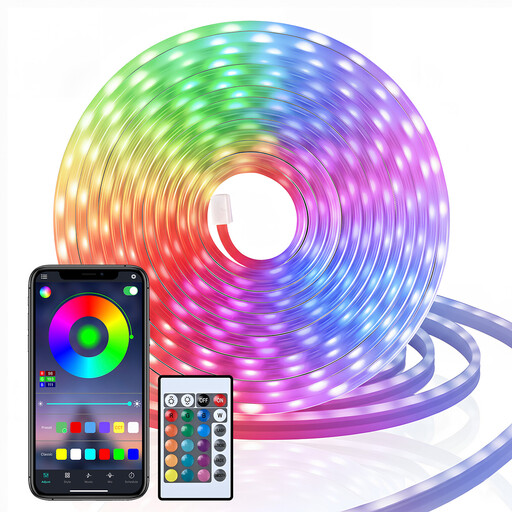
Why This Fits Their Persona: For users who prioritise creative design. Ideal as indirect lighting in open shelves, under kitchen cabinets, or in gaming setups where colour effects are desired.
This model bypasses the sensor trap by intentionally omitting a motion detector, instead offering full control via remote and app. The 5V USB power supply allows for continuous operation without battery worries.
Offers full RGB colour control, music synchronisation, and a flexible design for creative installations. It's an alternative for anyone looking for more than just functional white light.
We've compiled a complete, up-to-date list of products that fully meet these strict selection criteria and safety standards.
The battery life depends heavily on the battery capacity (mAh), brightness, frequency of activation, and the duration of illumination per activation. With average use (approx. 5–10 activations per day), a model with 800–1100 mAh can last from several weeks to months, depending on the settings, before it needs to be recharged via USB.
Most basic models in this price range do not offer adjustable sensitivity. Their function is limited to motion detection within a fixed radius. Higher-quality models may have additional light sensors that prevent the light from turning on in sufficient ambient light, which helps conserve the battery.
The included adhesive strips are generally optimised for smooth, clean, and grease-free surfaces such as painted wood, metal, tile, or plastic. Adhesion may be reduced on rough, untreated wood surfaces or wallpapered walls. It is advisable to thoroughly clean and dry the surface before application. For very uneven surfaces, using additional mounting adhesive may be a good idea.