
Lieferung heute & morgen

Qualitätsgarantie

Willkommens-Angebote freischalten: KOSTENLOSE Lieferung | Bis zu 80 % RABATT | Kostenlose 30-Tage-JoyPlus-Testphase
App herunterladen
A rechargeable LED clip-on lamp saves space, can be positioned flexibly and works without tying up a mains socket. These features make it useful for reading, working from home, crafts or lighting a shelf. However, models can vary considerably in battery life, brightness controls and clamp design.
Many products look similar at first glance. Before you buy, don’t just focus on the LED output or a low price. Check the specifications and make sure the lamp is suited to how you plan to use it.
The claim ‘long battery life’ doesn’t tell you much without details of the brightness setting. A lamp’s run time can vary depending on how bright it is. Check for:
With a USB-rechargeable lamp, it’s also worth checking whether the package includes just a cable or a mains adaptor too. The product description should state the charging time clearly.
Wattage alone doesn’t give you a complete picture of brightness. Light output is measured in lumens. A compact light output may be enough for a clip-on LED reading lamp or focused desk lighting. For a larger workbench, you may need a wider or brighter beam.
Colour temperature affects the look and feel of the light. 4000K neutral white is often suitable for work surfaces, reading and crafts, as it is neither particularly warm nor strongly blue. The colour rendering index, CRI or Ra, indicates how natural colours look under the light. A rating of Ra≥80 is a useful specification, but it doesn’t replace checking whether the light is distributed in a way that suits you.
A clip-on lamp needs to attach securely to the thickness of the desk or shelf you plan to use it on. Check the following:
A flexible reading lamp should stay in position without the head drooping after a short time. Don’t overtighten the clamp, as this could damage desk edges or coatings.
A dimmable LED clip-on lamp with several settings can be adjusted to suit different situations. Three brightness settings are useful for reading, writing and subtle ambient lighting. A touch switch can make the lamp easier to use, but make sure it won’t switch on accidentally with a light touch.
A focused beam is useful for a desk or bedside if you only want to light a specific area. A wider beam spreads light over a larger area. When choosing a lamp, consider the clamp position, the length of the lamp neck and the area you want to illuminate together.
ABS plastic can help keep the weight down. A silicone lamp neck reinforced with metal combines flexibility with a shape-retaining design. Also check the stated operating temperatures and electrical protection class. According to its product specifications, a model with Class III protection operates at low DC voltage. For everyday use, a neatly finished housing and a securely fitted clamp are important too.
The models below cater to different needs. The details are based on the respective product descriptions, so check them against the current listing before you buy.

Why this product suits this profile: This model combines 2.5 W power, a light output of 160 lm, three brightness settings and a built-in 1200-mAh battery. It’s well suited to simple lighting tasks at a desk, bedside or shelf.
The product specifications give clear figures for light output, colour temperature, battery and run time. The stated run times of 3, 7 and 30 hours show how usage time depends on the selected brightness setting.
4000K neutral white, 160 lm, three brightness settings and an adjustable lamp neck reinforced with metal.
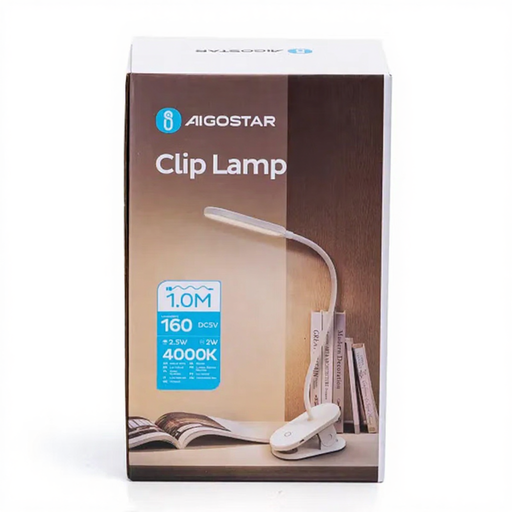
Why this product suits this profile: The white finish blends discreetly into light-coloured work and living spaces. The adjustable lamp neck and cordless design make it easy to direct the light precisely while reading, working or doing crafts.
The description lists 4000K, 160 lm, Ra≥80 and a battery capacity of 1200 mAh. These figures make it easier to compare with products that only make general claims about light quality.
Three settings, 4000K neutral white, Ra≥80 according to the product details, and a flexible silicone holder reinforced with metal.
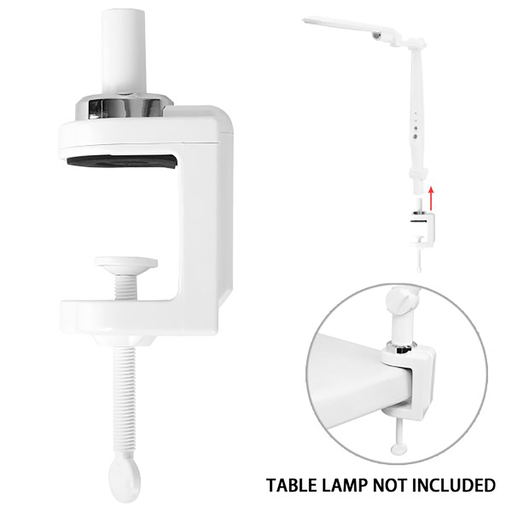
Why this product suits this profile: This clamp is designed as a mounting accessory for compatible LED desk or reading lamps. It’s suitable for worktops, workbenches and craft tables when you want to attach an existing lamp without taking up much space.
The maximum clamp thickness is clearly stated as up to 74 mm. This lets you check before buying whether the clamp will fit the edge of your desk or workbench.
PC construction, compact dimensions and a non-slip, surface-friendly design according to the product description.
We’ve put together a complete, regularly updated list of products that meet these strict selection criteria and fully comply with the safety regulations in force in the EU.
First, attach the clamp to a clean, sturdy edge. Tighten it just enough to hold the lamp securely. Then position the lamp neck to illuminate your work area. When using a clip-on lamp at a desk or bedside, make sure the lamp head isn’t pointing directly at eye level or towards other people.
For even lighting, it’s a good idea to position the lamp to the side of, or slightly above, the work surface. When charging, make sure the USB cable isn’t trailing across walkways or rubbing against moving parts.
It depends on the battery capacity, LED output and brightness setting. The product details for the Aigostar models mentioned above give run times of 3, 7 and 30 hours for different modes. A lower setting will generally extend the run time, while higher brightness uses more energy.
4000K is classed as a neutral white light and can be used in desk, reading and craft areas. Whether you find the colour comfortable depends on the room lighting, surfaces and your personal preference. It’s also important that the lamp provides even enough light across the area you want to illuminate.
LED clip-on lamps with low power consumption use relatively little energy. The actual cost depends on the lamp’s power, how long you use it each day and your electricity tariff. For a rough estimate, multiply the power in kilowatts by the number of hours it’s used, then multiply the result by the price per kilowatt-hour. One hour of use from a 2.5 W lamp is equivalent to 0.0025 kWh.