
Lieferung heute & morgen

Qualitätsgarantie

Willkommens-Angebote freischalten: KOSTENLOSE Lieferung | Bis zu 80 % RABATT | Kostenlose 30-Tage-JoyPlus-Testphase
App herunterladen
A rechargeable LED night light can be used flexibly in the bedroom, children's room, hallway or while camping. It does not need a socket while in use and, depending on the model, can be adapted to different situations with warm white light, RGB colours, a timer or touch control.
However, product descriptions are not always complete. A high number of colours says little about how the lamp is operated, while the term “wireless” does not explain how long the battery will actually last. You should therefore check certain technical details and safety features before buying.
For a wireless night light, battery capacity is an important parameter. If this information is missing, it is unclear how often the device will need to be charged. The maximum operating time can also vary considerably depending on the brightness level and colour mode.
You should therefore look for:
A model with a USB-C port can usually be charged conveniently in everyday use. With a USB connection rated at 5 V and 1 A, you should only use compatible chargers.
An RGB night light can create decorative accents. For night-time breastfeeding, changing nappies or walking from the bed to the door, however, warm white light is often more practical. Check whether both types of light can be selected separately and whether the brightness can be adjusted.
Warm white light in the region of around 2600 to 2800 K is generally perceived as yellowish and warm. Stepless dimming allows finer adjustment than just three fixed brightness levels.
A night light with a timer switches off after a set period. An ambient light sensor, on the other hand, responds to the brightness in the room. A motion sensor detects movement within a specific detection range. These functions serve different purposes:
An integrated sensor only works reliably if it is not obscured by furniture, textiles or decorations.
Moderate light output is often sufficient for a night light. The reference model with 12 SMD LEDs produces 40 lm and uses warm white light at 2600–2800 K, as well as seven RGB colours. The stated CRI value above 85 describes colour rendering compared with a reference light source. The higher the value, the more naturally colours may appear.
The light output should suit the intended location. A small bedroom night light needs different features from a lamp designed for a dark hallway.
Compact dimensions are practical for bedside tables and shelves. For example, the model mentioned measures 13 × 8 × 8 cm. ABS plastic and metal can enable a stable construction; the specific build quality, secure footing and manufacturer's information remain decisive.
For a children's room night light, you should also check:
A lamp is not a toy as a matter of principle and should only be used by children under supervision where specified by the manufacturer.
A USB-C night light offers a widely used connection and is suitable for charging in different locations. You should not open devices with lithium batteries or expose them to intense heat, and you should follow the manufacturer's instructions during charging.
You should also look for available product information such as:
The CE marking is not an independent quality seal. It indicates a declaration of conformity by the responsible party. When making your purchasing decision, you should therefore also consider the specific technical details and warnings.
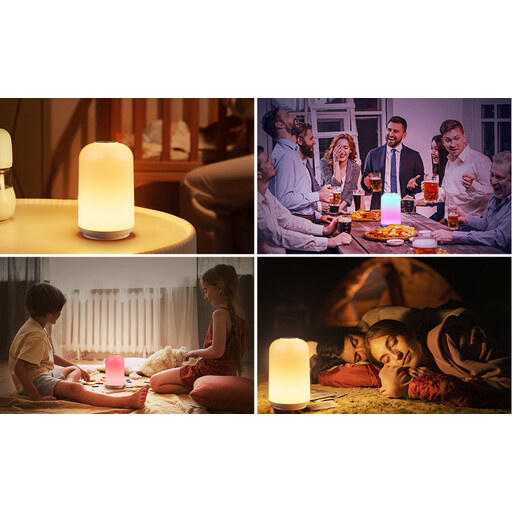
Why this product suits this profile: This compact model combines warm white light and seven RGB colours with stepless dimming and a rechargeable battery. It is suitable for bedside tables, shelves or children's room furniture.
The light modes and dimming function are clearly specified. The integrated battery allows the lamp to be used without permanently occupying a socket.
40 lm light output, CRI above 85, 1 W power consumption and USB charging at 5 V/1 A.
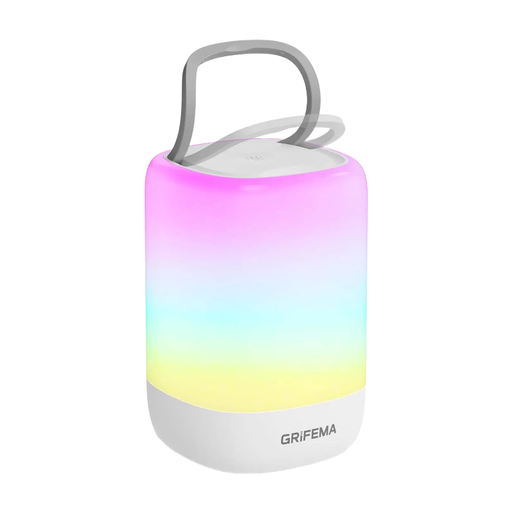
Why this product suits this profile: This portable LED lamp offers touch control, warm white light and seven RGB colours. It can be used in the bedroom, children's room or while camping.
The lamp is operated directly on its body. A 30-minute timer limits the lighting time instead of leaving the light on unnecessarily.
Stepless brightness adjustment from 100% to 5%, 3.7 V battery with 1500 mAh and USB-C charging port.
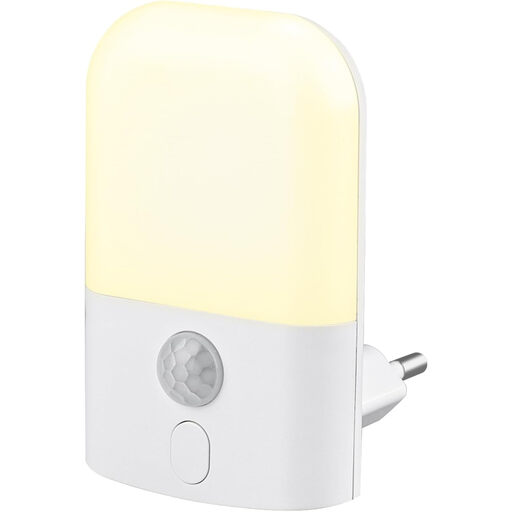
Why this product suits this profile: This plug-in model is an alternative for hallways, stairs, bathrooms or children's rooms when automatic activation is more important than battery operation.
The function is clearly designed to respond to movement and darkness. The lamp switches off after 60 seconds without detected movement.
Five brightness levels, warm white light at 2700 K, detection range of up to 3 m and 120°, plus 0.5 W power consumption.
For use by the bed or on a bedside table, dimming, warm white light and simple operation are particularly important. In a children's room, an LED night light for children with a timer and low brightness may be a sensible choice. For hallways and stairs, however, a motion sensor is often more practical than a lamp that stays lit continuously.
If you want to use a lamp while camping, travelling or in several rooms, look for low weight, an integrated battery and a robust surface. A decorative lamp with RGB colours is better suited to atmospheric lighting than to deliberately illuminating a path.
We have put together a complete, regularly updated list of products that fully meet these strict selection criteria and the safety regulations applicable in the EU.
This depends on the battery capacity, brightness level, light colour and usage. A stated operating time is only reliable if the manufacturer specifies it for a particular operating mode. If you use the lamp frequently, you should favour models with a stated battery capacity and a timer.
Warm white light between around 2600 and 2800 K is often used for subtle night-time lighting. RGB colours can serve decorative purposes. Low brightness, simple operation and compliance with the safety instructions are key. The colour of the light does not provide a basis for medical or sleep-related claims.
Running costs depend on power consumption, charging losses and usage time. With a 1 W model, direct energy consumption during operation is low. However, battery-powered lamps also incur charging losses. A timer can limit operating time and prevent the light from being left on unnecessarily.