
Lieferung heute & morgen

Qualitätsgarantie

Willkommens-Angebote freischalten: KOSTENLOSE Lieferung | Bis zu 80 % RABATT | Kostenlose 30-Tage-JoyPlus-Testphase
App herunterladen
A rechargeable LED night light can be useful in a child's bedroom, bedroom, hallway or when travelling. It does not need a mains socket where it is being used and, depending on the model, can be dimmed, charged via USB or controlled with a sensor. At the same time, eye-catching designs and impressive battery-life claims do not always lead to the right buying decision.
If you are looking for an LED night light for children, a light for a baby-room night light or a flexible bedside lamp, you should therefore compare the technical specifications, operation and safety information before buying.
A stated battery life of many hours often refers to the lowest brightness setting. At full power, the operating time can be significantly shorter. For example, the VAVA VA-CL009 is advertised as offering up to 100 hours at the lowest brightness, while approximately 7 hours is specified at maximum brightness.
You should therefore look for three details:
An RGB night light can add decorative splashes of colour. However, for night-time breastfeeding, changing nappies or finding your way to the bathroom, a dimmed warm-white night light is usually more practical. Coloured light does not replace precise information about brightness or colour temperature.
It is useful to choose a light where warm-white light can be selected separately. Some models also allow you to adjust the colour temperature, for example from warm light to a cooler white.
A silicone night light feels soft and can be pleasant to use as a children's or baby product. Nevertheless, you should take the cable, charging port, battery and heat development into account. A night light should not be placed in water or near heat sources, and should not be left unattended within the reach of small children while charging.
Also check whether the manufacturer's information includes details about the material, CE marking and the responsible person in the EU. A marking does not replace the need to follow the instructions for use.
For bedrooms, a low brightness level that can be adjusted to avoid glare is often sufficient. A dimmable bedside lamp with several settings is suitable for different situations: low light for falling asleep, medium brightness for brief orientation and a stronger setting for reading aloud.
Technical values should be stated as specifically as possible. The Brilliant LED Battery Table Lamp, for example, is specified as providing 200 lumens and 3,000 kelvin. Lumens describe luminous flux, while kelvin indicates colour temperature. A lower kelvin value generally appears warmer than a higher one.
A USB rechargeable lamp is flexible as long as the charger is compatible. Modern models with a USB-C night light can be charged with a suitable Type-C cable. However, it is not just the port that matters, but also:
On the VIVREAL Sloth A046, a red indicator shows that the lamp is charging, while a green indicator shows that charging is complete. The stated charging time is approximately 3 hours, and the operating time at maximum brightness is up to 6 hours.
A portable LED lamp should be light enough to move between the bed, changing area and travel luggage. For cupboards, kitchen worktops or hallways, however, sensor-activated cabinet lighting is often more functional. PIR sensors respond to movement; the cabinet lights listed here have a stated range of approximately 3 to 5 metres.
Before installing the light with adhesive strips, make sure the surface is clean, dry and strong enough to support it. Magnetic fittings offer another option if the lamp needs to be removed and charged regularly.

Why this product suits the profile: This compact night light combines warm yellow light with three brightness levels, Type-C charging and a soft silicone casing.
The maximum operating time is explicitly stated as up to 6 hours at the highest brightness setting. The charging and full-charge indicators make planning easier.
1,200 mAh battery, 5 V Type-C input, three brightness levels and a weight of approximately 168 g.
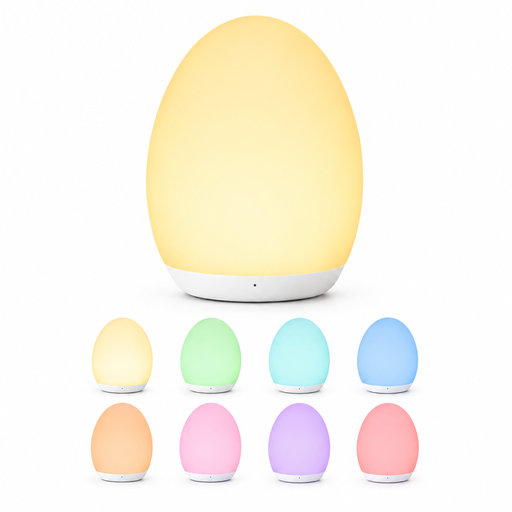
Why this product suits the profile: Warm-white dimmable light, touch controls, eight colours, a timer and a memory function cover a range of routines in the baby's room.
Operating time is differentiated by brightness: approximately 7 hours at maximum and up to 100 hours at the lowest setting. The 1-hour timer limits unnecessary operation.
2,000 mAh battery, touch controls, eight colour modes, memory function and compact dimensions of 9.2 × 9.2 × 11 cm.

Why this product suits the profile: These lights are designed for kitchens, cupboards, hallways and shelving, and switch on and off via a PIR motion sensor.
The sensor range of approximately 3 to 5 metres and three selectable colour temperatures are clearly specified. The 2-pack makes it possible to illuminate several areas.
41 LEDs, 1,100 mAh battery, USB charging, PIR sensor and slim dimensions of 300 × 38 × 10 mm.

Why this product suits the profile: This small reading lamp for the bedside can be clipped on or stood up, and at 37 g it is suitable for travel.
The description specifies concrete charging and operating times: approximately 1.5 hours to charge and up to 8 hours of use. Two brightness levels provide clear information instead of vague comfort claims.
Warm-white light at 3,000 kelvin, 350-degree rotation, 45-degree tilt and USB charging port.
We have put together a complete, regularly updated list of products that fully meet these strict selection criteria and the safety regulations applicable in the EU.
Operating time depends on battery capacity, brightness and light mode. A lamp with 2,000 mAh can stay lit considerably longer at low brightness than at full power. Always compare the operating-time specification for the setting you want to use, rather than just the maximum value in the product title.
Warm-white light of around 2,700 to 3,200 kelvin is often perceived as less cool and is suitable for providing subtle orientation in the bedroom. For a baby-room night light, you should also look for low brightness, stable positioning, suitable materials and the manufacturer's safety information. No medical or therapeutic effect can be inferred from this.
Running costs depend on how often it is charged, the battery size and the electricity price. With small LED lights, the energy required during charging is generally modest. An exact calculation is only possible using the actual charging cycles and the relevant electricity tariff. Timers, sensor operation and an appropriate dimming level can reduce unnecessary charging cycles.