
Lieferung heute & morgen

Qualitätsgarantie

Willkommens-Angebote freischalten: KOSTENLOSE Lieferung | Bis zu 80 % RABATT | Kostenlose 30-Tage-JoyPlus-Testphase
App herunterladen
A rechargeable LED table lamp can come in handy on your desk or bedside table, while reading or out on the terrace. However, models vary considerably in battery life, light colour, charging port and stability. A low price alone tells you little about whether a lamp is suitable for the way you intend to use it.
Manufacturers often quote a maximum operating time. This usually refers to a low brightness setting. If you use the lamp continuously at full power, the battery will run down sooner. Look for figures covering several brightness settings, and check whether the stated battery life is realistic for how you plan to use it.
A warm white LED lamp with a colour temperature of around 2,400 to 3,000 Kelvin creates a cosy atmosphere, making it suitable for bedrooms, decorative lighting or as a night light. For extended reading or focused work, a neutral white colour temperature of around 4,000 Kelvin may be more practical. Brightness, light distribution and the ability to adjust the lamp head are also important.
A cordless table lamp simply runs without being plugged into a socket. That says nothing about its resistance to moisture. Products intended only for dry indoor spaces shouldn’t be used on an unprotected balcony or in the rain. If you’re choosing a portable table lamp for outdoor use, check the manufacturer’s guidance on suitable conditions.
Battery capacity is measured in milliamp hours (mAh). A higher figure may mean a longer operating time, but it isn’t the only factor: LED power and brightness settings also affect energy use. A USB-C table lamp can be charged using many modern power adapters and cables. Older or especially compact models often use a different type of USB port.
Useful details to look for include:
A battery-powered table lamp with a built-in rechargeable battery differs from a model that takes replaceable batteries. Don’t open the casing of a lamp with an integrated lithium battery. Stop using it if it is damaged or visibly swollen.
Brightness is often measured in lumens (lm). A rechargeable reading lamp should direct light onto a book, keyboard or work surface. However, a high lumen rating alone doesn’t guarantee even illumination. A narrow or adjustable beam may work better for a specific area than a lamp that spreads light widely.
Colour temperature is measured in Kelvin:
The colour rendering index, CRI or Ra, describes how naturally colours appear under the light. The models described here specify a rating of Ra ≥ 80, which provides a useful technical point of reference.
An LED clip-on lamp should grip desks, shelves or headboards securely without putting unnecessary strain on the surface. Check the clamp range, materials and contact surfaces. A flexible arm makes it easier to direct the light, but one that isn’t sturdy enough may gradually droop.
For a dimmable table lamp, the controls and brightness steps are worth considering. Three fixed settings are simple to use, while stepless dimming allows finer adjustments. A low light setting can be useful as a night light in a bedroom or hallway. For outdoor areas, only use models explicitly approved for the purpose on dry, sheltered terraces or balconies.

Why this product suits this user: The clip-on design and three brightness settings cover the basics for use at a desk, on a shelf or by the bed.
The specifications list 160 lm, 4,000 K, three settings and a 1,200-mAh battery, rather than relying on vague marketing claims.
Flexible silicone arm, 120° beam angle, USB charging cable and stated battery life of 3, 7 or 30 hours, depending on the setting.

Why this product suits this user: Its decorative design and extensive dimming controls make it suitable for living rooms, bedrooms or dry outdoor areas.
The stated battery life is specifically tied to the lowest brightness setting. The lamp is also recommended for use only in dry conditions.
4,000-mAh battery, ten dimming levels and 3,000-K and 2,400-K light options; the stated maximum battery life is 160 hours at low brightness.

Why this product suits this user: Its light weight and ability to work as either a freestanding lamp or a book clip make it handy by the bed, when travelling or on the train.
Its compact design is described with specific dimensions, a weight of 37 g, an output of 16 lm and a charging time of around 1.5 hours.
Rotates 350°, tilts 45°, has two brightness settings and 3,000 K warm white light, with up to eight hours of use according to the product details.
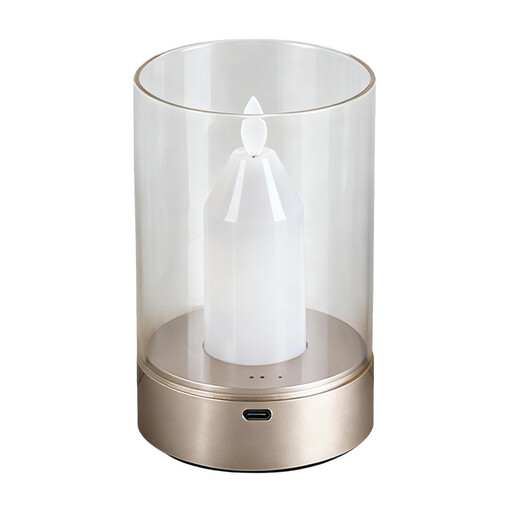
Why this product suits this user: The flickering LED effect is designed for anyone looking for a portable table lamp for a bedroom, living room or decorative display.
Outdoor use is limited to dry conditions; the care and protection guidance rules out water and high humidity.
USB-C port, 1,800-mAh battery, stepless dimming from 5 to 100 per cent and a stated operating time of 8 to 10 hours.
We’ve put together a complete, regularly updated list of products that meet these strict selection criteria and fully comply with the safety regulations applicable in the EU.
Battery life depends on capacity, LED power and the selected brightness setting. According to product details, compact reading lamps can provide several hours of use, while larger models may run for considerably longer at low brightness. If you use your lamp regularly, charge it after each extended period of use where possible.
It depends on light output, colour temperature and adjustability. For books and work surfaces, focused light distribution, an adjustable arm and sufficient brightness are all important. Warm white light can be comfortable for reading in the evening, while neutral white light at around 4,000 K is often a good choice for desk work and crafts.
Charging usually uses little electricity, although the amount depends on battery size, charging losses and how often you recharge it. Running costs are therefore influenced less by the nominal lumen rating than by power consumption in watts, daily usage time and your electricity tariff. The main benefit of battery power is that you can position the lamp wherever you need it, without leaving it connected to the mains.