
Lieferung heute & morgen

Qualitätsgarantie

Willkommens-Angebote freischalten: KOSTENLOSE Lieferung | Bis zu 80 % RABATT | Kostenlose 30-Tage-JoyPlus-Testphase
App herunterladen
Dark cabinets, cluttered drawers, or shadowy kitchen countertops are everyday annoyances. A rechargeable, motion-activated cabinet light promises a simple and flexible solution. However, the market is flooded with products whose real-world performance often falls short of their promises. Before you make a decision, it's crucial to understand the common pitfalls that can quickly turn a practical helper into a useless gadget.
This guide focuses on the objective criteria that define a reliable light, helping you to bypass common defects.
Many products advertise impressive features, but the same flaws often appear in the details. Pay close attention to these three points to avoid disappointment:
To avoid these pitfalls, you should base your choice on verifiable technical specifications. The following three features are crucial for long-term functionality.
Battery capacity, measured in milliampere-hours (mAh), is a key indicator of runtime. A higher mAh number generally means the light needs to be charged less often. Models with less than 500 mAh are often impractical for daily use. Look for a capacity of at least 800 mAh for standard applications. Another advantage is the ability to charge via a standard port. A USB LED strip can be flexibly charged with a phone adapter, a power bank, or a laptop, eliminating the need for a special charger.
A good LED strip with motion sensor uses a Passive Infrared (PIR) sensor. Two values are important here: the detection range (typically 3–5 metres) and the detection angle (often around 120 degrees). Even more crucial, however, is an integrated dusk sensor. This ensures the light only activates in darkness, saving precious battery power. The auto-off time should be between 15 and 30 seconds after the last detected movement to prevent constant on-and-off cycling.
The idea of drill-free installation is appealing, but the execution determines its durability. A solid solution often consists of two parts: a magnetic mount that is glued to the desired surface, and the light itself, which attaches to it magnetically. This allows for easy removal of the light for charging without stressing the adhesive strip. Before applying, ensure the surface is clean, dry, and free of grease to guarantee maximum adhesion. This is particularly important when used as an under-cabinet kitchen light or as a wardrobe light with sensor.
Based on the criteria mentioned, we have identified several models that are suitable for different needs and locations.
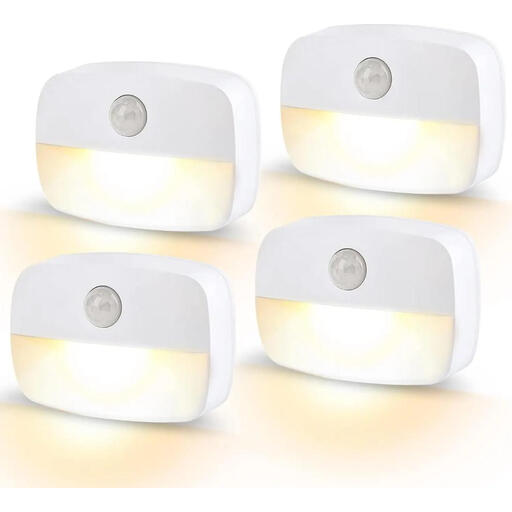
Why This Fits Their Persona: Ideal for users who want to quickly and affordably illuminate multiple areas like stairs, hallways, or small cabinets. Operating on AAA batteries makes them independent of power outlets for recharging.
Avoids the trap of complicated installation with a simple adhesive mount. Its focus on a single function (motion detection in the dark) reduces susceptibility to failure.
Very low energy consumption (0.5W); comes in a 4-pack for versatile applications.

Why This Fits Their Persona: Perfect for users looking for flexible lighting for kitchen cabinets or wardrobes. The ability to choose between three colour temperatures allows it to be adapted to any environment—from cool work light to warm ambient light.
Tackles the pitfall of weak batteries with a solid 800mAh capacity. The USB charging function and the 2-pack offer great value for money and prevent frequent repurchasing.
Three adjustable colour temperatures (cool white, neutral white, warm white); ultra-thin design (10 mm); simple magnetic mounting.
Why This Fits Their Persona: Suitable for illuminating long kitchen countertops, large wardrobes, or pantries. The 40 cm length and high number of LEDs ensure even, bright illumination without shadows.
Solves the problem of insufficient battery life during intensive use with a powerful 1100mAh battery. The 61 LEDs provide high light output that is sufficient even for demanding tasks.
Large length (40 cm) for wide surfaces; high battery capacity for long runtimes; also features three colour temperatures and USB charging.
We have compiled a complete, up-to-date list of products that fully meet these strict selection criteria and applicable safety regulations.
The battery life depends on the capacity (mAh) and frequency of use. A model with 800–1100 mAh can last for several weeks to months with average use (approx. 5–8 activations per day). Lights with an integrated dusk sensor, which only turn on in the dark, have a significantly longer runtime.
Yes, secure installation without drilling is possible if the system is well-designed. Models with a combination of a strong adhesive strip and a magnetic mount are recommended. The adhesive strip is fixed once, while the light can be easily removed from the magnetic mount for charging. This preserves the adhesive and ensures a long-lasting hold.
That depends on the model. Basic lights activate with any detected movement, regardless of the ambient brightness. Higher-quality models feature an additional dusk or light sensor. This ensures that the light only turns on when it is dark enough in the room, which saves the battery and increases efficiency.