
Lieferung heute & morgen

Qualitätsgarantie

Willkommens-Angebote freischalten: KOSTENLOSE Lieferung | Bis zu 80 % RABATT | Kostenlose 30-Tage-JoyPlus-Testphase
App herunterladen
A late-night trip to the bathroom, soothing a child, or getting a glass of water—these are moments when a reliable light source is crucial. A rechargeable night light with a motion sensor promises a convenient and safe solution. However, the market is flooded with products whose real-world performance often falls short of their marketing promises. This guide will help you avoid common purchasing mistakes and find a model that meets your needs for safety and functionality.
Many products fail in everyday use due to fundamental technical flaws. Pay attention to these three critical points to avoid a poor investment.
To avoid the issues mentioned above, you should check three technical features before buying. These define the quality and real-world usability of a rechargeable night light with a motion sensor.
The battery's capacity, measured in milliampere-hours (mAh), is a direct indicator of its runtime. A rechargeable night light should have a capacity of at least 500 mAh to operate for several weeks in sensor mode without needing a recharge. Also, look for a modern USB-C port. It not only allows for faster charging but is also compatible with most current charging cables for smartphones and other devices.
A good motion-activated orientation light has precisely defined sensor parameters. A 120-degree detection angle is ideal for registering movement across a wide area in front of the sensor. The range should be between 3 and 5 meters—sufficient for hallways, stairwells, or larger rooms without reacting to movement in adjacent rooms. An integrated dusk-to-dawn sensor ensures the light only activates in darkness, thereby saving energy.
The light color, or color temperature, is measured in Kelvin (K). For nighttime use, a warm white light with a value below 3200 K is recommended. It has a calming effect and is less disruptive to sleep than cool white light. A dimmable LED night light offers additional flexibility. This allows the brightness to be adjusted to the surroundings—from a soft glow in the bedroom to a brighter orientation light for a stair light with a sensor. Adjustable brightness is also beneficial for use as a rechargeable closet light.
Based on the quality criteria mentioned, we have identified models that offer well-designed solutions for specific use cases.

Why This Fits Their Persona: Ideal for families and seniors who want to prevent tripping hazards in hallways, stairwells, and bathrooms. The wireless installation and 2-pack allow for flexible coverage of multiple critical areas in the home.
The integrated 500mAh battery ensures a long runtime in sensor mode, bypassing the problem of constant recharging. The PIR sensor, with a range of 3-5 meters and activation only in darkness (≤20 LUX), operates precisely and efficiently.
Offers three color temperatures (Warm, Cool, and Mixed White) and 5-level dimming. This high degree of customisation allows for optimal adjustment to the specific location and personal preferences.
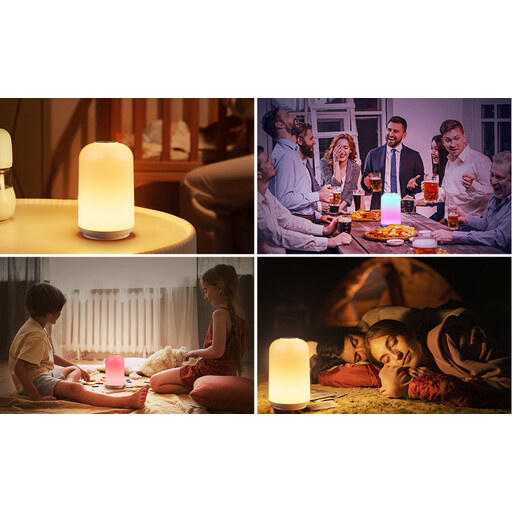
Why This Fits Their Persona: Perfect for a child's room as a soothing continuous light or a nursing light. The stepless dimming and RGB color options create a pleasant atmosphere without waking the child.
This model focuses on light quality rather than motion detection. It uses a dusk-to-dawn sensor for automatic operation and offers stepless dimming to avoid harsh, bright light. The battery allows for safe placement without cables within a child's reach.
The combination of warm white light (2600-2800K) and 7 RGB colors offers maximum flexibility for different moods. The stepless brightness adjustment is particularly advantageous for use as a nursing light.
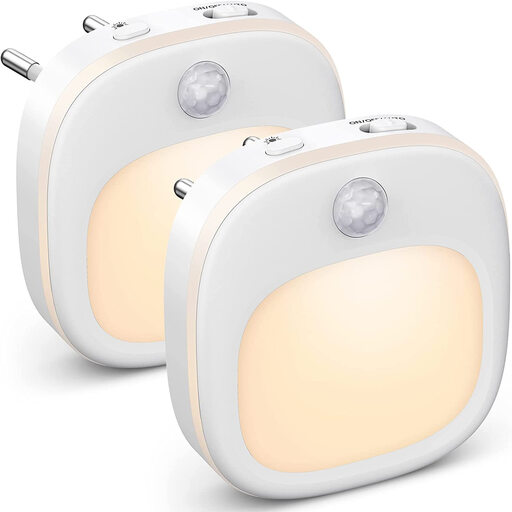
Why This Fits Their Persona: For users who prefer a reliable "plug-and-forget" solution. Ideal for permanently used areas like hallways, basement stairs, or guest bathrooms where flexible placement is not necessary.
This model plugs directly into a wall socket, completely bypassing issues with battery life and recharging. The integrated motion and dusk-to-dawn sensor ensures that power consumption remains minimal.
It offers the full functionality of modern night lights—a motion sensor, three color temperatures, and dimmability—without any maintenance. A one-time installation is all that's needed for long-term reliable operation.
We have compiled a complete, real-time list of products that fully satisfy these strict selection criteria and UK safety regulations.
Battery life depends heavily on usage. In pure sensor mode, where the light is activated only a few times per night for short periods, a single charge (on a ~500 mAh battery) can last for several weeks to months. In continuous-on mode, the runtime is reduced to just a few hours, depending on the brightness level.
Install the night light at knee to hip height (approx. 50-120 cm). Aim the sensor towards the path of travel and not directly at doors, windows, or heat sources (e.g., radiators) to avoid false activations. For stairwells, it is recommended to place one at the top and bottom of the stairs.
Yes, from a biological perspective, warm white light (below 3200 K) is the better choice for nighttime use. It contains a lower proportion of blue light, which can inhibit the production of the sleep hormone melatonin. Warm white light is perceived as more pleasant and is less disruptive to the natural sleep cycle.