
Lieferung heute & morgen

Qualitätsgarantie

Willkommens-Angebote freischalten: KOSTENLOSE Lieferung | Bis zu 80 % RABATT | Kostenlose 30-Tage-JoyPlus-Testphase
App herunterladen
A rechargeable night light with motion sensor can automatically illuminate dark pathways, cupboard areas or worktops without you needing to fumble for a light switch. For British households, easy installation, a rechargeable battery and a suitable brightness level are particularly important.
However, attractive product promises don't always lead to the right purchasing decision. Three common pitfalls to check before you buy:
A rechargeable night light should include details about battery capacity, charging voltage and operating mode. The models featured here mention 500 mAh, 800 mAh and 1100 mAh among others. A higher capacity can enable longer operating intervals, but runtime also depends on brightness, activation frequency and illumination duration.
USB charging at 5 V is practical, as compatible ports are available on power adapters, power banks, laptops or other USB chargers. Make sure to use only compatible charging sources. The battery should never be opened or modified. If you notice visible damage or bulging, stop using the product immediately.
A PIR sensor light reacts to changes in the heat radiation of moving people. The models mentioned in the product specifications work with a range of 3 to 5 metres. This range can be sufficient for a hallway or staircase area. In a small cupboard, you should position the light so that movement actually falls within the detection field.
With some versions, the light only activates in darkness. This reduces unnecessary switching during daylight. Also check whether a constant-on mode is available if the wireless night light is also intended to serve as continuous worktop or cupboard lighting.
A dimmable night light with multiple brightness levels can be better adapted to bedrooms, children's rooms, hallways or kitchens. The product specifications distinguish, for example, between:
The Kelvin value describes the light colour, not the brightness. For brightness, details such as lumens or specific dimming levels are relevant. A model with 30 lm is more suitable as an orientation light, whereas a light with 400 lm is more focused on work or utility areas.
The length also affects where you can use it. An LED light strip for the kitchen or a cupboard light measuring 30 or 40 cm can illuminate a larger area than a compact light. Check the available space and the sensor position before installation.

Why this product fits the profile: The 2-pack offers a compact solution for bedrooms, nurseries or hallways and doesn't require a fixed power supply.
Five brightness levels and three light colours prevent a fixed setting. The sensor mode can be distinguished from a constant-on mode.
500 mAh battery, USB charging, 3–5 m sensor range and up to 10 hours according to the product specification in sensor mode.
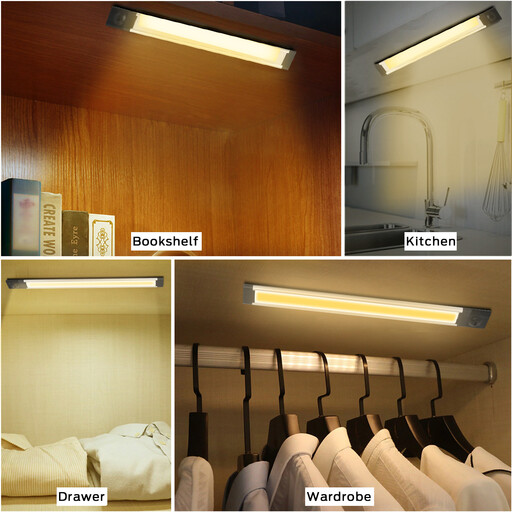
Why this product fits the profile: The combination of 400 lm, stepless gesture control and variable colour temperature suits buyers who want to cover different usage scenarios.
The brightness is not limited to a single level. Magnetic mounting and hooks reduce installation effort without drilling.
36 Epistar 4014 SMD LEDs, 400 lm, 2800–6500 K, PMMA light guide plate and gesture control.

Why this product fits the profile: The 40 cm long design is intended for kitchen wall units, shelves, wardrobes and longer surfaces.
The stated sensor range of 3–5 m and the slim depth of 10 mm make planned installation in tight areas easier.
61 LEDs, 1100 mAh battery, three colour temperatures and adhesive tape mounting without drilling.
Why this product fits the profile: The 20 cm version fits into narrow alcoves, smaller cupboards and short shelves where a longer LED under-cabinet light might get in the way.
The low profile of 10 mm and tool-free adhesive tape mounting take limited space into account and avoid drilling work.
2-pack, 21 LEDs, 800 mAh battery, three colour temperatures and stated sensor range of 3–5 m.
Before installation, clean the surface of dust and grease. For adhesive tape fixing, press the light firmly in place for some time. Do not mount it in damp areas and do not cover either the sensor or the LEDs.
For a hallway or staircase, a position where the sensor detects the direction of movement early is recommended. In a cupboard, the light should be attached so that open doors do not block the sensor. Also check the charge level regularly. A decrease in brightness can indicate that recharging is needed.
We have put together a complete, regularly updated list of products that fully meet these strict selection criteria and the safety regulations in force in the EU.
Many models are attached using adhesive tape, magnets or hooks. Clean the surface, attach the holder and then check whether the PIR sensor covers the desired area. Drilling is not required for the versions mentioned.
The runtime depends on battery capacity, brightness and the number of motion detections. For one model, usage of up to 10 hours in sensor mode is stated. This figure is to be understood as a product value and may vary in household use.
With a rechargeable night light, there are no direct costs from a permanent mains connection while it is lit. However, the battery must be recharged regularly via USB. The actual energy requirement depends on charging frequency, battery capacity and the selected brightness level.