
Lieferung heute & morgen

Qualitätsgarantie

Willkommens-Angebote freischalten: KOSTENLOSE Lieferung | Bis zu 80 % RABATT | Kostenlose 30-Tage-JoyPlus-Testphase
App herunterladen
A rechargeable outdoor lamp offers flexible lighting without fixed cabling. You can use it on the balcony, terrace, in the garden or while camping, and move it around as needed. However, not every cordless outdoor light suits the same purpose. If you focus only on design, headline brightness claims or the word “waterproof”, you may overlook important technical details.
For outdoor lights, the IP protection rating is crucial. An IP44 outdoor lamp is protected against solid objects from 1 millimetre and against splashing water from various directions. It’s suitable for a covered terrace or balcony, but shouldn’t be left standing in puddles permanently.
An IP54 outdoor light also offers higher protection against dust. Here too, the rule is: the light is protected against splashing water, but it isn’t automatically designed for heavy rain, immersion in water or being left permanently outdoors without shelter. Claims like “waterproof” should always be checked against the exact IP classification.
Battery life figures frequently refer to the minimum brightness. A rechargeable LED lamp with multiple brightness levels can run significantly shorter at full power. So check:
A small battery is often sufficient for short table lighting. If you plan to use the lamp for camping, during power cuts or across several evenings, you’ll need a higher capacity or an additional camping lantern.
A slim garden lamp or outdoor table lamp may look the part, but can tip over easily in the wind. Look for a stable base, non-slip elements and a weight that suits the location. In households with children and pets, avoid hot bulbs, fragile shades and exposed cables.
Brightness is given in lumens (lm). A light with 300 to 400 lumens can illuminate a table or a small seating area. For pure accent lighting, lower values are often enough. A 360-degree light distribution creates an even, ambient glow, whereas a directed beam is better for orientation or task lighting.
A dimmable outdoor lamp is handy if you want it for dining and as subtle balcony lighting. Touch controls or several fixed brightness levels make adjustment easier.
Steel, aluminium, ABS plastic and acrylic each have different properties. Steel can provide a decorative, premium finish, while plastic reduces weight. Also check dimensions and weight: a 21.5 centimetre-high light fits many tables, whereas a 125 centimetre battery floor lamp needs enough space and a stable, level surface.
For changing locations, a carry handle, non-slip base and low weight matter. A portable LED lamp should be easy to set up, charge and store without tools.
A battery-powered lamp with AA or AAA batteries is ready to go immediately and works well as backup lighting. An integrated rechargeable battery, on the other hand, reduces the need to buy batteries regularly. For longer use, charging port, battery capacity and the availability of a suitable cable are key. Solar and battery lighting can make sense in the garden if the lamp gets enough sunlight; on shady balconies, charging performance is often limited.
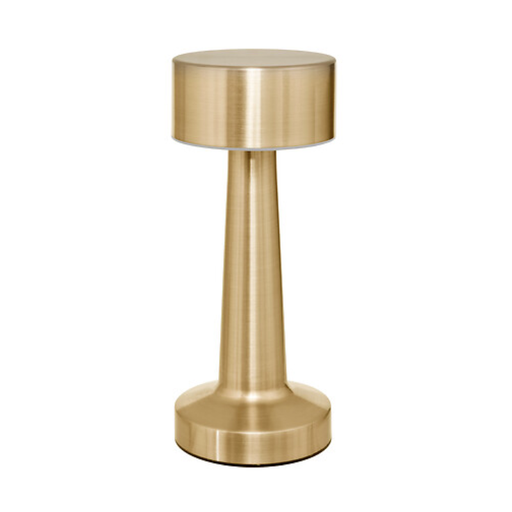
Why this product suits the profile: The compact rechargeable outdoor lamp stands 21.5 cm tall, weighs 270 g and can be placed flexibly on a balcony, terrace or garden table. The integrated 18650 lithium-ion battery allows it to run without a mains cable.
The specifications clearly state material, dimensions and battery type. That makes it easy to check before purchase whether the footprint and charging accessories suit your home.
Compact dimensions, steel housing with gold finish and cable-free use.
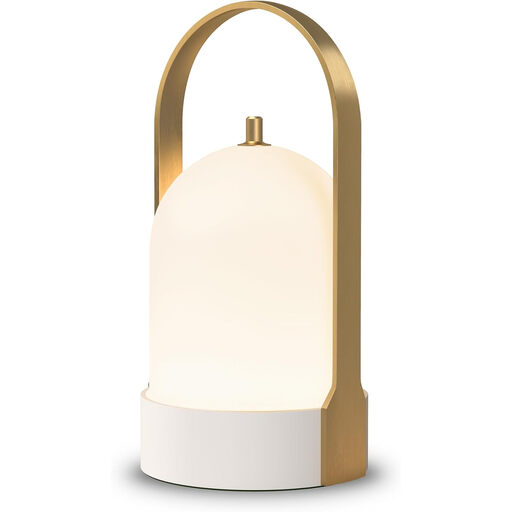
Why this product suits the profile: This rechargeable LED lamp combines a 4,000 mAh battery, four brightness levels and an IP44 rating. It’s at home on the dining table, terrace, campsite and indoors.
The IP44 spec defines its resistance to splashing water. For sustained heavy rain or standing water, a different protection rating is required.
4-level touch dimming, 360-degree light distribution and a stated run time of up to 80 hours at minimum brightness.
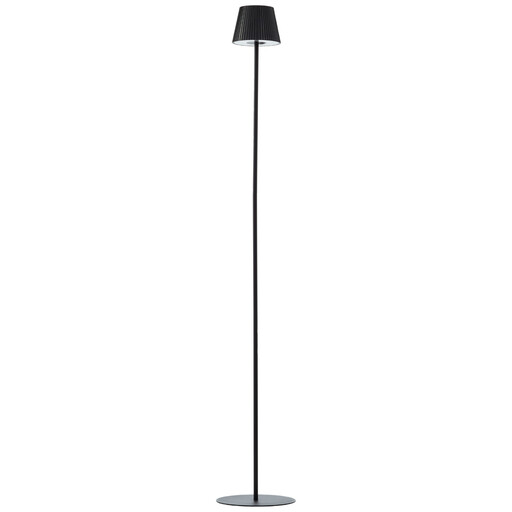
Why this product suits the profile: At 125 cm tall, 340 lumens and IP54, this battery-powered floor lamp suits larger terraces, covered garden areas and indoor spaces that open onto the outdoors.
The IP54 protection rating and maximum light output are explicitly stated. In extreme weather, the product information recommends storing it indoors.
125 cm height, 3-step touch dimming, 3,000 K warm white light and integrated ICR18650 battery.
We’ve compiled a complete, continually updated list of products that fully meet these strict selection criteria and the safety regulations applicable in the EU.
Charge a rechargeable outdoor lamp fully before first use, following the manufacturer’s instructions. Only use compatible chargers and cables. With integrated lithium-ion batteries, damage, unusual heat build-up or a swollen battery are warning signs. In such cases, the lamp must not be used further or opened.
Clean the housing and shade with a soft, dry cloth. Even a water-protected lamp should not be submerged. If you won’t be using it for an extended period, store it somewhere dry and protected. For a battery-powered lamp, remove the batteries if the product won’t be used for a long time.
Run time depends on battery capacity, LED output and brightness level. Manufacturer claims like “up to 80 hours” usually refer to the lowest setting. For realistic planning, check the run time at your preferred brightness.
IP44 protects against splashing water, not immersion or every weather condition. For exposed locations, follow the manufacturer’s guidance and bring the lamp indoors during heavy rain or frost.
Power consumption depends on output and how long you use it. Compared with many older light sources, LEDs use little energy. With a rechargeable lamp there are additional charging losses; wattage, charging frequency and operating time are the key factors for any estimate.