
Lieferung heute & morgen

Qualitätsgarantie

Willkommens-Angebote freischalten: KOSTENLOSE Lieferung | Bis zu 80 % RABATT | Kostenlose 30-Tage-JoyPlus-Testphase
App herunterladen
A rechargeable table lamp can be used flexibly on a bedside table, desk, balcony or while camping. However, not every model is suitable for every purpose. Some lights are advertised as versatile portable options but require a cable while in use. Others offer RGB colours but do not allow precise brightness adjustment. Battery-life claims can also be difficult to assess without knowing the selected brightness level.
As a Joybuy Product Recommendation Officer, I filter the relevant product data and organise it according to practical usage scenarios. This makes it easier to identify which cordless table lamp, LED light or portable table lamp best suits your requirements.
A long runtime usually only applies at a low light level. For bright illumination, operating time can be significantly shorter. So look for details such as battery capacity in mAh, charging time and runtime at different brightness levels.
A table lamp for outdoor use should not be chosen based on a marketing term alone. The IP44 rating, for example, protects against solid foreign objects and splashing water from various directions, but it does not mean the lamp is suitable for continuous use in the rain. Some products are intended for indoor use only, despite having an IP rating. The manufacturer’s instructions remain decisive.
An RGB table lamp is suitable for accent lighting, background light and creative photography. For focused work or reading, brightness, colour temperature and colour rendering are more important. So check whether the light only offers coloured effects or also provides neutral white and warm white light.
Brightness is often stated in lumens. For compact lights, a rating of 100 to 200 lumens is often sufficient for decorative lighting or use on a bedside table. For targeted work or photography, the illuminance in lux, the distance from the surface and the light distribution are also relevant.
A dimmable table lamp should offer several clearly defined brightness levels or continuous adjustment. Touch controls, rotary dials and buttons all differ in everyday use: a rotary dial often allows more precise adjustment, while touch controls save space.
Colour temperature is measured in Kelvin:
If you are looking for an LED table lamp with a battery for product photography, portraits or videos, you should also pay attention to the CRI value. A CRI of Ra 80 is common for general lighting; colour-critical photography may require different specifications. With RGB lights, the adjustable colour range is also important.
A USB-C port makes it easier to charge the lamp using existing power adapters and power banks. Nevertheless, check whether a charging adapter is included or needs to be purchased separately. The rechargeable table lamp should have a stable base and must not switch on accidentally while being transported.
For outdoor use, the manufacturer’s information on moisture and temperature is just as important as the IP rating. Many models are intended only for dry balconies, patios or covered areas. A light with an integrated, non-replaceable LED module should not be opened if it develops a fault.
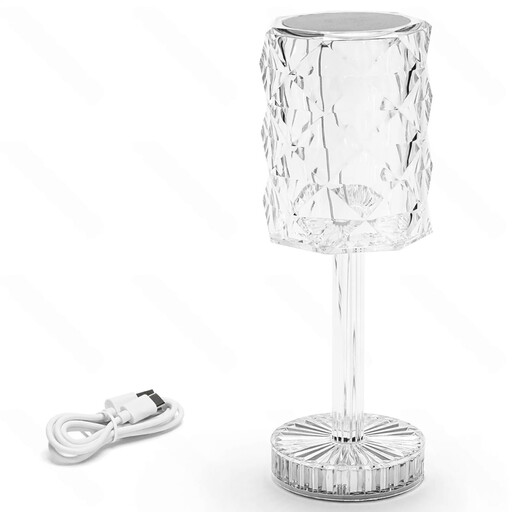
Why this product suits this profile: This compact rechargeable light is designed to create decorative pools of light on a desk, shelf or bedside table. It can be connected via USB to a power bank or mains adapter.
The product data specifies 105 lumens and an adjustable range of 2,700 to 6,500 K. This makes it easier to choose the light according to the desired ambience and use, rather than confusing RGB colours with task lighting.
1 W power, three colour-temperature ranges and USB operation. According to the product details, it is intended for dry indoor spaces only.

Why this product suits this profile: This flexible LED desk lamp combines a stable base with touch dimming and three colour temperatures. It is suitable for reading, working and use in a home office.
The technical specifications provide specific figures: 400 lumens, 4 W, 3,000/4,000/5,000 K, 2 × 1,800 mAh and a 1 m charging cable. This makes it easier to assess light output and portability.
Touch controls, flexible lamp neck, 400 lm and IP54 according to the product data. The stated operating range is 0 to 40 °C and indoors.
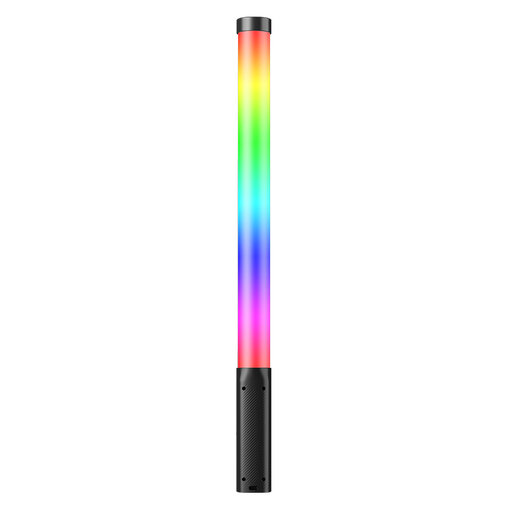
Why this product suits this profile: This portable RGB light is aimed at content creators and users who need variable colours and a broad colour-temperature range for portrait, product or video shoots.
Alongside RGB functions, the product description specifies a brightness of 360 lux at 0.5 m, 10 W power, a 3,300-mAh battery and 2,500 to 9,000 K. These figures are more relevant to planning a shoot than colour names alone.
RGB colour mixing, adjustable colour temperature and an integrated battery. The light is intended for use in a dry environment with adequate ventilation.
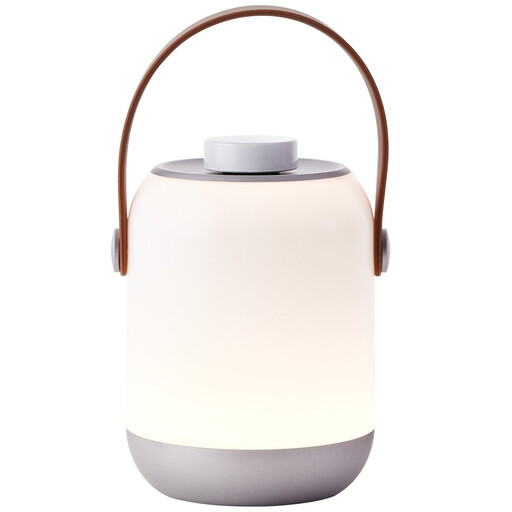
Why this product suits this profile: This compact model with warm white light is designed for flexible use around the home and on dry outdoor surfaces when you want a straightforward portable table lamp.
The specifications state 200 lumens, 3,000 K, dimming, 5 V and IP44. This makes it clear that the lamp provides warm accent and table lighting, rather than illuminating a large area.
Compact dimensions of 12 × 8.5 cm, 200 lm, warm white light and IP44 according to the product data. The integrated light source is not replaceable.
We have put together a complete, regularly updated list of products that fully meet these strict selection criteria and the safety regulations applicable in the EU.
Runtime depends on battery capacity, brightness, colour mode and battery age. Manufacturer specifications should therefore always be considered alongside the light level being used. A rechargeable table lamp at high brightness consumes more energy than a decorative lamp operated at a dimmed setting.
This depends on the model and its instruction manual. With integrated lithium-ion batteries, only compatible charging sources should be used. If the product is not expressly designed for continuous operation while connected to a cable, operation with a charged battery is recommended, together with a dry, well-ventilated environment.
Compared with many traditional light sources, LED lights generally require little power. Actual electricity costs depend on wattage, charging losses, charging frequency and usage time. For a rough estimate, you can multiply the power consumption by the daily operating time and your electricity tariff. However, a low wattage does not automatically mean sufficient brightness for every task.