Voiceovers in a noisy living space
If you’re recording recipe steps on your own and can hear fans or room noise, look for a position that lets you speak close to the microphone, then check the sound with a test recording.


Choose a microphone to suit your recording space. If background noise is an issue and you can speak close to the microphone, a directional dynamic voice microphone is worth considering. A USB condenser microphone may also suit a quiet room. USB makes it easier to get started, while an XLR microphone requires a suitable interface. Check the setup, what’s included and a test recording with both quiet and emphatic sentences. A manufacturer’s claims about noise processing can’t guarantee a particular result in your room.
If you’re recording recipe steps on your own and can hear fans or room noise, look for a position that lets you speak close to the microphone, then check the sound with a test recording.
If you want to record without a separate audio interface, check that the USB connection and cable are compatible, and that the setup suits your desk.
If you want to listen back while recording longer scripts and adjust the level, or already use an XLR setup, check the controls and compatibility with your existing interface.
First, decide whether you can reliably position the microphone close to you. Then consider the connection, setup and whether you can monitor your recording.
| Priority | What to check before buying | Who is it important to? |
|---|---|---|
| Clear speech despite background noise | Check the polar pattern, whether you can speak close to the microphone, and how a test recording sounds with your usual fan noise. | If I’m recording recipe steps in a noisy living space, I want to capture my voice clearly and test the sound for myself; around 35% of consumers name room noise as their main concern. |
| Easy connection | Check compatibility with your computer, the right cable, and whether a stand or microphone arm is included. | If I’m recording on my own at a computer, I want to get started without an additional XLR interface; around 29% of consumers prioritise an easy connection. |
| Monitoring and level control | Check for a headphone socket and easy-to-reach gain or mix controls, then test with both quiet and emphatic sentences. | When recording longer recipe scripts, I want to be able to monitor the volume and recording as I go; around 22% of consumers put monitoring and level control first. |
| Existing or planned XLR setup | Check the available inputs on your interface and whether the specific microphone requires phantom power. | If I want to keep using my existing interface or set up an XLR system, the microphone needs to be compatible; around 14% of consumers name expanding their XLR setup as their main concern. |
Manufacturers describe noise and level processing features on some models. However, these don’t guarantee that fan noise or room echo will disappear from your recordings.
Record a few normal, quiet and emphatic sentences in your intended recording space, and listen back to the pauses too.
Finding the right setup and making repeated test recordings can take extra time.
According to RØDE, the RØDE NT1 Signature Series needs a suitable interface with 48 V phantom power. The included XLR cable doesn’t replace the interface.
Before choosing, check that your interface is compatible and provides the required phantom power.
You’ll also need a suitable audio interface for an XLR setup.
The Shure MV6, MV6 Gen 2 and MV7+ are different models; the MV7+ may also come with different stand options. The Audio-Technica AT2020USB-X and AT2020USB+ are different models too.
Compare the full model name, connections and included items for the specific listing.
Depending on the version, you may need additional accessories for mounting or connecting the microphone, so check what’s actually included.
The dynamic MV6 is a USB voice microphone, while the MV7+ offers USB-C and XLR. The models differ in their connections and configurations.
The NT-USB Mini is a compact USB option, while the NT1 Signature Series is an XLR condenser microphone for a suitably equipped recording space.
The AT2020USB-X is a USB condenser microphone for recording on your own at a computer.
According to Sennheiser, the Profile USB is also designed for voiceover recording and has easy-to-reach controls.
According to CHERRY, the UM 6.0 ADVANCED offers a directional mode for a single voice and an omnidirectional mode for sound from all directions.
These Joybuy products offer different options for recording your voice, from a dynamic USB/XLR microphone to a wireless lavalier and podcast kit. Check that the connection and setup suit your recipe recording space.
 No image available
For recording a single voice when you want to position the dynamic microphone close to you and monitor your recording on a computer.
Unidirectional recording; USB and XLR connections, gain control, mute button and headphone socket.
The microphone arm is included. According to the product description, the controls are inactive when using XLR; an XLR cable isn’t included. The C-clamp is designed for desks less than 2 inches thick.
 No image available
An option for recording at a computer if you want to monitor your voice directly through headphones.
USB and XLR connections, cardioid polar pattern, gain control, mute button and headphone socket.
A desk stand is listed; the kit also features RGB lighting and echo control.
 No image available
For computer recording if you want to use a USB condenser microphone with a headphone socket.
The product details list a mute button, headphone socket, USB cable and Type-C adapter.
The kit is described as having seven pieces. Before buying, check that the connections are compatible with your recording device.
 No image available
A portable alternative if you don’t want to record recipe scripts at a fixed desk.
The set is described as a wireless lavalier microphone; the receiver offers real-time monitoring.
The product description lists Android devices with Type-C/OTG, iPhones and cameras as compatible devices. Check compatibility with your specific recording equipment.
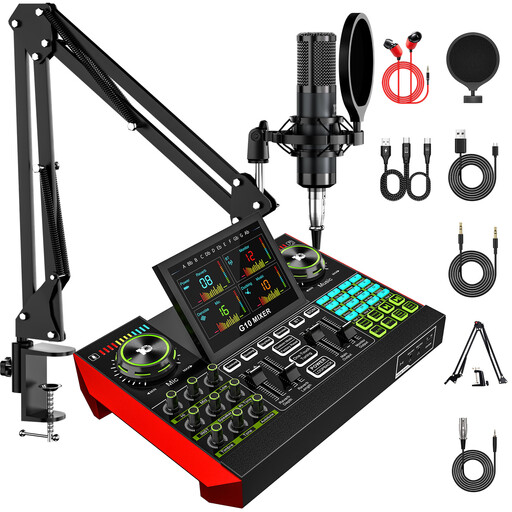 No image available
For voice recording if you want to use a sound card mixer alongside your microphone in your recording space.
According to the product name, the kit includes a 3.5 mm condenser microphone, a sound card mixer and a microphone arm.
It’s described as suitable for use with computers and mobile devices. Check that the kit’s connections are compatible with your device.
The USB models described here are designed to connect directly to a computer. Check the connection and cable for the specific version you’re buying. The RØDE NT1 Signature Series, by contrast, is an XLR-only model and, according to RØDE, requires a suitable interface with 48 V phantom power.
Point the front of a directional microphone towards your mouth and test the recording with normal, quiet and emphatic sentences. RØDE recommends a distance of around 10–15 cm for voiceovers with the RØDE NT-USB Mini only; don’t assume this distance will suit other models without testing it.
When you buy new goods from a business as a consumer, statutory claims for defects are generally made against the seller; according to § 438 BGB, the standard limitation period is two years from delivery. This is separate from any voluntary manufacturer’s guarantee. For contracts from 31 July 2026, the Verbraucherzentrale also describes a one-off 12-month extension if you choose repair rather than replacement when making a warranty claim.
No. Electrical and electronic waste must be collected separately. The Umweltbundesamt lists local recycling centres and suitable in-store take-back options as ways to dispose of it.