
Lieferung heute & morgen

Qualitätsgarantie

Willkommens-Angebote freischalten: KOSTENLOSE Lieferung | Bis zu 80 % RABATT | Kostenlose 30-Tage-JoyPlus-Testphase
App herunterladen
A recliner chair is more than just a piece of furniture; it's a personal sanctuary. But the path to the perfect oasis of relaxation is often paved with costly mistakes. Many models promise comfort but prove to be unusable after a short time. Before you make a decision, it's crucial to understand the typical flaws that manufacturers often keep quiet about.
This guide focuses on the objective criteria that define a durable and truly comfortable chair. We'll highlight the three most common defects that lead to disappointment and show you what to look for when making your choice.
The market is filled with chairs that look impressive at first glance. However, an attractive exterior often hides design flaws that drastically reduce their long-term value.
To avoid these pitfalls, you should focus your attention on three core technical areas. These define the longevity and true comfort of your future chair.
The type of adjustment mechanism is a fundamental decision. A manual recliner is typically operated by a side lever or by using body pressure. These models are often more robust and less prone to failure than electric versions, as they do without complex electronics. Look for a mechanism that is smooth yet stable. For chairs with additional features like a 360-degree swivel (swivel chair) or a rocking function, the quality of the ball bearing and base plate is crucial for silent, fluid operation. A frame advertised as stable, such as an OKIN frame, indicates a design built for higher load capacities.
A truly comfortable living room chair is distinguished by its well-designed padding. Look for specifications like high-resilience foam and an integrated pocket spring system. This combination offers an ideal balance of soft cushioning and firm support, which prevents sagging. The upholstery should be not only visually appealing but also functional. Breathable fabrics prevent excessive sweating during long periods of sitting and are easier to maintain than many synthetic alternatives, which may be durable but offer poor air circulation.
Modern recliners often offer more than just a reclining position.
Based on the quality criteria mentioned, we have identified options for different user profiles.
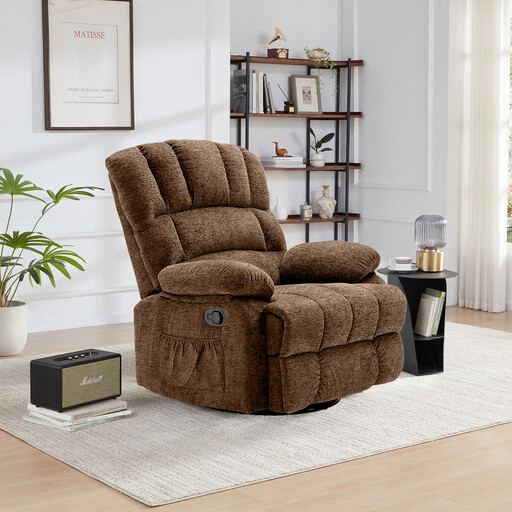
Why This Fits Their Persona: This model is designed as an XXL chair, offering an extra-wide seat and a high weight capacity of up to 350 pounds (approx. 158 kg). It's an excellent choice as a central TV chair for individuals who value generous space or have a taller build.
The use of an OKIN frame addresses the weakness of unstable mechanisms. The high-resilience foam padding with a pocket spring system counteracts the problem of rapid volume loss.
Combines three functions: 360° swivel, 30° rocking, and a manual recline function up to 160 degrees. The breathable fabric cover ensures comfort during extended periods of sitting.
Why This Fits Their Persona: For users seeking a reliable, straightforward solution without electronics. A manual recliner with a high-quality mechanism is ideal for reading nooks or as a long-lasting companion in the living room, where function is the priority.
By eliminating electrical components, a potential point of failure is removed. The focus is on a reinforced steel frame and a precise yet simple lever mechanism, which maximizes longevity.
Maximum reliability and simple operation. These chairs are often attractively priced without compromising on core stability and seating comfort.
We have compiled a complete, up-to-date list of products that fully meet these strict selection criteria and quality standards.
Most modern recliners are designed for straightforward assembly. They typically arrive in two main parts (the seat base and the backrest) that simply slide together without the need for tools. Assembly usually takes only a few minutes.
For long-term stability and safety, you should look for a minimum specified weight capacity of 150 kg (approx. 330 lbs) for a chair for heavy people. Models designated as XXL chairs typically meet this requirement and feature a reinforced frame and a more robust mechanism.
No, a high-quality manual recliner is engineered with a balanced mechanism. Adjusting the backrest usually requires only a light pull on a lever or gentle body pressure. No significant physical effort is needed.