
Lieferung heute & morgen

Qualitätsgarantie

Willkommens-Angebote freischalten: KOSTENLOSE Lieferung | Bis zu 80 % RABATT | Kostenlose 30-Tage-JoyPlus-Testphase
App herunterladen
A recliner chair with reclining function should provide reliable support when reading, watching television or enjoying a short nap. In practice, however, three common purchasing mistakes often lead to the wrong choice: generous padding is mistaken for good ergonomics, the reclining area is planned without considering the distance from the wall, and load-capacity specifications are not compared with the actual seating area.
Terms such as “ergonomic chair”, “overstuffed” or “zero gravity” are not proof of quality on their own, either. What matters are clear, verifiable product details: dimensions, reclining angles, materials, construction, weight limit and type of mechanism.
A very soft armchair may feel comfortable when you first sit in it. For longer periods of use, however, it is important that the seat and backrest retain their shape and provide adequate support. Details such as foam density, spring cores or elasticated foam are therefore more relevant than purely promotional claims about softness.
A recliner does not replace medical advice for people with back or leg problems. Users should pay particular attention to whether the seat height, lumbar support and footrest are suitable for their own height.
A TV recliner with a reclining function requires considerably more room than a traditional reading chair. In addition to the floor space, you need to consider the extended depth. A model with an initial depth of around 94 cm may require approximately 164 cm when fully extended. Before buying, you should therefore take the distance from the wall, walkways, coffee table and radiators into account.
A stated maximum load is a technical guideline, not a recommendation for every seating situation. In addition to body weight, dynamic loads when sitting down and standing up must be taken into account. For people who need more room, seat width, the distance between the armrests and the stability of the base are also crucial.
Start by noting the available space. The important measurements are:
An oversized chair may be more comfortable for taller people, but can quickly dominate a small home. For a bedroom, office or compact flat, a bean bag chair or chaise longue with a smaller footprint may be more practical.
Manual recliners are usually adjusted using a side handle, lever or body pressure. They do not require a power connection and avoid an extra cable in the living area. With electric models, buyers should instead pay attention to cable routing, the power supply, controls and the relevant safety information.
A recliner with a footrest should open and close without excessive effort. Also check whether the footrest is long enough and whether the backrest remains stable in an intermediate position. A rocking recliner also combines the chair with a rocking motion, so a stable, level floor is important.
Chenille, corduroy, linen-look fabric and microfibre differ in their feel, breathability and cleaning requirements. For families or intensive use, removable or easy-clean covers are advantageous, provided the manufacturer explicitly states that this is the case.
The following features are also important:
A swivel recliner offers greater freedom of movement in the room. However, if you have small children or pets, you should check whether the swivel or rocking function leaves enough clearance from other furniture.
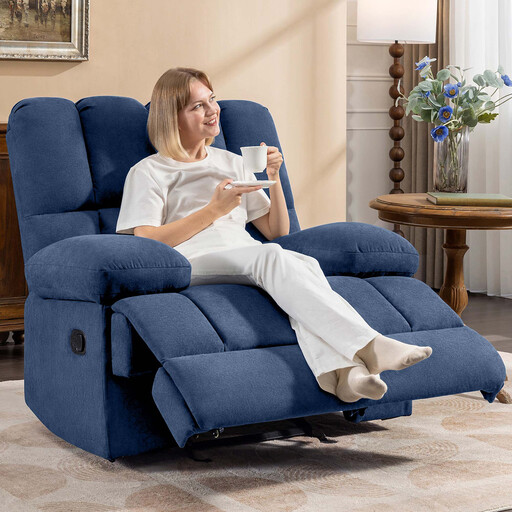
Why this product suits this profile: This manual recliner combines a wide seat with a footrest and a backrest that, according to the product details, adjusts from 90° to 150°. It is well suited to users who want to read or watch television without electric controls.
The stated adjustment range and dimensions of 105 × 94 × 103 cm, or 105 × 164 × 81 cm when extended, make planning the available space more straightforward.
Chenille cover, high-density memory foam and, according to the supplier, a construction that is 90% pre-assembled.
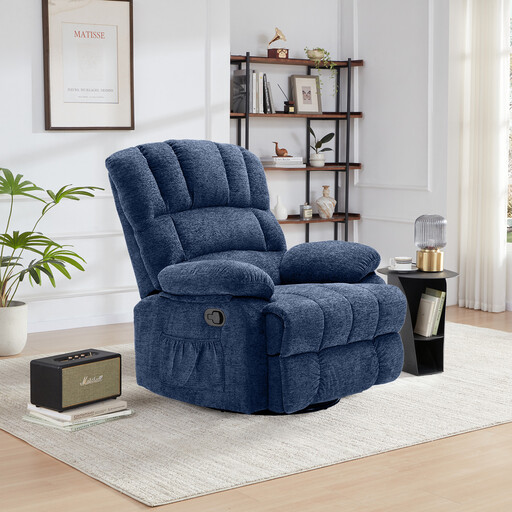
Why this product suits this profile: The combination of a 360° swivel function, a backrest that reclines to a maximum of 160° and a 30° rocking function offers several seating positions for the living room or bedroom.
The technical angle and dimension specifications help distinguish the advertised flexibility from a vague, undefined claim of comfort.
Rocking, swivel and reclining functions; according to the product description, the seat and backrest are fitted with elasticated foam and a spring system.
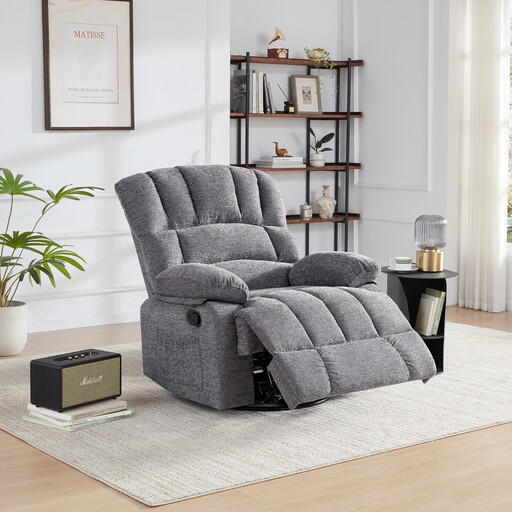
Why this product suits this profile: As a generously sized TV recliner, this model is suitable for longer periods of sitting, gaming or taking a nap. The grey colour option works well with a range of interior styles.
The maximum reclining position of 160° and stated load capacity of 350 lb provide concrete points of comparison for frequent users and people who need more space.
Basic dimensions of 105 × 94 × 103 cm, net weight of 38.5 kg and, according to the supplier, tool-free assembly.
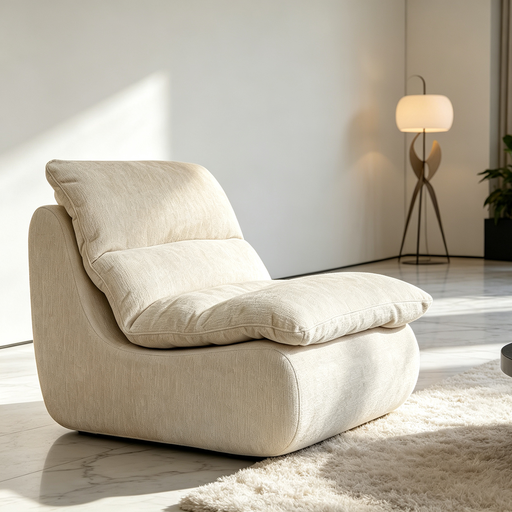
Why this product suits this profile: This compact bean bag chair is designed for reading corners, small flats, offices or gaming areas and requires no assembly.
The compact design reduces the risk of underestimating the extended depth of a traditional recliner. The non-slip base is designed for smooth floors.
High-density foam, chenille cover, vacuum packaging and, according to the product details, a maximum load capacity of 136 kg.
We have put together a complete, regularly updated list of products that fully meet these strict selection criteria and the safety regulations applicable in the EU.
As well as the basic footprint, you should allow for the fully extended depth. With many large models, this can reach around 160 cm. You should also leave walkways clear and allow sufficient space from walls and furniture.
A manual recliner does not require a power connection and is suitable for users who prefer simple operation. Electric versions often offer convenient adjustment at the touch of a button, but require cables, a power supply and a suitable socket. The right choice depends on where the chair will be placed and how you want to operate it.
Its lifespan depends on how intensively it is used, body weight, the mechanism, padding and care. Without standardised testing conditions, it is not possible to give a reliable figure in years. Regularly checking screw connections, joints and the cover, as well as observing the load limit, can help maintain the chair’s usability.