Classical music fans with limited space
You want to place your record player on a level surface and away from your speakers, even if they’re close to the wall. Audio-Technica recommends not placing a record player on or near speakers.


For classical LPs, choose a record player with speeds, phono or line output, and controls that suit your records and your audio system. Whatever the drive type, place it on a level surface away from your speakers: Audio-Technica advises against placing a record player on or near speakers. Whether the speakers themselves can stay close to the wall depends on the model and how they sound from your listening position.
You want to place your record player on a level surface and away from your speakers, even if they’re close to the wall. Audio-Technica recommends not placing a record player on or near speakers.
You want to listen to your LPs through your existing active speakers or amplifier, and need to match the phono and line signals to the available inputs.
You want to know whether you’ll need to operate the tonearm yourself, or whether a model starts automatically, returns the tonearm, or simply lifts it at the end of the record.
For the AT-LP120XUSB, Audio-Technica advises against placing the record player on or near speakers. Genelec explains that reflections from the wall behind a monitor can affect bass response, but its specific monitor spacing recommendations are not a general rule for every speaker model.
| What matters when buying | What to check | Who this matters to |
|---|---|---|
| A stable, vibration-resistant position | Check that you have a level surface, separate from your speakers, with enough room for the dust cover. If you’re considering a wall mount, check its dimensions, load capacity and suitability for your particular wall. | With limited space, I want to be able to keep my record player separate from my speakers. Around 36% of consumers put a vibration-resistant position first. |
| Tracking and speed | Compare the speed required by your LPs with those supported by the model. Check the cartridge, the availability of a suitable replacement stylus and any adjustments that may be needed. | For my classical LPs, I want to choose the right speed and cartridge, then set up the tonearm as instructed. Around 29% of consumers prioritise suitable tracking and speed. |
| Connecting to your audio system | Check whether you have active or passive speakers and identify the available inputs. Match a line output to a line input, or a phono output to a phono input. | I want to connect my existing speakers or amplifier without mismatching phono and line connections. Around 21% of consumers base their choice mainly on how the player connects to their audio system. |
| Manual operation or automatic functions | Check the specific model’s start-up, tonearm lowering, lift at the end of the record and tonearm return separately. | When I listen to whole sides of an LP, I want to know which steps I’ll need to do myself. Around 14% of consumers pay particular attention to how the player operates. |
Even a record player with a vibration-resistant drive can be affected by speaker vibrations and sound pressure if it’s poorly positioned.
Place the player on a level surface, away from your speakers. If you’re considering a wall mount, check that it’s suitable for your wall and that its load capacity and dimensions are right.
A phono signal without suitable pre-amplification may be very quiet. Using two phono preamps in a row can cause distortion.
Before connecting your equipment, check the outputs, switch settings and inputs on the specific devices. Passive speakers also need a suitable amplifier.
An automatic tonearm lift isn’t the same as automatic start and return. Rega lists an integrated MM phono preamp for the Planar 1 Plus; this feature shouldn’t be assumed to apply to the Planar 1.
Check the full model name and verify the start, end-of-record and connection features individually.
The SL-1500C is an example of a direct-drive record player with a phono equaliser and automatic tonearm lift.
The Debut Carbon EVO is a belt-drive model that needs to be set up manually. Pro-Ject also offers separate wall mounts for suitable installations.
The manual AT-LP120XUSB and fully automatic AT-LP70XBT are different models with different operating methods.
The DP-300F is an example of a fully automatic belt-drive record player with a switchable phono preamp.
The Planar 1 is a manual record player with a factory-fitted Carbon cartridge; the Planar 1 Plus is a separate variant.
The CS 518 is an example of a manual record player with a fully gimballed tonearm.
The following Joybuy listings include fully automatic and all-in-one record players. Check which controls and connections you need, and whether you can position the player separately from speakers close to the wall.
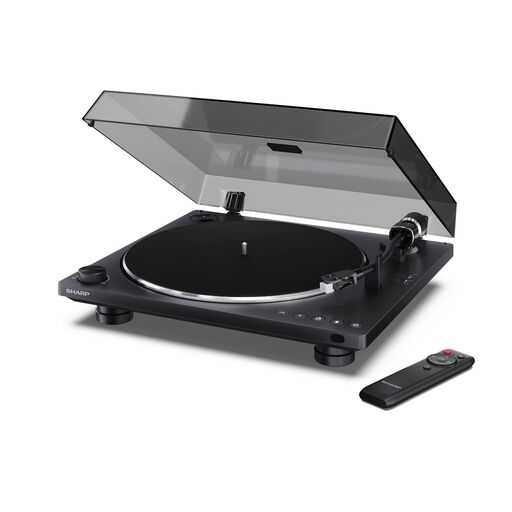 No image available
Full automation is worth considering if you want to minimise manual handling of the tonearm. Also check that the model supports the speeds your LPs require and can be positioned separately from your speakers.
A dust cover and black finish are also listed.
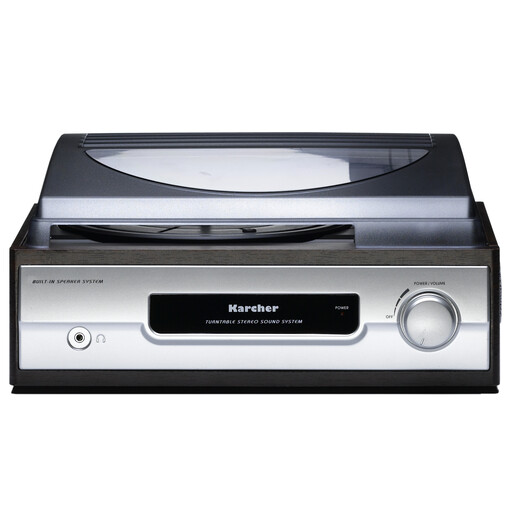 No image available
The built-in speakers may suit you if you want to listen directly through the player. The product title lists 33 and 45 U/min, auto-stop, a headphone socket and line-out.
Auto-stop doesn’t necessarily mean the player starts automatically and returns the tonearm. Check that its controls suit the way you listen to whole sides of LPs.
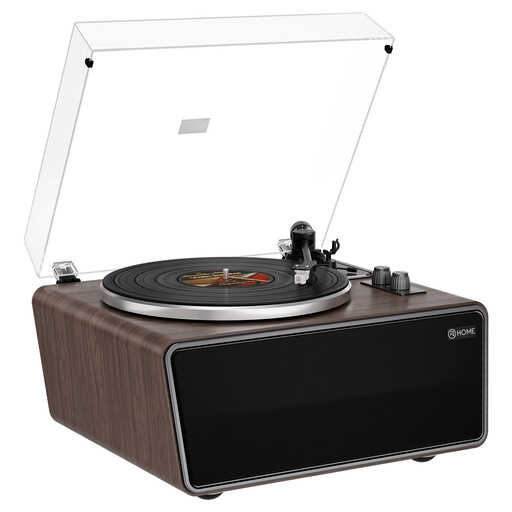 No image available
The all-in-one design with built-in speakers is worth considering if you want to listen directly through the player. A phono preamp and adjustable counterweight tonearm are also listed.
The product title lists 33⅓ and 45 U/min, as well as phono and line RCA outputs. Check that these outputs are compatible with your existing audio system.
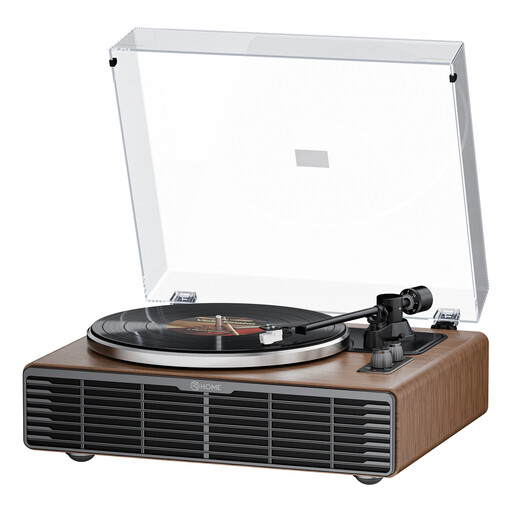 No image available
The built-in speakers may suit you if you’re considering listening directly through the player. The product title lists a belt drive, an AT3600L cartridge, and RCA phono and line outputs.
Bluetooth and a transparent dust cover are also listed. The drive type alone doesn’t tell you whether the player will be sufficiently isolated from speaker vibrations.
It depends on the speaker model and how it sounds from your listening position. Genelec explains that reflections from the wall behind a monitor can affect bass response, but its specific spacing recommendations for monitors aren’t a general rule for every speaker model. Either way, don’t place your record player on or directly next to speakers that cause vibrations.
Yes, if your active speakers have a suitable line input and the record player outputs a line signal, for example through a switched-on built-in phono preamp. A phono-only output needs a suitable phono preamp; passive speakers also need an amplifier. Audio-Technica explains these connection differences in its guidance on connecting record players to speakers.
An automatic tonearm lift raises the tonearm, but doesn’t necessarily handle start-up and return. Technics lists an automatic tonearm lift for the SL-1500C, while Denon describes automatic start and return for the DP-300F. Check these functions separately for the exact model you’re considering.
Set up the tonearm and cartridge according to the instructions for your particular model. For its adjustable tonearms, Audio-Technica recommends setting the balance and tracking force correctly, then checking the tracking force after changing the stylus or cartridge. For models with preset settings, follow the manufacturer’s instructions.
Where EU harmonisation rules apply to a device, the manufacturer uses the CE marking to declare that it meets the relevant requirements. The European Commission points out that the mark isn’t an independent sound or quality test. According to the German Environment Agency, electrical and electronic waste must not go in household rubbish; it should be collected separately, for example at a recycling centre. Check the information for the specific listing.