Choose a reader based first on your recorder’s card format and the connection on the device you want to copy to. A USB-C plug alone doesn’t guarantee smartphone compatibility or a particular transfer speed. For a reliable backup, you’ll also need a separate destination with enough storage, and you should check that you can open the copied files before reusing the recorder’s card. A hub is most useful when your laptop doesn’t have enough ports for a card reader as well as a backup drive or power supply.
Finding the right card reader for you
If you want to check your recorder’s card format
To avoid arriving at your hotel with a reader that has the wrong slot, check your recorder’s card against the formats explicitly supported by the reader. The Zoom H6essential manual specifies a microSD card. The Hama models listed here support SD and microSD, while model 00124156 also supports CompactFlash Type I.
If you travel with a laptop that has few ports
If you also need to connect a separate drive or a power supply, check whether your existing ports are enough or whether a hub would make your setup easier to use. Anker describes its 553 USB-C Hub as having card slots and additional data ports.
If you want to back up recordings directly to your smartphone
If you’re copying files without a laptop, the connector, file access and storage on your particular phone all need to be compatible. Apple explains how to access supported external storage devices using the Files app. Check the requirements for your device and card before travelling.
What to look for when buying
When copying files in a hotel room, the most important things are the right card slot, a working connection to your destination device and a second copy you can check. Faster transfer speeds only matter if both the card and reader support them.
| What you need |
What to check before buying |
Who should pay particular attention |
| Card format |
Check the label on the card or recorder. Don’t assume SD, microSD and CompactFlash Type I are interchangeable. |
If I want to read the recorder card directly, the slot must match its format exactly. Around 33 % of consumers prioritise card format when buying. |
| Connection and file access |
Check whether the destination device has USB-A or USB-C. If you’re using a smartphone, also check that you can access external files. |
If I’m copying files without a laptop, I need to be able to connect the reader to my phone and access the recordings. Around 27 % of consumers put device connections and file access first. |
| A second copy you can check |
Plan to use a separate destination with enough free storage. Open the copied files and keep the recorder card for now. |
If I don’t want to risk losing my only copy of a recording, I need a separate storage destination and a readable copy. Around 27 % of consumers prioritise this backup process. |
| Copying speed |
Compare the card’s UHS class with the modes supported by the reader. Don’t assume the manufacturer’s maximum speeds guarantee a particular copying time. |
If I want to transfer lots of files or large files, support for faster cards may matter—but it must match the recorder card. Around 13 % of consumers look first at potential transfer speeds. |
Common mistakes when copying cards
-
Assuming USB-C means it will work with a smartphone
The connector, card standard and ability to access files on your phone are separate requirements. A suitable port alone doesn’t tell you whether your smartphone can read the card.
Check your phone’s connection, its support for external storage and file access in the app you plan to use.
-
Choosing an SD-only reader for a microSD card
An SDHC/SDXC reader won’t necessarily work with a microSD card. What matters is the slot explicitly specified and the card used by your recorder.
Compare the physical card with the reader’s listed slots instead of relying on the general term “SD”.
-
Treating copying and moving files as equally safe ways to back them up
Moving files off the recorder’s only card doesn’t create an extra copy. A backup process needs a separate destination and a copy you can check.
Copy the files to a destination with enough storage, open a few to check them and leave the recorder card unchanged for now.
Brands to consider
Hama
Depending on the model, the card readers listed support SD and microSD, or also CompactFlash Type I.
- Hama lists SD and microSD support and a USB-A plug for model 00123900.
- Model 00124156 also supports CompactFlash Type I. USB-A doesn’t mean it can connect to USB-C without a suitable adapter.
Kingston
The MobileLite Plus SD is worth considering if you want to read an SDHC or SDXC card using a compatible USB-A port.
- Kingston lists UHS-II, backwards compatibility with UHS-I and USB 3.2 Gen 1.
- The SD version isn’t listed as having a dedicated microSD slot. Its advertised optimal performance with Kingston cards isn’t an independent speed comparison.
SanDisk
The ImageMate PRO USB-C is worth considering if you have a compatible USB-C port and genuinely need support for several card formats.
- SanDisk lists SD, microSD and CompactFlash up to UDMA 7. The stated speeds of up to 312 MB/s for SD and microSD are manufacturer maximums.
- A maximum speed like this doesn’t show how fast it will work with a particular recorder card. The German product page lists PC and Mac, but doesn’t claim general smartphone compatibility.
Sony
The MRW-S1 is a compact USB-A reader for SD cards, including UHS-II cards.
- Sony lists UHS-II and USB 3.1 Gen 1 interfaces.
- The listed specifications don’t mention a dedicated microSD or CompactFlash slot.
Anker
The 553 USB-C Hub is designed for mobile workstations that need extra ports as well as card slots.
- Anker lists SD and microSD slots as well as two USB-A data ports.
- If you only need to read one card, you may not need the extra hub functions. Power pass-through requires compatible devices and a suitable power supply.
Joybuy products for cards and connections
These products combine card readers or card slots with USB-C connections for copying files on the go. Before buying, check that the card format and connection are right for your recorder and destination device.
 No image available
Acer 7-in-1 USB-C Hub ODK6V0 with card reader
An option if you want to combine card reading with extra ports on a USB-C hub.
The product title lists SD and TF card slots, HDMI with 4K@30Hz, 100W PD and 3 USB 3.0 ports with 5Gbps.
View at Joybuy
 No image available
4-in-1 USB-C card reader with USB-A adapter
This reader is an option if you want to read SD or microSD cards using a compatible USB-C device.
The title lists SD, microSD/TF and SDHC, as well as USB-C and a USB-A adapter. The stated transfer speed is up to 480 Mbit/s over USB 2.0.
View at Joybuy
 No image available
7-in-1 external DVD drive with SD/TF card reader
This device combines card reading with an external DVD drive. If you’re only copying recorder files, the extra drive function is relevant only if you need it too.
The product title lists USB 3.0, Type-C and an SD/TF card reader.
View at Joybuy
 No image available
HOCO HB45 Spirit 2-in-1 USB 3.0 Card Reader
This compact card reader may be a good option for travelling, provided its slots match your recorder card.
The product title lists USB 3.0 and a 2-in-1 design. Before buying, check the card format against the details for the specific slot.
View at Joybuy
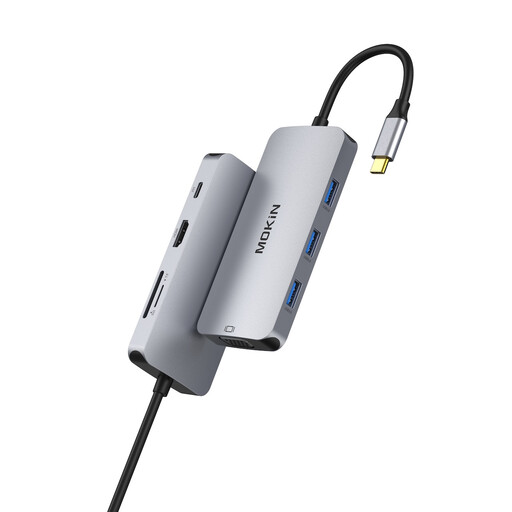 No image available
MOKiN USB-C Hub with HDMI, VGA, 3 USB 3.0, SD/TF and PD
This hub is worth considering if you want to combine card reading with extra ports and your laptop supports the required USB-C or Thunderbolt connection.
The product title lists SD/TF card slots, HDMI, VGA, three USB 3.0 ports and PD. According to the product information, the device isn’t designed for devices in MHL mode.
View at Joybuy
Frequently asked questions
Do I have to remove the card from the recorder to copy files?
Not with every model. The Zoom H6essential manual explains how to access files on its microSD card via USB. Check your own field recorder’s manual to see whether it supports this too.
Can I copy audio files using an iPhone instead of a laptop?
This may work with a compatible external storage device and the right connection. Apple explains how to access files using the Files app. Also check which file systems are supported and which data partition the storage device is designed to use, and test your particular setup before travelling.
When can I delete the original recordings from the recorder card?
Only delete them once you’ve confirmed that the extra copy is saved to the destination and can be opened. Germany’s Federal Office for Information Security describes recoverability as part of a complete data backup plan. When copying files, this means remembering that moving them doesn’t create a second copy.
What are my legal rights in Germany if a card reader is faulty?
For an ordinary purchase of goods, the seller is generally liable for defects for two years from delivery, as explained by the Verbraucherzentrale (consumer advice centre). This statutory liability for defects is separate from a voluntary manufacturer’s warranty.


