Family interviewers
If several family members will be speaking at once, first decide whether you want to record their voices separately. Samson describes using multiple XLR microphones to capture and adjust each voice individually.


If you’re recording on your own, a directional USB or USB/XLR microphone with direct headphone monitoring is a simple place to start. If several family members will be speaking at once and you want to edit their voices separately, you’re better off with multiple microphones and enough inputs. A single directional microphone will pick up people sitting to the side or behind it less clearly. Check the connections and what’s included, plan the seating, then listen to a test recording made from the intended position.
If several family members will be speaking at once, first decide whether you want to record their voices separately. Samson describes using multiple XLR microphones to capture and adjust each voice individually.
If you’ll usually be speaking alone from a fixed position, you can place a directional microphone close in front of you. Audio-Technica explains that the ATR2100x-USB’s cardioid pickup pattern captures sounds from the sides and rear less strongly.
A suitable USB connection makes it easy to get started on a computer, while a headphone output lets you monitor the recording. Shure, Audio-Technica and Samson describe these features on their respective USB models.
Start by deciding how many people will speak at once and whether you want to edit their voices separately. From there, you can work out the connection type, microphone position and how you’ll monitor the recording through headphones.
| What matters | What to check before buying | Who is this especially important for? |
|---|---|---|
| Recording several voices | Make sure the number of speakers, separate tracks and available microphone inputs work together. | When several family members are sharing stories at once, I want to capture their voices appropriately and edit them separately if needed. Around 36% of consumers put recording multiple voices first. |
| Making voices stand out at home | Check the pickup pattern and microphone position, then listen to a test recording made from the intended position. | With everyday background noise, I want voices to sound close and clear without relying on a particular room’s acoustics. Around 29% of consumers prioritise clear voices in a home environment. |
| Easy connection | Check USB compatibility with your computer, along with the cables and stand you’ll need. If you’re using several XLR microphones, make sure you have enough inputs. | If I want to get started without a separate audio interface, a straightforward connection and simple setup matter most. Around 21% of consumers say ease of getting started is their top priority. |
| Monitoring the recording | Check for a direct headphone output and its controls; assess any level-adjustment features on the specific model. | When volume varies, I want to check during a test recording that quieter sections and the chosen microphone position work well. Around 14% of consumers put sound and level monitoring first. |
A cardioid pickup pattern captures sound from the sides and rear less strongly. As a result, people sitting in different places may not all come through equally clearly.
First decide who will be speaking at the same time and whether you need separate tracks. Then test your planned seating arrangement with a short recording.
USB can let you connect directly to a computer. But if you’re using several XLR microphones, you’ll need enough inputs and all the other connections your setup requires.
Before buying, map out the full connection chain: microphones, cables, inputs and a way to monitor the recording.
Manufacturer claims about features on a specific model don’t tell you how voices will sound from every seat or in every room.
Have everyone speak from their intended position and listen to a test recording through headphones before starting a longer session.
The ATR2100x-USB offers both USB and XLR connections for close-miked speech.
The Q2U is a dynamic USB/XLR option for close-miked speech.
The MV7+ is aimed at users who want USB-C and XLR connections, along with built-in adjustment features.
The H6essential is a recorder for family conversations using multiple microphones or separate tracks.
The following Joybuy products include compact lavalier microphone sets for two-person conversations, as well as USB or USB/XLR microphones for a dedicated storytelling spot. A single directional microphone isn’t necessarily suitable for several people around a table.
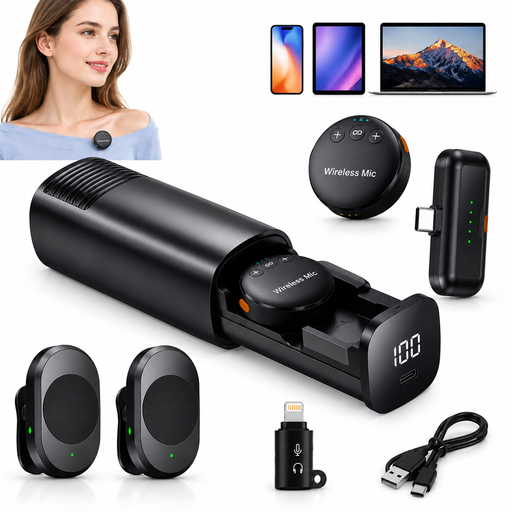 No image available
For conversations between two people, with one transmitter available for each speaker.
Listed in the product name: 2.4 GHz, latency under 20 ms, range up to 40 m, 500-mAh charging case, and USB-C and Lightning.
 No image available
For two-person recordings when a compact USB-C connection is suitable for your device.
Listed in the product name: 2TX+1RX and a range of 150 m.
 No image available
For one person speaking close to the microphone from a fixed position, with headphone monitoring while connected via USB.
USB and XLR connections, cardioid pickup pattern, headphone monitoring over USB and a desktop stand are listed. An XLR cable isn’t included; speakers sitting to the side or behind the microphone may be picked up less clearly.
 No image available
For one person recording stories from a fixed position, if a boom arm suits your setup.
Dynamic cardioid microphone with USB/XLR, headphone monitoring over USB and a boom arm. An XLR cable isn’t included; people sitting to the side or behind the microphone may be picked up less clearly.
 No image available
For one person recording from a fixed position, if a direct USB connection and headphone output suit your setup.
USB-C, XLR, a headphone output and a desktop stand are listed; according to the product description, an XLR cable is included. RGB, gain control, echo and mute are listed in the product name.
You don’t need a separate audio interface to connect a compatible USB microphone directly to a computer. A microphone with an XLR-only output needs suitable equipment to record on a computer; if you’re using multiple microphones, you’ll need enough inputs.
One shared microphone can work if people take turns speaking or sit in suitable positions, and separate tracks aren’t important. If people will speak at the same time and you want to edit their voices separately, multiple microphones and suitable inputs are a better choice.
Ask everyone taking part to speak from their intended position, then listen to a short test recording through headphones. Check that quieter sections and people sitting to the side remain clear, and note which background sounds are being picked up.
Depending on your setup, you’ll need enough inputs, suitable cables and mounts as well as the microphones. For computer recording, the XLR signal will also need to pass through suitable equipment. Check these items against what’s actually included before choosing a setup.
Section 201 of the German Criminal Code (StGB) makes it a criminal offence to record another person’s non-public spoken words on an audio device without authorisation. The official text on “Gesetze im Internet” is provided by the Federal Ministry of Justice and the Federal Office of Justice. Make sure everyone involved agrees to the recording beforehand.