
Lieferung heute & morgen

Qualitätsgarantie

Willkommens-Angebote freischalten: KOSTENLOSE Lieferung | Bis zu 80 % RABATT | Kostenlose 30-Tage-JoyPlus-Testphase
App herunterladen
A red permanent marker seems like a simple tool—until it fails at a critical moment. The marking smudges on an important shipment, the ink fades on a lab sample, or the pen dries out after just a few days. Choosing the right marker is crucial to avoid such costly and frustrating mishaps. Many products don't live up to the promises on their packaging. This guide will help you understand the technical features and find a pen perfectly suited for your specific application.
Before you make a decision, you should be aware of the three most common pitfalls that lead to purchase mistakes:
To find the right red permanent marker, focus on these three core technical parameters.
The composition of the ink determines the longevity of your marking. The main distinction for permanent applications is between alcohol-based and oil-based inks. A good waterproof red permanent marker should be resistant not only to water but also to abrasion and many chemicals. Look for specifications like lightfast to prevent the colour from fading due to UV radiation, which is especially important for outdoor applications. A brand like 'Edding' is often synonymous with a robust all-purpose marker, but special inks are required for specific needs, such as labeling CDs or optical glass.
The marker's tip is crucial for its intended purpose:
red overhead projection pen like this is excellent for detailed labeling of lab equipment, small components, or presentation transparencies. Models like the Staedtler Lumocolor red are widely used in this field.The most important factor is the material you want to write on. A marker for glass needs an ink that adheres to the smooth, non-porous surface without beading or smudging. A marker for plastic must be formulated so that it doesn't damage the surface but still forms a permanent bond. Read the product description carefully to ensure the pen is approved for materials like metal, wood, leather, stone, or special nano-coatings.
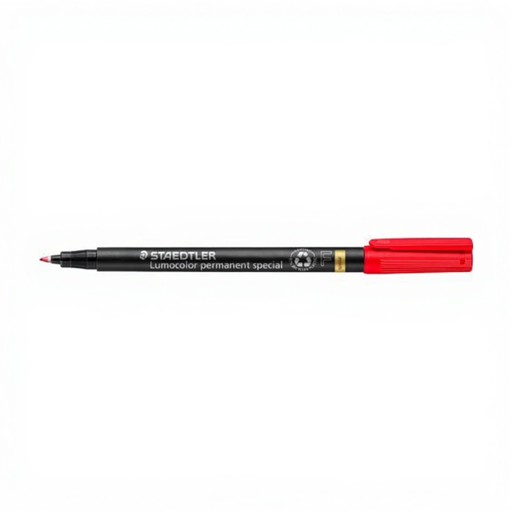
Why This Fits Their Persona: Ideal for users in laboratories, precision engineering, or IT who need precise and permanent labeling on difficult, smooth surfaces like optical glass, nano-coatings, or lab equipment.
Its special ink is explicitly designed for non-porous and coated surfaces, bypassing the poor adhesion trap where standard markers fail.
Adheres reliably to demanding surfaces. The 0.6 mm fine tip allows for extremely precise and legible markings.
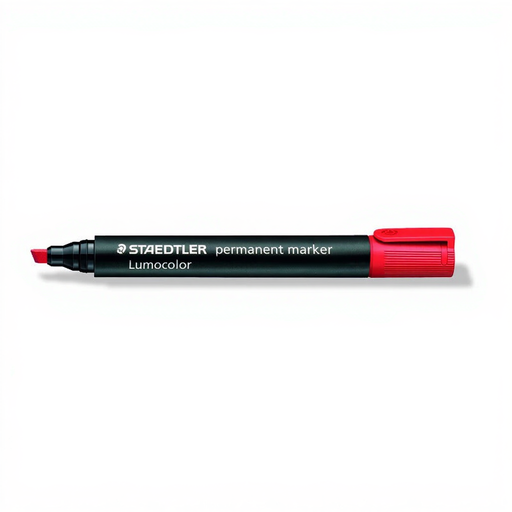
Why This Fits Their Persona: Perfect for logistics, trades, and office organisation, where a robust, versatile, and always-ready marker is needed for cardboard, plastic, and metal.
The DRY SAFE technology directly counteracts the problem of rapid drying. According to the manufacturer STAEDTLER, the pen can be left uncapped for days without drying out (in accordance with ISO 554).
The chisel tip allows for variable line widths from 2 to 5 mm for flexible labeling. The refillable system makes it an economical and sustainable choice.
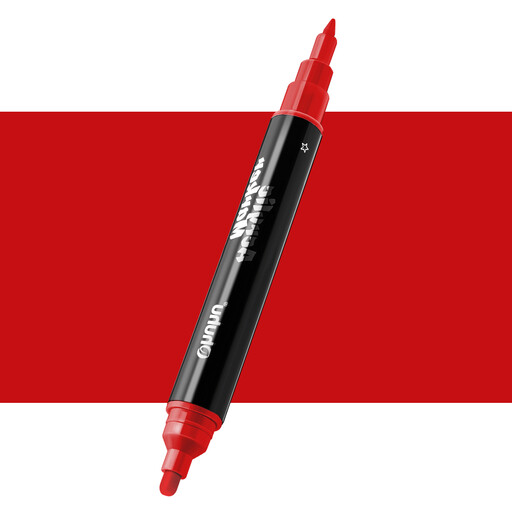
Why This Fits Their Persona: For artists, crafters, and DIYers looking for an opaque, vibrant pen for a wide variety of materials like stone, wood, ceramic, fabric, or canvas.
As an acrylic pen, it is specifically designed for high opacity on diverse surfaces, including dark ones, solving the compatibility issues common with standard markers.
The water-based ink is low-odour and becomes waterproof after drying. The dual tip (0.7-2 mm and 1.7-3 mm) offers maximum flexibility for fine details and colouring large areas.
We have compiled a complete, up-to-date list of products that fully meet these strict selection criteria and German safety regulations.
Removability largely depends on the surface. On smooth, non-porous surfaces like glass or metal, the ink can often be dissolved with alcohol-based solvents (e.g., isopropyl alcohol) or special stain removers. On porous materials like wood or fabric, removal is difficult to impossible as the ink soaks into the material. Always test cleaning agents on an inconspicuous area first.
"DRY SAFE" is a technology developed by manufacturers like STAEDTLER. It means the pen can be left uncapped for a specific period (often several days, according to tests like ISO 554) without the ink drying out at the tip. This is achieved through special ink formulations and a cap design that minimises evaporation. It is an important feature for reliability in work environments where pens are used frequently.
In many cases, yes, but there's no guarantee. Markers optimized for plastics often adhere well to glass, as both are smooth, non-porous surfaces. However, for critical applications where absolute smudge and water resistance is required (e.g., in a lab), you should use a pen explicitly designated as a marker for glass or for "almost all surfaces" to ensure optimal adhesion.