Hosts looking to reduce fat
If you’re specifically looking for less fat than in a comparable product, an unsalted recipe isn’t enough. Check for a reduction claim and read the nutritional information per 100 g.


If you’re looking for a verified reduction in fat for your birthday party, check the packaging for a relevant claim and what it is being compared with. According to the Consumer Advice Centre, a fat-reduction claim means at least 30 % less fat than a comparable product. Unsalted or plain nuts may be another option for your snack bowl, but they are not automatically reduced-fat. Also check the nutritional information, ingredients and allergen warnings on the specific pack.
If you’re specifically looking for less fat than in a comparable product, an unsalted recipe isn’t enough. Check for a reduction claim and read the nutritional information per 100 g.
If you’re choosing between plain and seasoned nuts, check the information on salt, added oil and other ingredients. This is a separate consideration from a verified reduction in fat.
If any guests need to avoid certain allergens, check the information about peanuts, tree nuts and possible traces on every pack before serving. Keep the original packaging to hand in case anyone has questions.
First decide whether you’re looking for a verified reduction in fat or mainly want to choose the salt and ingredients in your snack bowls. Whichever you choose, the allergen information must be suitable for your guests.
| Criterion | What to check | Who it matters to |
|---|---|---|
| Fat reduction | Check for a reduction claim and what the product is compared with; read the fat content per 100 g on the pack. | If I specifically want to serve nuts with less fat than a comparable product, the word ‘unsalted’ isn’t enough. For around 44 % of consumers, this evidence is the top priority. |
| Recipe and salt | Compare the ingredients and salt and fat content per 100 g across the packs you’ve chosen. | For a snack bowl with plain and seasoned options, I want to choose the ingredients and salt content myself. Around 33 % of consumers say this matters most to them. |
| Allergens | Read the ingredients list and any may-contain warnings on each mix before serving. | If guests need to avoid allergens, I need information about the actual mix being served, not a general description of the snack bowl. This is the top buying criterion for around 23 % of consumers. |
Salt and fat are listed separately. For its unsalted, unroasted GUT&GÜNSTIG nut kernel mix, EDEKA lists 58.5 g of fat per 100 g; this alone doesn’t indicate a reduction in fat.
If your goal is to reduce fat, look for an explicit fat-reduction claim, check what it is compared with, and read the nutritional information.
Sunflower oil and salt are included in the ingredients list for EDEKA’s roasted and salted Nuss-Kern-Mix. EDEKA lists 58 g of fat and 0.7 g of salt per 100 g for this version; other mixes have their own recipes.
Compare the specific packs. If you’d like to offer both flavours, serve them in separate, clearly labelled bowls.
Peanuts and tree nuts need to be considered separately when choosing snacks. According to the German Food Federation, a may-contain warning does not mean that traces are definitely present, nor that they can be ruled out.
Keep the original packaging and make the ingredient and possible trace information available. For someone with a severe allergy, a general assessment of the mix is no substitute for following that person’s individual requirements.
These brands and own-label ranges offer different types of nuts to help you compare packs. The brand alone tells you neither whether a product has reduced fat nor the recipe of an individual product.
Seeberger’s range includes both plain and roasted nuts.
Lidl’s Alesto range includes both plain nuts and seasoned party snacks.
The ja! range at REWE includes roasted nut mixes with and without salt.
EDEKA stocks roasted mixes as well as an unsalted, unroasted GUT&GÜNSTIG nut kernel mix.
ALDI SÜD stocks a range of different types of nuts.
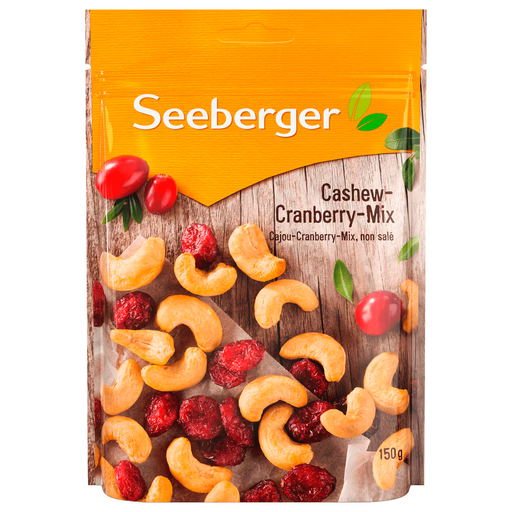
These two Seeberger products are options for a snack bowl with roasted cashews or a cashew and cranberry mix. Don’t choose them solely because of their product descriptions when looking for reduced-fat nuts; the relevant pack claim and what it is compared with are what matter.
 No image available
For a snack bowl of roasted, unsalted cashews instead of a seasoned mix. Check the label to see whether the pack suits your fat-reduction goal and your guests’ allergen requirements.
 No image available
For a snack bowl combining cashews and cranberries. Before buying, compare the ingredients and nutritional information per 100 g with other mixes, and check the allergen warnings before serving; the product name doesn’t prove a reduction in fat.
No. ‘Unsalted’ describes the salt content, not the fat content. According to the Consumer Advice Centre, a fat-reduction claim means at least 30 % less fat than a comparable product. Check the claim and the nutritional table on the specific pack.
Check the ingredients list and, where applicable, any may-contain warnings on each pack. The Federal Office of Consumer Protection and Food Safety lists peanuts and tree nuts among the substances that must be considered as allergens on food labels; for your guests, the label on the specific mix being served is what matters.
Yes. EDEKA recommends roasting small quantities in a pan over a medium heat without adding extra fat. This means no roasting oil is added, but it doesn’t automatically reduce the nuts’ natural fat content.
Follow the instructions on the relevant pack. For its roasted, unsalted ja! nut kernel mix, REWE recommends storing it in a dry place and protecting it from heat and light. If any guests have allergies, also keep the original packaging with its ingredient information.