Which choice is right for you?

Families focused on comparing fat content

If you want to swap peanut puffs for another snack, check the specific fat-reduction claim and what product it’s compared with. The reduced-fat options listed by REWE are corn and peanut snacks, not portions of whole nuts.

Families who prefer nut kernels

If you’d rather have a short ingredients list or an option without salt, look for plain or appropriately roasted nuts. The words ‘roasted without oil’ don’t, on their own, mean that the product has less fat.

Families with toddlers or known allergies

In this case, choosing an appropriate way to serve the snack and checking the ingredients and allergen information come first. The child health information portal kindergesundheit-info recommends nut butter or finely ground nuts, for example, instead of whole nuts for toddlers.

What to look for when buying

First decide whether you want peanut puffs with a stated fat reduction or a snack made from nut kernels. Then check the ingredients, nutritional information per 100 g and whether the texture is suitable for your child.

Criterion What to check Who it matters to
Fat comparison Check which peanut puffs the fat-reduction claim refers to, then compare the fat figures per 100 g. If I usually buy peanut puffs, I want to know exactly what ‘less fat’ means; around 40% of consumers put this comparison first.
Ingredients and salt Check the ingredients list for salt and added oil, and look at the salt content per 100 g. For an after-school snack, I’d rather have nut kernels with a short ingredients list than a seasoned corn snack; around 30% of consumers prioritise this.
How it’s served and allergens Choose an age-appropriate form and check the ingredients and allergen information on every packet. If a toddler will be eating the snack or there’s a known allergy, I need to check the texture and labelling first; these are the main buying considerations for around 30% of consumers.

Common selection mistakes

  • Assuming reduced-fat puffs mean reduced-fat nuts

    The products by Lorenz and Wurzener listed by REWE are corn and peanut snacks. Their fat-reduction claims refer to peanut puffs, not whole nuts.

    Before choosing a snack, check the first ingredients listed and the specific product it’s compared with.

  • Assuming ‘roasted without oil’ means low in fat

    Nuts can still be high in fat even when no oil is added during roasting: EDEKA lists 63 g of fat per 100 g for its roasted GUT&GÜNSTIG almonds.

    If fat content matters to you, check the nutritional information rather than relying on the description of how the product is made.

  • Planning to serve whole nuts to toddlers

    Whole nuts can pose a choking risk for toddlers. So a nut mix isn’t automatically a suitable snack just because of its ingredients.

    Take your child’s age and ability to eat into account. kindergesundheit-info suggests nut butter or finely ground nuts as possible options for toddlers.

  • Checking allergen information only when you can see nuts

    A corn and peanut snack can contain peanuts even if you can’t see them. You can’t tell from the product image whether it contains other relevant ingredients.

    If you have a known allergy, always check the ingredients and allergen information on the specific packet before choosing a snack.

Brands and ranges to help you choose

Seeberger

Seeberger offers plain nut kernels, including walnuts, cashews and almonds. Its range is a good place to start if you’re looking for nuts rather than peanut puffs.

  • Several types of nuts are available in plain options.
  • ‘Plain’ doesn’t mean reduced-fat.

REWE / REWE Beste Wahl

The REWE online range includes both nut products and the reduced-fat corn and peanut snacks by Lorenz and Wurzener.

  • You can assess each type of product separately by checking its ingredients and nutritional information.
  • A fat-reduction claim for puffs doesn’t also apply to the nut kernels on offer.

EDEKA / GUT&GÜNSTIG / EDEKA Herzstücke

EDEKA lists, among other products, roasted unsalted peanuts and GUT&GÜNSTIG almonds roasted without oil or salt.

  • The product information helps you choose according to salt content and roasting method.
  • According to EDEKA, the roasted almonds contain 63 g of fat per 100 g; ‘roasted without oil’ doesn’t mean reduced-fat.

Alesto bei Lidl

Lidl’s Alesto range includes both plain nuts and seasoned party snacks.

  • The range includes plain options if you’re looking for nut kernels.
  • Check each packet: different types of snacks won’t necessarily have the same ingredients or salt content.

FARMER NATURALS bei ALDI SÜD

ALDI SÜD’s FARMER NATURALS range includes plain walnut kernels and almonds, among other products.

  • The range of nuts and pack sizes offers options for households with different needs.
  • A plain option isn’t automatically reduced-fat.

Suitable products at Joybuy

Chestnut kernels are one snack option to consider instead of peanut puffs. The type of product alone doesn’t prove that it contains less fat; for a fair comparison, check the nutritional information on the specific packet.
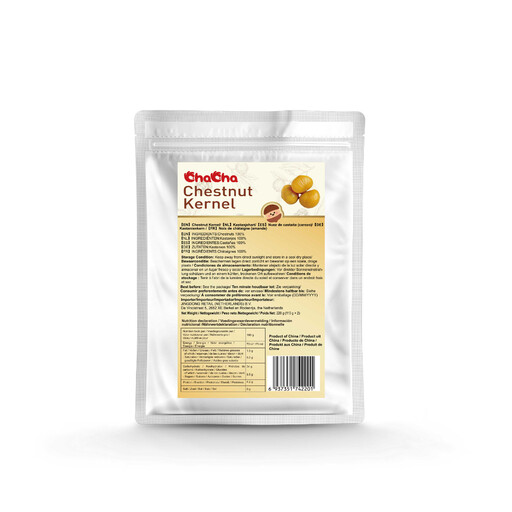
ChaCha chestnut kernels, 220 g

ChaCha chestnut kernels, 220 g

For anyone who’d like to choose chestnut kernels instead of peanut puffs as a snack. Before buying, check the nutritional information and ingredients on the packet, and make sure the texture is suitable for your child.

View at Joybuy

Frequently asked questions

Are reduced-fat peanut puffs the same as reduced-fat nuts?

No. The examples by Lorenz and Wurzener listed by REWE are corn and peanut snacks, not whole nuts. If you want to assess a fat-reduction claim, check the ingredients list and the specific product it’s compared with.

Are nuts without salt or added roasting oil automatically reduced-fat?

No. These descriptions refer to the salt content or how the product is made, not to a reduction in fat. EDEKA lists 63 g of fat per 100 g for its GUT&GÜNSTIG almonds roasted without oil or salt.

What forms of nuts are suitable for toddlers?

Whole nuts aren’t suitable for toddlers because of the choking risk. kindergesundheit-info suggests nut butter or finely ground nuts as possible options. Take your child’s age and ability to eat into account, and check the ingredients on the specific packet.

What should I look out for if I have a peanut allergy?

Check the ingredients and allergen information on every packet, even for peanut puffs with no visible pieces of peanut. The Federal Ministry of Agriculture, Food and Regional Identity lists peanuts among the ingredients that must be declared on food packaging.

Can nuts be part of an after-school snack?

Yes, depending on your child’s age and the form that’s suitable for them. The Federal Centre for Nutrition lists nuts as one possible ingredient for snacks between meals; when choosing a specific product, ingredients, salt content and individual tolerance are still important.