What should you look for when buying?
First, check the current packaging for any allergens relevant to you. Then compare the sugar information and decide whether a packaged waffle meets your other requirements.
| What to check |
What to look for when buying |
Who it matters most to |
| Allergens and traces |
Read the ingredients list and check which allergens are highlighted on the pack of the product you’re buying; check any precautionary allergen statements separately. |
If I need to avoid a particular allergen, whether it may be present is more important to my choice than any sugar claim. For around 42% of shoppers, checking for allergens is likely to be the main concern. |
| Sugar information |
Compare the sugar content per 100 g and check whether the pack says ‘no added sugar’, ‘sugar-free’ or ‘reduced sugar’. |
Once I’ve accounted for my allergen, I want to know how much sugar the specific waffle contains and what its label means. Around 33% of shoppers are likely to prioritise comparing sugar content. |
| Several ingredients to avoid |
For packaged products, check every ingredient; if baking at home, also consider ingredient packaging and the risk of cross-contact. |
If I need to avoid several ingredients, I want to know what the whole recipe contains rather than rely on a single product claim. For around 25% of shoppers, this is likely to be the main priority. |
Brands and products to help you choose
The information below applies to the specific waffles mentioned, not to every product from each brand. Check the current packaging to see whether a variety is suitable for your allergen profile.
Gullón
Sugar Free Vanilla Wafer may be an option if you’re mainly looking for a sugar-free waffle and its ingredients are suitable for you.
- World of Sweets lists less than 0.5 g of sugar per 100 g for this variety.
- The product information lists wheat, soya and possible traces of nuts and milk. The waffle contains maltitol and isomalt; according to the product information, excessive consumption may have a laxative effect.
Happy lea life
The vanilla waffle with no added sugar is a different choice from a waffle specifically labelled sugar-free.
- Posylka.de lists 7 g of sugar per 100 g; the ingredients include maltitol.
- The ingredients include egg yolk powder. According to the seller, traces of sesame, peanuts and hazelnuts may be present.
BERTHA’S
BERTHA’S markets its butter and vanilla waffles as gluten-free and reduced-sugar.
- According to BERTHA’S, the gluten-free flour base is made from maize flour and maize starch.
- The recipe contains butter and eggs. BERTHA’S also mentions possible traces of nuts, tree nuts and sesame; the sugar content is 22.0 g per 100 g.
GUT&GÜNSTIG
Lüttich sugar waffles offer a point of comparison for a traditional sugar waffle, rather than a product shown to be reduced-sugar.
- EDEKA lists 24.1 g of sugar per 100 g for this variety and provides its ingredients.
- According to EDEKA, the variety contains wheat, egg and soya; possible traces of milk and lactose are also listed.
Browse suitable waffles at Joybuy
This selection from Joybuy includes a hazelnut waffle with no added sugar and a spelt waffle. Check both against your allergen profile using the current packaging; the product name alone doesn’t mean either is suitable for everyone with allergies or prove that its sugar content is reduced.
 No image available
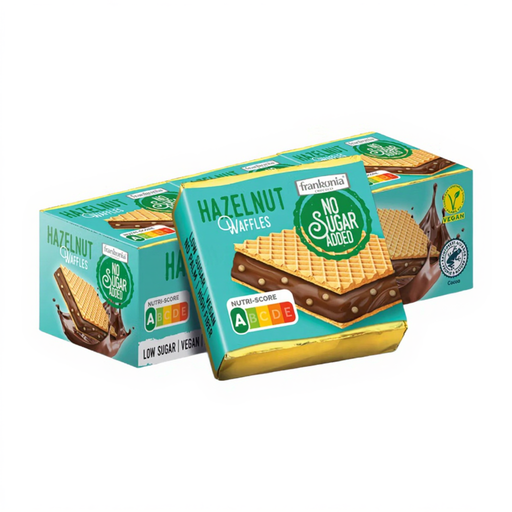
Frankonia hazelnut waffles with no added sugar, 9 × 19,4 g
An option if you want to avoid added sugar and hazelnuts aren’t an ingredient you need to avoid. Check the pack for wheat and soya, as well as any possible traces of other allergens relevant to you. ‘No added sugar’ doesn’t tell you the total sugar content.
View at Joybuy
 No image available
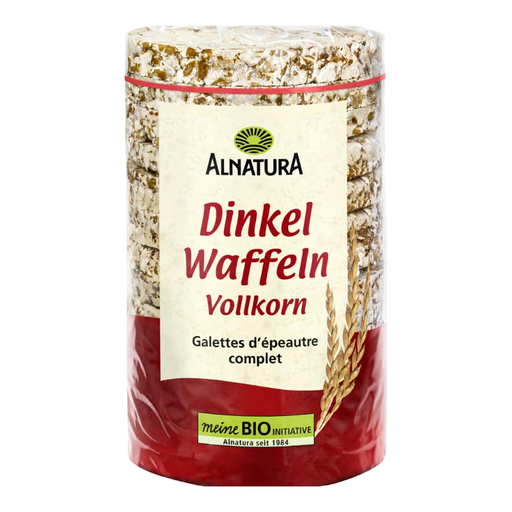
Alnatura organic plain spelt waffles, 100 g
A spelt waffle for shoppers who can tolerate spelt and want to compare the ingredients and nutrition information on the pack. Spelt is a type of wheat and contains gluten. Check the full allergen and precautionary information before choosing it; a low sugar content alone doesn’t prove that it’s labelled ‘reduced sugar’.
View at Joybuy
Frequently asked questions
Is a reduced-sugar waffle suitable if you have a food allergy?
Not just because of its sugar claim. ‘Reduced sugar’ describes a comparison with a similar food, not the allergens it contains. Check the ingredients and precautionary allergen information for the specific variety against your allergen profile.
What’s the difference between ‘no added sugar’ and ‘sugar-free’?
‘No added sugar’ doesn’t rule out naturally occurring sugars, and sweeteners may still be present. ‘Sugar-free’ is a different claim: Lebensmittelklarheit explains that it means no more than 0.5 g of sugar per 100 g or 100 ml. When comparing waffles, it’s still worth checking the nutrition information per 100 g.
What does a warning about possible traces of nuts mean?
It indicates that nuts may be present unintentionally due to cross-contact, not that they were deliberately used as an ingredient. The German Federal Institute for Risk Assessment distinguishes these warnings from the labelling of allergenic ingredients used in a product. You can’t tell what the warning means for your specific allergy just from a general product list.
Are homemade waffles easier to assess if you need to avoid several ingredients?
Baking at home gives you more control over the ingredients, but the finished waffles won’t automatically be free from the allergens you need to avoid. For example, EDEKA’s low-carb waffle recipe contains eggs, quark, butter, peanut butter and hazelnuts. Check every ingredient you use and take the risk of cross-contact in the kitchen into account.


