
Lieferung heute & morgen

Qualitätsgarantie

Willkommens-Angebote freischalten: KOSTENLOSE Lieferung | Bis zu 80 % RABATT | Kostenlose 30-Tage-JoyPlus-Testphase
App herunterladen
A refrigerator without a freezer compartment is a specialised solution for many households and offices. Whether as a space-saving option for a first apartment, a quiet beverage cooler for the office, or an energy-efficient supplement to your main appliance, forgoing a freezer creates more usable cooling space. However, the market can be confusing, and not every model delivers on its promises. Incorrect size specifications, disruptive operating noises, and inflexible designs often lead to buyer's remorse.
This guide will help you identify the crucial features and make an informed decision.
Before you choose a model, you should be aware of the typical problems that often only become apparent after the purchase.
To avoid the pitfalls mentioned above, focus on these three objective criteria. They are the foundation for a smart purchasing decision.
For a single-person household, a net capacity of 80 to 120 litres is usually sufficient. Measure the intended installation spot precisely and plan for about 5-10 cm of clearance on the sides and back for air circulation. A compact refrigerator with a width under 50 cm is ideal for niches. Pay attention to the interior layout: adjustable glass shelves offer more flexibility than fixed plastic ones.
The loudness of a refrigerator is measured in decibels (dB). For living areas, bedrooms, or as an office refrigerator, the value should be as low as possible.
A refrigerator with a reversible door hinge is a must-have for anyone who wants to remain flexible with placement. This allows you to have the door open from the left or right, depending on your room's layout. Good LED interior lighting provides a clear view without consuming much energy, and an automatic defrost function in the cooling section significantly reduces maintenance.
Here are recommendations tailored to specific use cases that take the above criteria into account.
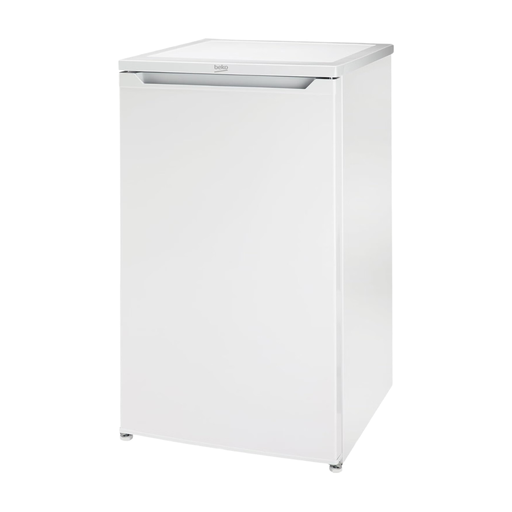
Why it's a good fit: With a width of just 47.5 cm, this Beko refrigerator fits into the smallest kitchen or niche. The 88-litre net capacity is perfectly sized for students or singles, offering ample space for weekly groceries.
The reversible door hinge solves the problem of limited flexibility. No matter the kitchen layout, the door can be mounted to fit.
Compact dimensions combined with maximum installation flexibility. The sturdy glass shelves can hold up to 25 kg.
Why it's a good fit: In a work environment, quiet is crucial. This model operates at a noise level of just 38 dB, which is equivalent to a whisper in a library. It won't disturb phone calls or focused work.
The clearly stated, low dB rating prevents the trap of an unexpectedly loud appliance. You get a reliable specification for a quiet environment.
Very quiet operation that won't disrupt concentration in the office or home office. The automatic defrost feature minimises maintenance.
Why it's a good fit: As a secondary appliance in the basement, garage, or entertainment room, this refrigerator offers pure cooling space for drinks and extra food. The annual energy consumption of 85 kWh (energy efficiency class E) is reasonable for a supplementary unit.
Instead of an impractical interior, this model offers three sturdy glass shelves and a vegetable crisper. The 88-litre net capacity is clearly defined and can be used efficiently.
Efficient use of space and low maintenance thanks to the automatic defrost function. Ideal for purely storing chilled goods.
We have compiled a complete, up-to-date list of products that fully meet these strict selection criteria and German safety regulations.
1. How quiet is a "quiet" refrigerator without a freezer, really? A refrigerator considered quiet has a noise level between 35 and 40 decibels (dB). A value around 38 dB, like the featured Beko model, is comparable to a soft whisper and is not perceived as disruptive in most living and working environments.
2. What does "reversible door hinge" mean, and why is it important? A reversible door hinge means you can move the refrigerator door's hinges from one side to the other. This allows you to decide whether the door opens to the left or the right. This is especially important in small rooms or with a fixed kitchen layout to ensure the door doesn't hit a wall or other furniture.
3. How much electricity does a small refrigerator use? Power consumption depends on the energy efficiency class, size, and usage. A modern, small freestanding refrigerator like the Beko TS190040N model with energy efficiency class E consumes about 85 kilowatt-hours (kWh) per year, according to the manufacturer. This provides a good estimate of the running costs.