Those reheating individual portions
If you’re serving portions of cooked cauliflower cheese, you probably don’t want to tie up the oven. Look for straightforward controls and a way to check that the food is heated through.


For individual portions that have already been cooked, a solo microwave is an obvious choice if you want to keep the oven free for other dishes while you cook. If you’d also like to brown the cheese topping, you’ll need a separate grilling or combination step. For a larger or rectangular dish, usable interior dimensions and turntable space matter more than the stated capacity alone. Whatever appliance you use, make sure the food heats evenly and is piping hot throughout.
If you’re serving portions of cooked cauliflower cheese, you probably don’t want to tie up the oven. Look for straightforward controls and a way to check that the food is heated through.
If you’d like a golden topping after reheating, allow time for an extra grilling or combination step as part of your cooking plan.
If you want to use a larger or rectangular dish, compare its dimensions with the appliance’s interior and, where relevant, its turntable.
A good fit if: you mainly reheat individual portions and don’t expect a browned cheese topping.
The trade-off: without a grill, browning the topping will need to be a separate step.
A good fit if: you’d like to brown the cheese topping as well as heat the food through, and can make time for it in your cooking plan.
The trade-off: the grill doesn’t replace even heating or the need to check that your dish is suitable for the selected setting.
A good fit if: you’d regularly like the appliance to take on oven duties while your main oven is being used for something else.
The trade-off: extra features and a larger cooking cavity take up space; the F.A.Z. Kaufkompass notes the space required by the combination model it tested.
| Priority | What to check when buying | Who will find it most important |
|---|---|---|
| Heating portions through | Controls for time and power, plus enough room for your portion dish. Stir the food while heating, or divide it into portions so you can check the centre. | When I’m serving several portions one after another, I want to be able to adjust the process easily and check how the food is heating; around 33% of consumers prioritise heating individual portions through. |
| Browning the cheese topping | Check for a grill or combination setting, and make sure your dish and any accessories are suitable for the setting you plan to use. | If you want a browned cheese topping after reheating, allow time for an extra step; around 25% of consumers make this a priority. |
| Dish size and space | Compare the dish’s width, depth and height with the interior dimensions, door opening and, where relevant, turntable. Follow the appliance instructions for its location. | If I need my rectangular casserole dish to fit in the microwave while the oven is in use, usable dimensions are key; around 25% of consumers prioritise having space for their dish. |
| Keeping extra effort to a minimum | Check that the control panel and interior are easy to clean, and compare information on standby consumption and display shut-off. | In a shared kitchen, I want to be able to operate and clean the appliance easily between uses; around 17% of consumers prioritise low operating, cleaning or energy costs. |
A browned cheese topping doesn’t mean the casserole is hot enough all the way through.
Heat the casserole evenly first, then treat browning as a separate step. The Federal Institute for Risk Assessment recommends heating all parts of the food to at least 70 °C for two minutes.
The interior dimensions, door opening and any turntable can all limit the space you can actually use.
Measure your dish and compare its dimensions with those of the specific appliance.
If it doesn’t fit, you may need an extra dish for individual portions.
Heating food later won’t reliably destroy heat-stable bacterial toxins that may already have formed.
Keep cooked food chilled until you’re ready to reheat it, and plan the reheating accordingly. The Federal Institute for Risk Assessment notes that some of these toxins are heat-stable.
According to Panasonic Germany, the NN-SD36 is a solo microwave with an inverter and a 29-litre cooking cavity. It could be a good option if you don’t need a grill.
According to CASO Design, the MG 25 Ceramic menu combines a microwave and grill with a flat base, which may be useful if you’re using a rectangular dish.
The MG23T5018CW and MC32DB7746KDE1 offer different features and aren’t interchangeable.
According to LG Germany, the MH6535GIS is a 25-litre inverter microwave with a quartz grill.
This selection includes solo microwaves for individual portions, as well as appliances with a grill or fan oven if you’re planning extra steps or other cooking tasks.
 No image available
The glass base, instead of a turntable, and the extra heating functions suit a cooking plan involving a rectangular dish and other preparation steps.
Microwave with 10 power levels, grill and fan oven.
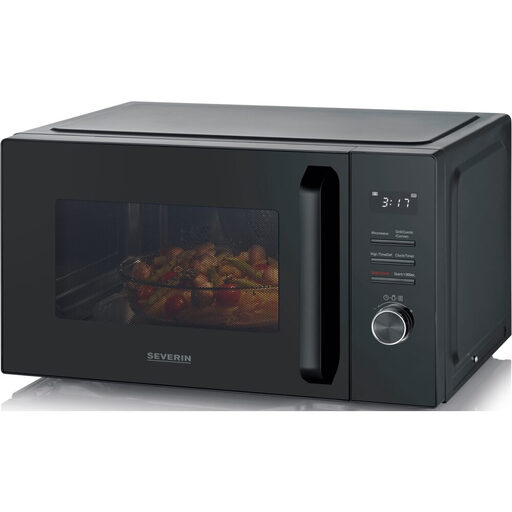 No image available
This model combines reheating individual portions with grill and fan oven functions for extra preparation steps.
29-litre cooking cavity and 31.5-cm turntable; microwave with seven power levels, grill and fan oven.
 No image available
This solo model is an option if you want to reheat individual portions and don’t need a grill.
19-litre cooking cavity, 24.5-cm turntable, 700 W and six power levels.
 No image available
This solo model is an option for reheating individual portions without a grill function.
700 W, six power levels, 360° turntable and timer up to 30 minutes.
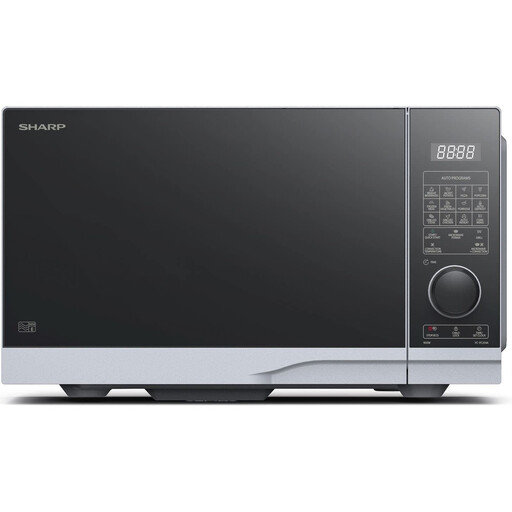 No image available
The combination of microwave, grill and fan oven is worth considering if you need more than just reheating.
25-litre cooking cavity, 900 W microwave function, 10 power levels and 288-mm turntable.
The Federal Institute for Risk Assessment recommends heating food to 70 °C for at least two minutes throughout when reheating. Stir the casserole part-way through heating in the microwave. If the dish makes this difficult, smaller portions and checking the temperature in several places can help. Keep cooked food chilled until you’re ready to reheat it.
No. Suitability depends on the material the dish is made from and the setting you’re using. For plastic microwave-safe dishes, follow the stated temperature and wattage limits, and don’t continue using damaged dishes. For grill and combination settings, also check the instructions for both the appliance and the dish.
The Federal Environment Agency highlights differences in energy use and standby consumption; for an accurate picture, check the details for the specific model and consider how you’ll use it. If a fault develops, remember that your statutory rights against the seller are separate from any voluntary manufacturer’s guarantee.
No. The Federal Environment Agency explains that old electrical appliances must be collected separately; one option is to take yours to a local recycling centre. Whether you can return it to a retailer depends on the applicable conditions.