
Lieferung heute & morgen

Qualitätsgarantie

Willkommens-Angebote freischalten: KOSTENLOSE Lieferung | Bis zu 80 % RABATT | Kostenlose 30-Tage-JoyPlus-Testphase
App herunterladen
Remote-control cars vary considerably in their drive system, controls, battery and intended use. Eye-catching design or a stated top speed alone won’t tell you whether an RC car is suitable for the living room, tarmac or off-road use. Check a few technical details before you buy to avoid a disappointing purchase and find a car that suits the driver’s age and ability, as well as the space available.
High motor power can actually be a disadvantage in confined spaces. For younger users and beginners, two speed settings, responsive steering and good straight-line stability are often more important than outright speed. A fast car also needs more space, quick reactions and a suitable surface.
An RC off-road truck with large tyres can handle grass, sand and uneven ground better. Even so, buyers should check the ground clearance, tyre tread, suspension and drive system. By contrast, a small 4WD RC car with smooth drift tyres is mainly intended for flat floors, tiles or indoor tracks.
A rechargeable RC car is only practical if the product listing clearly states whether the battery, charging cable and remote-control batteries are included. It’s also worth checking the charging time, stated run time and whether the battery can be removed. Some models need separate batteries for the remote control, even if the car itself runs on a lithium battery.
Don’t choose a remote-control drift car on looks alone. Interchangeable tyre sets, a gyroscope and proportional controls give you more ways to use it. This is particularly useful for teenagers and adults who want to practise different driving techniques with an RC drift car.
For frequent use, key features include a shock-resistant body, protected drive components and an accessible battery compartment. ABS plastic is listed as the body material for several RC models. Metal parts can affect a model car’s appearance and durability, but depending on the design, they can also add weight.
When choosing an RC off-road truck, check whether the manufacturer describes its components as water-resistant or explicitly says the vehicle is suitable for damp conditions. Don’t assume a product is waterproof. After driving on sand, grass or mud, clean and check the tyres, chassis and body.
Simple toy cars without loose small parts or complex electronics are often easier for children aged 3 and over to handle. Many drift and racing models with small components, on the other hand, are intended for ages 8 and over, or for teenagers and adults. The scale, remote control and speed should all be suitable for the user.
Always follow the manufacturer’s specific guidance. Products with small parts may present a choking hazard and should be kept out of reach of children under 3. More powerful vehicles are best used under adult supervision. The relevant EU safety requirements and markings should be clearly stated in the product description or on the packaging.
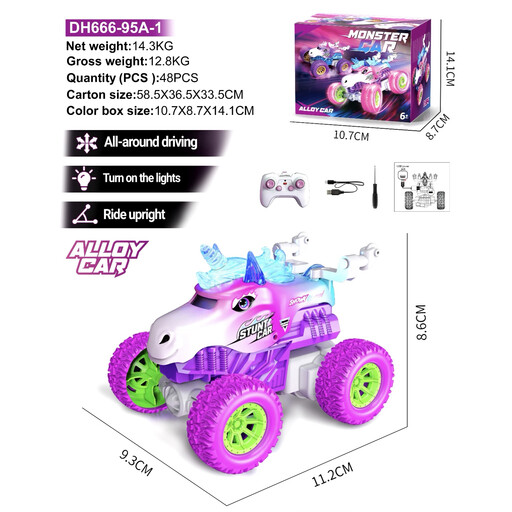
Why this product suits this type of user: This compact RC car offers simple forward, reverse and steering functions, plus two speed settings. You can start off slowly on a flat surface, then move on to stunts.
According to the product details, the 2.4 GHz remote control is designed to operate several cars at the same time. Switching speeds helps beginners avoid controls that feel too sensitive.
Alloy and ABS construction, built-in lights, 360-degree turns and 2.4 GHz control.
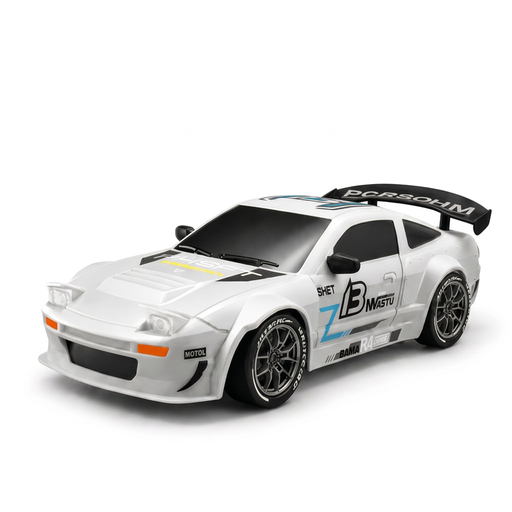
Why this product suits this type of user: This 1:24 model combines 4WD, an adjustable gyroscope, two types of tyres, suspension and LED lights. According to the product description, it’s aimed at teenagers and adult hobbyists.
The different tyres let you switch between drifting and racing. Two speed settings and the adjustable gyroscope make it possible to adapt gradually as your driving skills improve.
4WD transmission, interchangeable tyres, lithium battery, suspension and remote-controlled LED lights.
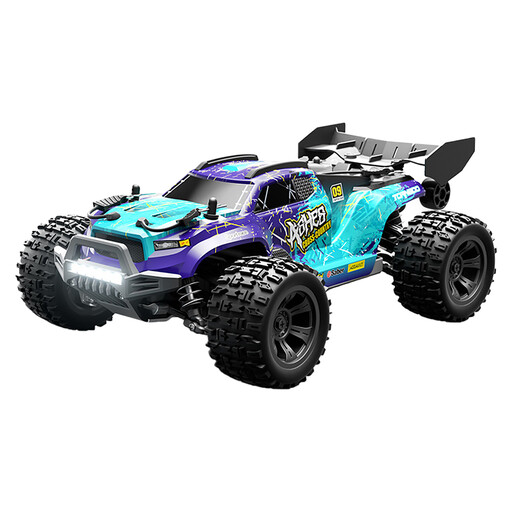
Why this product suits this type of user: This model is a good option if you’re looking for an RC off-road vehicle with large tyres, suspension and LED headlights for varied terrain.
The all-wheel drive, aluminium chassis, suspension and non-slip tyres are designed for uneven surfaces. Its suitability will still depend on the terrain and how well it’s maintained.
4WD, 7.4-volt lithium battery with 1,500 mAh capacity, metal chassis, shock absorbers and LED headlights.
We’ve put together a complete, regularly updated list of products that meet these strict selection criteria and fully comply with the safety regulations applicable in the EU.
The key factors are the specific age recommendation, the size of the parts and the speed. A simple toy car without small parts that are difficult to access may be more suitable for younger children than a complex drift model. Always follow the manufacturer’s instructions and warnings. Direct supervision is advisable for products with small parts.
Run time depends on the battery, motor, driving style, surface and outside temperature. Some 1:24 drift models are stated to run for around 20 to 40 minutes per charge. Treat this as a guide rather than a guarantee. A spare interchangeable battery and a compatible charger can be useful if you want longer play sessions.
As well as the purchase price, you’ll need to allow for electricity, remote-control batteries, replacement tyres and, where necessary, spare batteries. Tyres wear out faster on smooth surfaces if you drift frequently. A model with interchangeable tyres can give you more flexibility. With a die-cast car, Hot Wheels cars, a Siku model or a Carrera slot car track, ongoing vehicle battery costs are often not an issue, as these models are operated manually or using a separate track system.