
Lieferung heute & morgen

Qualitätsgarantie

Willkommens-Angebote freischalten: KOSTENLOSE Lieferung | Bis zu 80 % RABATT | Kostenlose 30-Tage-JoyPlus-Testphase
App herunterladen
A remote-control stunt car for children can drift, flip over, drive sideways or put on a show with LED lights and sound effects, depending on the model. However, product descriptions vary considerably when it comes to drive systems, batteries, controls and suitable surfaces. If you focus only on big promises such as “all-terrain” or “360° stunts”, you could end up with a car that barely works on your living-room carpet or whose battery doesn’t last long enough for everyday play.
A small RC off-road car may work on smooth ground, grass or firm sand, but wet, deep sand, coarse gravel and high kerbs can put strain on the drive system. Ground clearance, tyre tread, wheel diameter and the actual drive design all matter.
Indoors, tiles, laminate or a short-pile carpet are usually more suitable than a deep-pile carpet. Remote-control drift cars often need a smooth surface to drift properly. On grass or paving, the drift effect may therefore be limited.
An RC stunt car with 360-degree spins, sideways movement, transformation features, a spray function and several control options sounds versatile. Even so, a simple two-stick or button remote may be easier for younger children to understand. Gesture or watch controls also take time to get used to, so try them under supervision at first.
Check the age recommendation, too. Models with small parts or lithium batteries aren’t automatically suitable for toddlers. Read the information and warnings for the specific product before buying.
“Rechargeable” doesn’t mean that every battery and charging cable is included. Some cars come with a rechargeable battery for the vehicle, while the remote requires extra AA or AAA batteries. Charging time and play time per charge also affect how practical the car is.
Selected 1:24 drift models are described as offering a run time of around 20 to 40 minutes per charge. This will depend, among other things, on speed, surface and use of the lights.
A 4WD RC car drives all four wheels and can provide more even power distribution during drifts or climbing manoeuvres. Some larger off-road vehicles also feature individual wheel drive, Mecanum wheels or movable axles. These designs allow the car to slide sideways or drive on either side, but they’re not the same as a traditional racing car.
Check the following before you buy:
A 2.4 GHz remote control is used with many current RC models. According to product descriptions, this technology can support several vehicles being used at the same time. That’s handy for siblings or group play, but it doesn’t replace the need to keep a safe distance from people, roads and stairs.
Proportional controls let you adjust speed and steering more precisely. For children aged around 3 to 8, a simple model with clear forward, reverse and turning commands may be more suitable. Teenagers and RC enthusiasts are more likely to appreciate precise throttle and steering controls.
A rechargeable RC car with USB charging is easy to use day to day. It’s still important to have an accessible battery compartment, a suitable charger and a safe place to store the battery. After driving outdoors, clear sand and grass from the wheels, axles and body.
ABS plastic, shock-absorbing chassis and reinforced metal chassis are features that can be objectively described. However, they don’t tell you on their own how long a car will last. Driving style, drop height, care and the availability of replacement parts also make a difference.
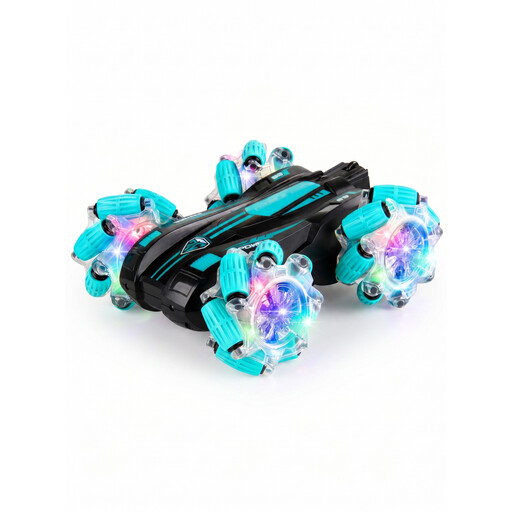
Why it suits this profile: This compact stunt car combines simple button controls with 4WD, driving on either side and LED wheels. It’s suitable for first stunt attempts on appropriate indoor and outdoor surfaces.
The product description lists a rechargeable lithium battery and an automatic demonstration mode. This means beginners don’t have to control every manoeuvre themselves straight away.
4WD, 360-degree spins on the spot, driving on either side and LED lights.
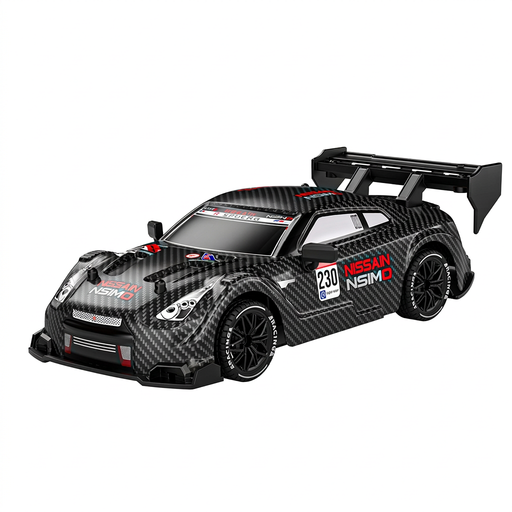
Why it suits this profile: According to the product description, this model is aimed at children aged 8 and over, as well as RC enthusiasts who want to switch between controlled drifting and high-speed driving.
Two interchangeable sets of tyres make the difference between drift and racing modes clear, instead of trying to cater for both with a compromise tyre.
Proportional 2.4 GHz controls, shock-absorbing chassis and USB-rechargeable battery.
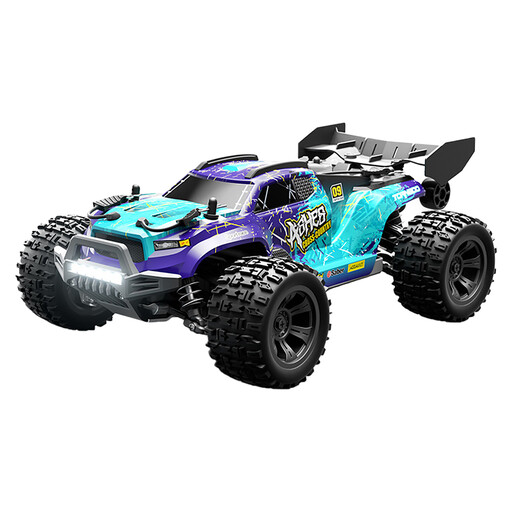
Why it suits this profile: Designed for driving over grass, sand, mud and snow, this vehicle is aimed at older children, teenagers and RC users who regularly drive outdoors.
The description lists an aluminium chassis, shock absorbers and treaded, abrasion-resistant tyres. These are several key features for driving over uneven surfaces.
7.4-volt, 1,500 mAh battery, 4WD, LED headlights and a 2.4 GHz remote control.
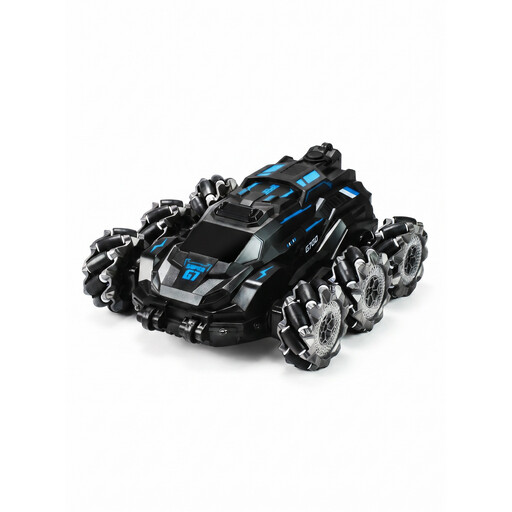
Why it suits this profile: LED lights, music, spray mist and a movable six-wheel swing arm make this a fun and varied RC gift for children aged 6 and over.
According to the product description, the spray function uses clean water only. Even so, check that the play area is suitable for getting wet before use.
6WD, 2.4 GHz controls, LED effects and a choice of handheld or gesture controls.
We’ve put together a complete, regularly updated list of products that meet these strict selection criteria and fully comply with the safety regulations in force in the EU.
The specific age recommendation, small parts and complexity of the controls all matter. A simple remote-control toy car with clear buttons may be more suitable than a powerful drift model. Children under 3 shouldn’t use models with a relevant warning. Younger children should ideally be supervised by an adult.
It depends on battery capacity, motor power, speed, surface and lighting. Some 1:24 drift models are described as offering around 20 to 40 minutes of use. For longer play sessions, a second compatible battery may come in handy, provided the manufacturer offers one.
Many models are designed for both, but not every surface is suitable. Drift cars often perform better on tiles or smooth floors, while an RC off-road car with treaded tyres may be better suited to grass, sand or firm gravel. Read any water-resistance information carefully: splash-resistant doesn’t automatically mean the whole vehicle can be submerged.