
Lieferung heute & morgen

Qualitätsgarantie

Willkommens-Angebote freischalten: KOSTENLOSE Lieferung | Bis zu 80 % RABATT | Kostenlose 30-Tage-JoyPlus-Testphase
App herunterladen
Remote-control toy cars for children vary considerably in how they work, their age recommendations, power supply and suitability for different play environments. A model with flashing lights might be fun in the living room, while an off-road monster truck is best enjoyed outside. If you’re a parent, grandparent or buying a gift, it’s worth checking the product details rather than relying on eye-catching marketing claims.
A product may be described as a remote-control car for children aged 3 and over, or even advertised for younger children, while a safety warning about small parts gives a different age limit. For example, the F1 Remote Control Car is described as suitable for children from 18 months to 5 years. At the same time, the product information warns that it contains small parts that could pose a choking hazard and says it is not suitable for children under 3.
It’s important to consider the age recommendation, safety warnings and intended use together. Younger children should always be supervised during play. Keep small accessories, detachable figures and battery compartments out of reach of toddlers.
Lights, music, spray effects and 360-degree stunts can look appealing in product photos. But a complex remote control may be too much for a remote-control car for toddlers. Check whether your child can operate the car independently — moving forwards and backwards and steering — and whether the remote has large, clearly labelled buttons.
Children aged around 6 and over may enjoy extra features such as rolls, spins or different driving modes. The controls should always suit the child’s stage of development.
An RC car for children often needs batteries for both the car and the remote control. The F1 car, for example, needs 3 AA batteries, which aren’t included. The VTech race track runs on 4 AA batteries, which are included according to the product information. Other cars have a built-in lithium battery and come with a USB charging cable.
Before you buy, check:
For a remote-control car for toddlers, look for large controls, a sturdy body and a manageable range of features. According to the product description, the F1 model has a thick, robust construction and a detachable driver figure. However, the detachable figure should be considered alongside the safety warning.
Interactive toys such as the VTech Tut Tut Baby Flitzer are designed for children aged 1 and over. The VTech race car, tractor and fire engine respond to movement, buttons or so-called sensor zones. Parents should check these toys regularly for loose or damaged parts.
For younger children, a small number of clearly distinct controls is usually easier to understand. A car that moves forwards and backwards and turns in one direction may be enough to get started. A four-way remote-control buggy for children is a better fit once your child is confident with the controls.
Cars with a 2.4 GHz remote control are often described as having a stable connection and being less prone to interference. However, that doesn’t guarantee the car will work equally well in every setting. Walls, furniture, other wireless devices and the distance from the car can all affect how it performs.
A remote-control monster truck for children with treaded rubber tyres is designed for carpets, tarmac or firm ground, but not necessarily for water or deep puddles. According to the product description, the Crocodile RC Car has large tyres, a shock-absorbing design, LED lights and a spray function. It has a built-in battery rated at 3.7 V and 1,200 mAh.
For toys with electronic parts, use them only on a suitable surface, don’t immerse them in water and check for visible damage after play. A damp cloth is enough to clean many plastic parts; harsh cleaning products can damage surfaces and stickers.
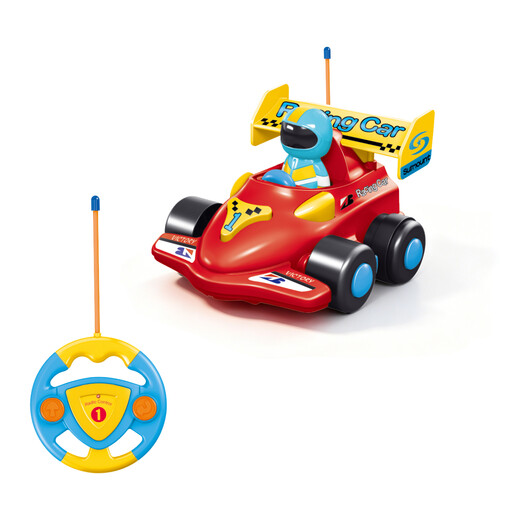
Why it suits this buyer: The controls are limited to moving forwards, backwards and left. This keeps things simple for beginners. Check the age recommendation against the safety warnings carefully before ordering.
The simple controls avoid unnecessary complexity. However, the 3 AA batteries required aren’t included, so you’ll need to factor them in.
Sturdy, thick construction; lights, engine-start and music functions, plus a detachable driver figure.

Why it suits this buyer: This set combines a race track, two vehicles and interactive sensors. It’s a good choice for families looking for a structured play system with a range of ways to play.
The track can be assembled in several layouts, so play isn’t limited to a single direction of travel. Make sure you have enough space at home for the large packaging and track setup.
11 sensor zones, two different vehicles, a start-finish section, tunnel and adjustable track sections.
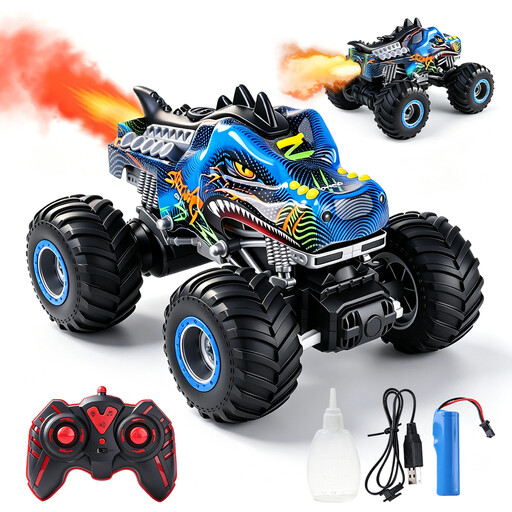
Why it suits this buyer: For children aged 3 and over who want a dinosaur-themed toy car with off-road tyres, lights and stunt features. The product information recommends direct supervision.
The treaded tyres and stated shock absorption make it better suited to firm outdoor surfaces than small city cars. The lights and music may, however, seem quite loud indoors.
360-degree spins, 2.4 GHz remote control, LED modes, built-in 3.7 V battery and spray function.
We’ve put together a complete, regularly updated list of products that meet these strict selection criteria and fully comply with the safety regulations in force in the EU.
Look for a clear age recommendation, a secure battery cover and a remote control with a few large buttons. A monster truck with stunt features may be suitable if your child plays under supervision and uses the car on an appropriate surface.
There’s no single answer. Battery life depends on the motor, lights, music, driving surface and type of battery. If the car is used frequently, rechargeable AA or AAA batteries can help reduce running costs. For cars with built-in lithium batteries, check the charging time, cable and availability of replacement parts.
A race track offers set routes, construction play and role-play, and can be enjoyed by several children. A single RC car takes up less space and is more flexible to use indoors or outside. When choosing a gift for a boy or a girl, their interests, the space available and the kind of play they enjoy matter more than a general product category.