
Lieferung heute & morgen

Qualitätsgarantie

Willkommens-Angebote freischalten: KOSTENLOSE Lieferung | Bis zu 80 % RABATT | Kostenlose 30-Tage-JoyPlus-Testphase
App herunterladen
Remote control toy cars for children vary significantly in terms of controls, battery, materials and where they can be used. A vehicle that runs well on smooth floors won’t necessarily be suitable for grass or gravel. Likewise, an RC stunt car with 360-degree rotation isn’t right for every age group.
For parents, grandparents and other family members, it’s worth taking a close look at the technical specifications. Marketing terms like “all-terrain vehicle”, “long battery life” or “shockproof” don’t tell you much on their own. What really matters is whether the design suits the child, the intended environment and how it will actually be used.
A remote control car for children aged 3 and over usually has simple button controls and a moderate speed. Complex stunts, gesture control or rotating Mecanum wheels, on the other hand, are typically aimed at older children. A model intended for children aged 8 and over can overwhelm younger users with multiple control modes and fast movements.
So the age recommendation shouldn’t be treated as a mere formality. Even adult supervision doesn’t replace the age suitability stated by the manufacturer.
Large tyres and a 4WD RC car can offer advantages on grass, sand or concrete. However, that doesn’t automatically mean the vehicle can be driven through puddles or water. Only if the manufacturer explicitly describes appropriate protection should the product be used in damp conditions.
With a water-capable model, you also need to pay attention to the charging port, battery instructions and cleaning. After play, the vehicle should be dried before being stored or charged.
Many RC cars come with a built-in lithium battery and a USB charging cable. However, the remote control sometimes requires additional AA batteries. These may not be included in the box. So before you buy, you should check:
For toy vehicles for ages 3 and over, forward and reverse movement plus left and right steering are usually sufficient. The City Container Truck, for example, features a 2.4 GHz remote control, light functions and an automatic demonstration mode. According to the product details, it is intended for children aged 3 and over. Small parts should still be kept away from children under 3.
From around age 6, additional features such as drifting, spinning or LED lighting can become interesting. However, an RC stunt car should only be used in a sufficiently open space and under supervision, because the wheels and bodywork move quickly during stunts.
A 4WD RC car distributes power to all four wheels, allowing it to perform better on uneven surfaces than a simple two-wheel-drive model. For grass, paved paths or light gravel, grippy tyres and sufficient ground clearance are particularly important.
With a remote control off-road vehicle, you should also consider the following:
The 1:18 4WD off-road model features an aluminium chassis, shock absorbers, LED headlights and a 7.4-volt battery, according to the product description. The remote control requires three AA batteries, which are not included. The specifications are aimed more at older children, teenagers or adults than at young beginners.
ABS plastic is used in many children’s vehicles because it is relatively lightweight and dimensionally stable. Even so, the bodywork, wheels, axles and fastenings should be checked regularly. If there are cracks, loose parts or a damaged battery, the vehicle must not be used any further.
Look out for the CE marking, the age recommendation, warning notices and details of the responsible person in the EU. A CE marking is not a quality judgement; it indicates the manufacturer’s declared conformity with the relevant EU requirements. Charging and battery instructions should be fully traceable in the product description or manual.
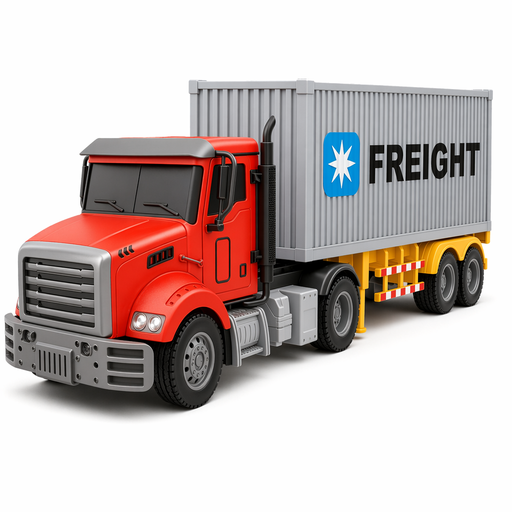
Why this product fits the profile: The simple forward, reverse and steering function makes it a great introduction to remote control children’s vehicles from age 3.
The product details explicitly state the age suitability, battery, USB cable and 2.4 GHz remote control. No additional AA batteries are needed for the remote control.
45 cm long vehicle body, front and roof LEDs, removable container and a stated range of up to 30 m.
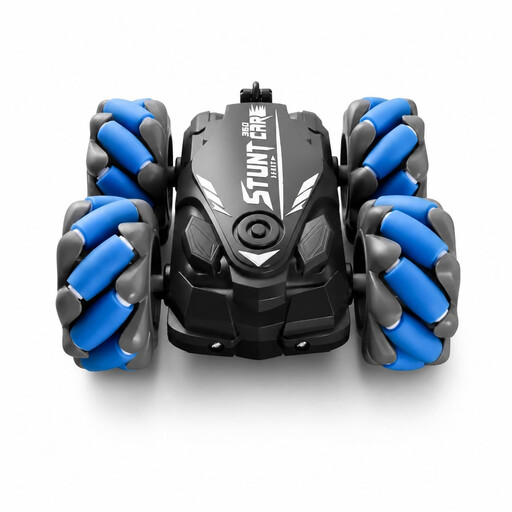
Why this product fits the profile: For children aged 8 and over who want to use classic controls as well as gesture control and controlled stunt functions.
The age limit of 8 and over, along with instructions on supervision, charging behaviour, spinning wheels and damaged components, are clearly stated.
4WD drive, Mecanum wheels, sideways drifting, 360-degree spins, dual-sided driving and built-in battery.
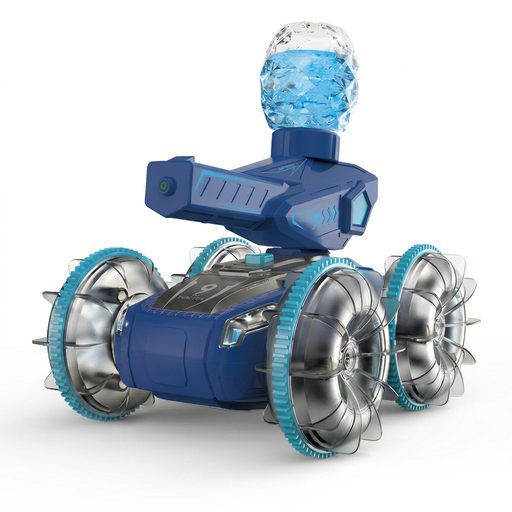
Why this product fits the profile: Suitable for users who want a vehicle for land and shallow water play with two control modes.
The description distinguishes between land and water use. Nevertheless, water depth, seals, cleaning and battery instructions should be checked before use.
4WD propeller wheels, 360-degree rotation, water spray function, LED lighting and hand or gesture control.
We’ve put together a complete, regularly updated list of products that fully meet these strict selection criteria and the safety regulations in force in the EU.
Not every children’s vehicle has to be remote controlled. PLAYMOBIL vehicles such as a fire engine pick-up, a tractor or a Volkswagen T1 are aimed at children aged 4 and over and focus on manual play and role-playing. The fire engine pick-up set includes figures, accessories and a manual water spray function. No batteries are required for these.
Such models can be a good fit if imaginative play, collecting and combining with other sets are more important than speed or stunt functions. The same guidance about small parts and supervision applies here too.
The actual run time depends on the battery, motor, surface, speed and use of light or sound functions. Manufacturer’s figures for play time should be taken as a guide. After play, the battery should be charged according to the instructions and not left permanently on the charger.
A model is only suitable if the stated age recommendation is 3 and over and the child can operate the controls. Small parts, rotating wheels and batteries require extra caution. Children should always be accompanied by an adult during their first play sessions and when charging.
That depends on the product specifications. Grass, concrete, sand or gravel may be suitable for appropriately designed vehicles. Water, mud and snow should only be driven on if the manufacturer expressly allows it. After every outdoor run, the tyres, axles and bodywork should be checked for dirt or damage.