
Lieferung heute & morgen

Qualitätsgarantie

Willkommens-Angebote freischalten: KOSTENLOSE Lieferung | Bis zu 80 % RABATT | Kostenlose 30-Tage-JoyPlus-Testphase
App herunterladen
For many children, a race track is a highlight in the playroom. However, the selection is vast, ranging from simple wooden tracks for toddlers to complex, remote-controlled systems for school-aged children. Making the right choice isn't always easy. As a Joybuy Product Recommendation Officer, I'll help you navigate common pitfalls and find a race track that offers long-lasting fun.
This guide focuses on objective criteria to help you make an informed decision, rather than falling for short-lived marketing promises.
Before you decide on a model, you should be aware of the most common issues that can quickly spoil the fun.
To avoid these problems, you should examine three crucial aspects. These will help you objectively assess the quality and long-term value of a race track.
The right race track depends heavily on the child's age and interests. Pay close attention to the manufacturer's age recommendation, as it provides clues about the complexity and safety.
The durability and safety of a race track are determined by its material. Look for the following features:
To ensure long-term fun, the expandability of the system is a critical factor.
Here are some recommendations tailored to different needs and age groups that take the aforementioned pitfalls into account.

Why This Fits Their Persona: This set is specifically designed for toddlers. It combines an easy-to-build track with interactive elements that react to the vehicles. The sturdy parts and child-friendly remote control are ideal for small hands.
It bypasses the "short-lived fun" trap with 11 magic sensors that trigger phrases, music, and sounds. The robust construction prevents frustration from unstable parts.
Promotes an understanding of cause and effect through interactive sensors. The system is compatible with other Tut Tut Baby Flitzer products, making it expandable.

Why This Fits Their Persona: This set is more than just a race track; it's a versatile race track building kit. Kids can build five different remote-controlled models from 604 pieces, which fosters creativity and technical understanding.
It counters the "lack of versatility" by allowing the construction of five different models. As a STEM toy, it offers high replay value that goes far beyond a simple race track.
Offers control via remote and app, including simple programming functions. The rechargeable battery is practical and more environmentally friendly than disposable batteries.
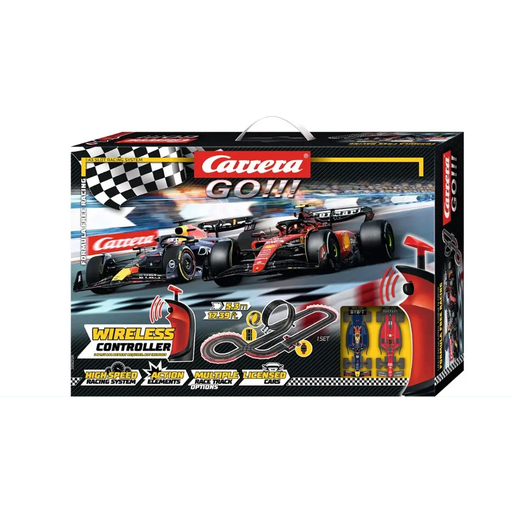
Why This Fits Their Persona: For kids who love the thrill of head-to-head races, this classic Carrera track set is an excellent choice. It includes two licensed Formula 1 cars and a challenging track layout.
Carrera is an established system with countless expansion options. This avoids the "closed system" trap and secures the investment for the long term.
The wireless hand controllers offer more freedom of movement during play. The track includes a race track with a loop for extra action and challenge.
We have compiled a complete, real-time list of products that fully satisfy these strict selection criteria and UK safety regulations.
How can I identify an age-appropriate race track? Check the manufacturer's age recommendation on the packaging. For children under 3, systems without small, swallowable parts and made from robust material are essential. Simple plug-in systems are suitable for preschoolers, while a complex race track building kit or a fast remote-controlled race car are better suited for school-aged children who have better fine motor skills and concentration.
Are race tracks from different brands compatible with each other? Generally, no. Systems like Carrera, Hot Wheels track, or Playmobil Sky Trails are self-contained ecosystems. Tracks, vehicles, and power supplies are usually only compatible within the same product line from the same manufacturer. It is therefore advisable to choose one system and expand it specifically as needed to avoid compatibility issues.
What does "STEM toy" mean in the context of race tracks?STEM toys (Science, Technology, Engineering, and Mathematics) playfully promote skills in these areas. A race track building kit, where children plan and construct tracks while observing physical principles like gravity or centrifugal force, is a good example. Such toys encourage problem-solving and enhance spatial awareness.