
Lieferung heute & morgen

Qualitätsgarantie

Willkommens-Angebote freischalten: KOSTENLOSE Lieferung | Bis zu 80 % RABATT | Kostenlose 30-Tage-JoyPlus-Testphase
App herunterladen
A remote-controlled car for children can vary considerably depending on age, surface and control system. That is why appearance is not the only consideration for parents, grandparents and other family members. Easy-to-understand controls, a suitable age rating, durable materials and a practical battery setup for everyday use are all essential.
Light effects, music, water cannons, stunts and multiple control modes may seem appealing. However, an overloaded remote control can quickly become frustrating for toddlers. An RC car for children should suit their motor development. For younger children, a few clearly recognisable buttons are usually easier to understand than a complicated control system.
The product description “remote-controlled car from 3 years” is no substitute for reading the full warning notice. Check whether the product contains small parts, whether direct supervision is required and which batteries are used. With a toy featuring a removable driver or accessories, this warning can be particularly important.
An RC monster truck with large tyres can offer advantages on grass, sand or gravel. However, this does not mean that every model is suitable for deep mud, stairs or continuous exposure to water. An all-terrain RC car should be assessed based on its tyre tread, ground clearance, impact protection and the explicitly stated conditions of use.
Pay attention to the age group specified by the seller and to the safety warnings. For children aged approximately 18 months to 3 years, particularly simple vehicles may be suitable. These often provide only forward, reverse and steering functions. For older children, 2.4 GHz remote controls, stunt functions or gesture control may be appealing.
The range in the intended environment is also important. A living room presents different requirements from a garden, courtyard or park. High speed is not necessarily an advantage for younger children, as a slower vehicle is easier to control.
ABS plastic is used for the bodywork of many remote-controlled toy cars. More useful than general marketing terms are specific details such as rounded edges, impact protection, one-piece construction or treaded tyres with reliable grip.
With a remote-controlled amphibious vehicle, it is important to distinguish clearly between splash-resistant components and use in shallow water that is explicitly described by the manufacturer. Even with waterproof models, you should follow the instructions regarding the battery compartment, charging port and cleaning. Water used during play should not come into contact with the remote control.
Check whether batteries are included. A model using three AA batteries has different ongoing costs from a vehicle with an integrated 3.7-V lithium battery. For rechargeable models, the charger, charging cable and charging instructions should all form part of your buying decision.
Batteries should always be stored out of the reach of young children. Use only suitable battery types, do not mix old and new batteries, and remove batteries before storing the product for a prolonged period. The instructions provided by the relevant manufacturer take precedence.
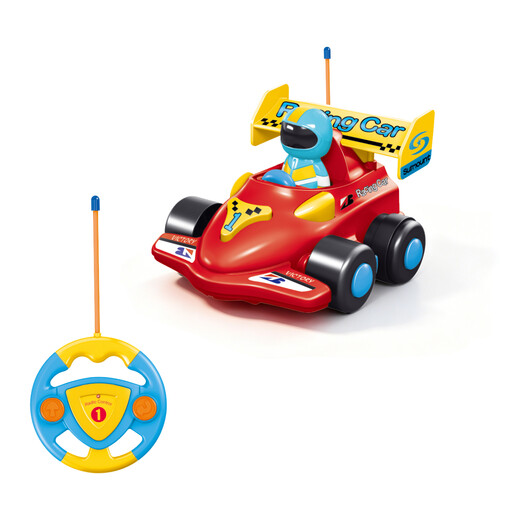
Why this product suits this profile: This vehicle offers relatively straightforward controls, including forward, reverse and left steering. According to the product details, it is intended for children from 18 months to 5 years; however, the specific warning regarding small parts must be observed.
The simplified controls avoid an unnecessarily complicated remote. Buyers should take account of the “not suitable for children under 3 years” warning and the requirement for supervision before use.
Flashing lights, motor and music sounds, plus a removable driver figure. Requires 3 AA batteries, which are not included.
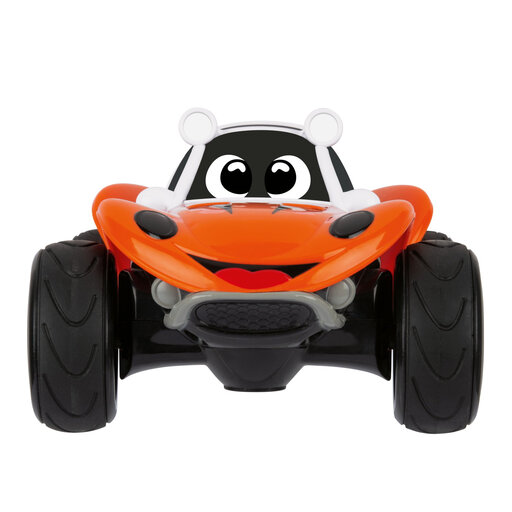
Why this product suits this profile: According to the product details, this buggy is intended for children aged 24 months and over. It features a steering-wheel remote with four directional buttons. The design is ideal for families who prefer clearly structured controls.
The age rating and guidance on supervised use are clearly stated. The remote control must not be immersed in water or other liquids.
Off-road wheels, movement in four directions and the ability to jump over obstacles. Requires 4 AA and 2 AAA batteries, available separately.
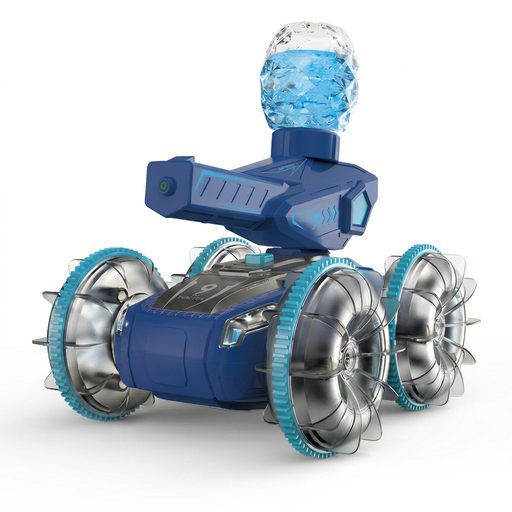
Why this product suits this profile: According to the product description, this vehicle is designed for use on land and in water and is offered as a model for children aged 3 and over. It is aimed at families looking for a versatile vehicle for the garden, sand, gravel and shallow water.
The intended uses are specified clearly, rather than relying on general claims about off-road performance. Before play, follow the guidance on shallow water, sealing and supervision.
4WD, propeller wheels, a water-spray function, 360-degree rotation, LED lights, plus hand and gesture control. The 2.4 GHz connection is designed to allow several vehicles to operate simultaneously.
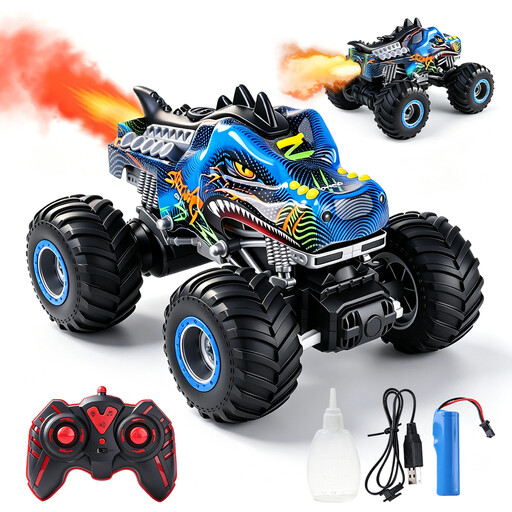
Why this product suits this profile: This remote-controlled buggy and monster truck combines large treaded tyres with stunt functions. According to the product details, it is suitable for children aged 3 to 8 and can make a great gift for boys and girls.
The key buying details are clearly provided: age rating, 2.4 GHz remote control and integrated battery. The vehicle should be used under the direct supervision of an adult.
360-degree stunts, deep tyre treads, LED lighting with three modes and a water-spray function. It features a built-in 3.7-V 18650 lithium battery with 1,200 mAh capacity.
We have put together a complete, regularly updated list of products that fully meet these strict selection criteria and the safety regulations applicable in the EU.
Before buying a remote-controlled car, check the following:
For toddlers, a model with simple forward, reverse and steering controls is usually easier to manage than a stunt vehicle. The official age rating, warning regarding small parts and requirement for supervised use are all crucial. The vehicle should also be driven slowly and in a controlled manner on the intended surface.
Battery life depends on the battery capacity, motor, surface and lighting and sound functions. A general estimate is therefore not reliable. Check the manufacturer’s specifications and, if the vehicle will be used frequently, plan for replacement or charging intervals. For battery-powered models, make sure you have suitable replacement batteries available.
Ongoing costs mainly come from batteries or the electricity used for charging. Models requiring AA or AAA batteries need new cells regularly. With an integrated lithium battery, frequent battery purchases are no longer necessary. However, you should still consider the charging accessories and guidance on safe storage.