
Lieferung heute & morgen

Qualitätsgarantie

Willkommens-Angebote freischalten: KOSTENLOSE Lieferung | Bis zu 80 % RABATT | Kostenlose 30-Tage-JoyPlus-Testphase
App herunterladen
A remote-controlled car for children can combine movement, imaginative play and technical curiosity. However, not every RC car is right for every age or home. Some models look robust in product photos but need lots of batteries. Others offer plenty of features, but may not suit younger children because they have small parts or complicated controls.
Before buying, parents, grandparents and other family members should avoid these three common mistakes:
The age recommendation isn’t just a decorative detail; it’s an important factor in your decision. Check the manufacturer’s information and the warnings on the product page. Even a toy car for children aged 3 and over may have removable figures, accessories or moving parts.
For younger children, larger models with simple controls and few removable parts are usually easier to manage. A remote-controlled children’s vehicle should also be used under adult supervision, especially by children under 3 or when the vehicle has small parts.
Not all remote controls offer the same options. Simple models might move forwards and backwards, and turn in one direction. More advanced vehicles have several channels, allowing you to raise a loading platform or use other functions.
Look for:
A remote-controlled drift car generally needs more room and is better suited to older children or teenagers. Slower models with a manageable turning circle are more practical in the living room.
ABS plastic, metal parts and rubber tyres can all be useful, depending on the type of vehicle. A toy car for indoor use should be compact, while an RC construction vehicle used outdoors will benefit from grippy tyres and a movable loading platform.
Also check:
For example, the VTech Tut Tut Speedy Flitzer Fire Engine needs two AAA batteries. Demo batteries are included, but should be replaced for regular use. According to the product description, the battery compartment is child-safe and has an automatic shut-off function.
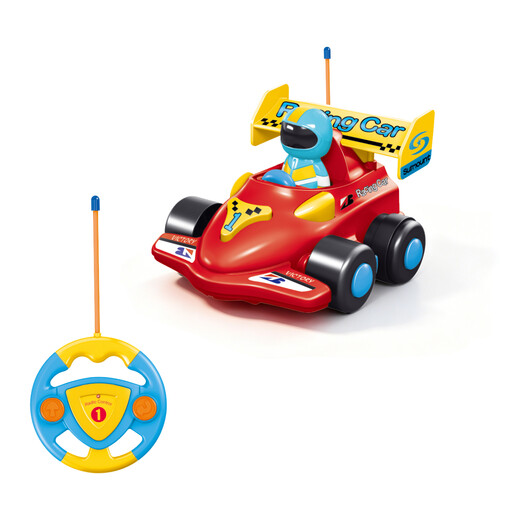
Why it suits this profile: The controls are limited to moving forwards, backwards and left, keeping things straightforward. The model is listed as suitable for children aged 18 months to 5 years; however, its small-parts warning means you should check the age guidance carefully.
The simple controls avoid an overloaded remote. However, remember to budget separately for the 3 AA batteries required.
Simple driving functions, a removable driver, lights, and start-up and acceleration sounds.

Why it suits this profile: This set combines a remote-controlled vehicle with a built race track, creating a defined play area that’s ideal for playing together.
The 11 sensors and different track sections provide a structured way to play, rather than letting the cars race around unchecked. Make sure you’ve considered the assembly and space needed beforehand.
Two vehicles, several track layouts, a start-finish area and four AA batteries included.
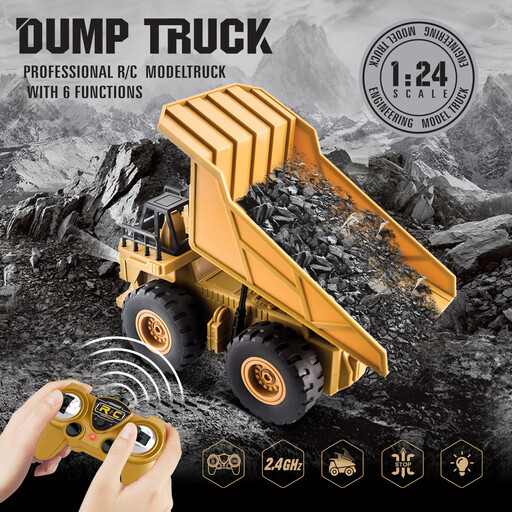
Why it suits this profile: This remote-controlled construction vehicle is for children who enjoy building-site scenarios and imaginative play with working features. The 1:24-scale model has a lifting loading platform, making it suitable for controlled loading and unloading.
The functions are clearly specified: driving, steering and raising the loading platform. The built-in battery means you don’t need batteries for the vehicle, while the remote control requires 2 AA batteries.
6-channel control, a 3.7-volt/500-mAh battery, rubber tyres, lights and horn effects.
We’ve put together a complete, regularly updated list of products that meet these strict selection criteria and fully comply with the safety regulations in force in the EU.
It depends on the specific model. According to the product information, some interactive toy cars are designed for children aged 1 or 2 and over. However, if the vehicle has small parts, a warning may state that it isn’t suitable for children under 3. Always check the product description, packaging and safety information.
There’s no single answer. Battery life depends on the motor, driving surface, sound and light functions, and battery quality. Before you buy, check whether batteries are included, which type is required and whether the model switches off automatically.
A compact RC racing car can be used in larger, clear spaces. Slower models with limited controls are better suited to small rooms. Move obstacles out of the way, keep the car away from stairs and don’t leave children unsupervised while they’re driving.