Who would benefit from a remote shutter release?

Figurine photographers using a fixed tripod setup

If your camera is set up and you want to avoid camera shake when taking a shot, first check that the connector is compatible and the cable is long enough for your setup. Canon Germany and Nikon Germany describe compatible wired remote shutter releases for supported cameras.

Photographers who move around their setup

If you move around while arranging figurines or adjusting the light by a window, a compatible wireless remote may be a suitable option. Sony describes the RMT-P1BT for supported cameras; compatibility depends on the specific model.

Photographers taking multiple lighting variations

If you want to repeat planned shots over a period of time, a compatible timer can be useful. JJC describes interval and delay functions for the TM-F2; these functions are not automatically available on other variants.

What should you look for when buying?

Wired remote shutter release

A good fit if: Your camera is on a fixed tripod and supports the remote’s connector.

The trade-off: You don’t need to pair via Bluetooth, but the cable limits where you can use the control.

Wireless remote

A good fit if: You move around your figurine or window-light setup and your camera supports the specific model.

The trade-off: With Bluetooth, you’ll need to consider pairing and battery life.

Wired interval timer

A good fit if: You’re planning timed or repeated shots with a compatible camera.

The trade-off: Extra timer functions may be unnecessary for single stills; the functions described apply to the JJC TM-F2.

Camera app or self-timer

A good fit if: You only occasionally want to take a shot without touching the camera and it has a suitable feature.

The trade-off: App features depend on the camera model; with the self-timer, you can’t choose when to take the shot on the spur of the moment using a handheld device.

Buying consideration What to check before buying Who it matters most to
Take a shot without touching the camera in a fixed setup Check the camera model and connector type; if you’re choosing a wired remote, also consider the cable length you need. If I don’t want to touch my camera on the tripod when taking a shot, the right connector is essential. Around 42% of shoppers cite this as their main concern.
Work around your setup without a cable Check compatibility with your exact camera model and, for Bluetooth, find out how to pair the device. If I move around while arranging my figurines, wireless shooting matters more than having a cable on my tripod. Around 25% of shoppers cite this as their main concern.
Repeat shots over time Check which timer functions the specific model offers and whether its connector is compatible with your camera. If I want to take several shots at planned times, I may need a compatible timer. Around 17% of shoppers cite this as their main concern.
Avoid buying an extra device Check your camera manual for a suitable app-based remote control or self-timer. If a camera feature I already have is enough for the occasional figurine photo, I don’t want to buy a separate device. Around 16% of shoppers cite this as their main concern.

Avoid common buying mistakes

  • Assuming similar-looking connectors are interchangeable

    Different connectors won’t necessarily fit the same camera. Canon lists E3 and N3 as different connector types; for certain camera models, Fujifilm says an additional adapter is required for the RR-100.

    Check your camera’s full model name against the manufacturer’s compatibility list and make sure you’ve identified the right connector.

    Some Fujifilm models may also require an adapter.

  • Assuming Bluetooth support means a remote will be compatible

    Bluetooth on your camera alone doesn’t guarantee that it will work with every Bluetooth remote. Sony requires you to pair the RMT-P1BT before connecting it.

    Check compatibility for your exact camera model and set up the remote before an important shoot.

  • Automatically buying a timer for single shots

    An interval timer offers extra functions you may not need for individual figurine photos. A suitable camera app or self-timer may be enough for occasional shots.

    Before buying, consider whether you really need planned repeat shots and check the features of the specific timer model.

Camera brands to consider

Canon

Canon offers wired remote shutter releases for different connectors and describes app-based remote control for supported cameras.

  • The RS-80E3 is designed for E3 remote connectors; Canon offers a different remote for N3.
  • App features and accessory compatibility depend on the camera model.

Nikon

Nikon describes the MC-DC2 as a wired option and the ML-L7 as a wireless alternative for supported cameras.

  • According to Nikon, the MC-DC2 lets you take a shot without touching the camera; the ML-L7 has additional control buttons.
  • Compatibility is not guaranteed for every Nikon camera.

Sony

Sony offers a Bluetooth remote and a wired remote shutter release for compatible cameras.

  • Sony describes the RMT-P1BT for supported cameras; the RM-VPR1 is supplied with an 800-mm cable.
  • The RMT-P1BT needs to be paired; features depend on the camera model.

Fujifilm

The RR-100 is designed for the X and GFX models listed in Fujifilm’s compatibility information.

  • Fujifilm lists the specific camera models that are compatible.
  • For some models, Fujifilm specifies that an additional 2.5 mm to 3.5 mm adapter is required.

JJC

The TM-F2 is a timer remote shutter release for the cameras listed by the manufacturer that have a compatible connector.

  • JJC describes interval, delay and shutter release functions for the TM-F2.
  • The extra functions may be unnecessary for single stills; information about the TM-F2 does not automatically apply to other TM variants.

Smartphone accessories for a fixed setup

This section covers smartphone selfie sticks with a remote for hands-free photos in a fixed setup. If you need a remote shutter release for a separate camera, check its exact model and supported connectors or wireless features.
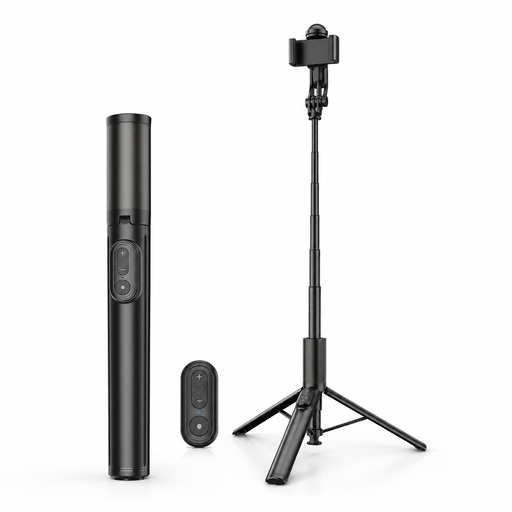
Verbex K60 Black selfie stick with smartphone holder

Verbex K60 Black selfie stick with smartphone holder

This smartphone selfie stick with a stand and zoom remote is designed for hands-free smartphone photography in a fixed setup; it is not described as a remote shutter release for a separate camera.

Before buying, check that your smartphone is within the stated 6.0-inch limit.

Joybuy

Frequently asked questions

Do I need to buy a remote shutter release to photograph figurines by a window?

Not necessarily. First, check whether your camera has a suitable app-based remote control or self-timer; with a fixed tripod setup, a compatible remote can help you avoid touching the camera when taking a shot.

How do I set up a Bluetooth remote?

For the Sony RMT-P1BT, Sony requires you to pair the remote with your camera before connecting for the first time. The menu path and available features may vary by model; if it doesn’t respond, Sony suggests checking the Bluetooth settings, lock switch, pairing and battery, among other things.

What should I check if a wired remote shutter release doesn’t work?

Check your camera’s full model name against the compatibility information and make sure you’re using the right connector. For example, Canon distinguishes between E3 and N3 remotes; for some cameras, Fujifilm specifies that the RR-100 needs an additional adapter.

What extra items might I need to buy?

Check whether your specific camera model needs an adapter and whether a wireless remote runs on batteries. For some models, Fujifilm says the RR-100 needs an additional adapter; for Bluetooth remotes, check the information provided by the relevant manufacturer.

What rights do I have when shopping online in Germany?

When you buy online as a consumer, you generally have a 14-day right to cancel; your statutory rights against the seller are separate from any voluntary guarantee. The Verbraucherzentrale explains these rights and the conditions that apply to each.

What should I look out for when buying electronic accessories?

When monitoring products on the market, the Bundesnetzagentur checks for things including the CE marking, product identification, manufacturer details, and instructions and safety warnings in German. By applying the CE marking, the manufacturer declares that a conformity assessment procedure has been carried out; it is not an independent performance test.