
Lieferung heute & morgen

Qualitätsgarantie

Willkommens-Angebote freischalten: KOSTENLOSE Lieferung | Bis zu 80 % RABATT | Kostenlose 30-Tage-JoyPlus-Testphase
App herunterladen
A modern body composition scale with an app promises to track far more than just your weight. It offers insights into body fat, muscle mass, water percentage, and other health metrics, all visualised directly on your smartphone. However, the market is saturated with models whose promises often fall short in practice. Before you make a decision, it's crucial to understand the common pitfalls that can lead to an unsatisfying purchase.
As your Joybuy Product Recommendation Officer, I'll help you distinguish essential features from superfluous marketing gimmicks, ensuring you find a device that reliably supports your health goals.
Many scales advertise a long list of features, but the devil is often in the details. Pay close attention to these two points to avoid a poor investment:
To separate the wheat from the chaff, you should focus on the following three core aspects. These determine the real-world utility and longevity of your body composition scale.
Nearly every digital scale with BMI and muscle mass uses Bioelectrical Impedance Analysis (BIA). This technology passes a very weak, imperceptible electrical current through the body. Since fat, muscle, and water conduct electricity differently, the scale can estimate the body's composition from the resistance (impedance). The quality of the electrodes and the underlying algorithm are crucial for the consistency of the measurements. For reliable trend analysis, it's more important that the scale delivers repeatable results under the same conditions (e.g., in the morning after waking up) than for it to hit a clinically exact absolute value.
A stable smart bathroom scale Bluetooth connection is essential for seamless data synchronisation. Check if the app receives regular updates and is compatible with current operating systems (iOS/Android). A good app is characterised by intuitive operation, clear graphs for progress tracking, and the ability to create multiple user profiles—a must-have for a diagnostic scale for the family.
While some scales advertise over 20 metrics, most of these are calculated estimates. Focus on the core metrics: weight, body fat percentage, muscle mass, BMI, and perhaps water percentage. A useful additional feature is a body fat scale with heart rate monitoring, as it provides another indicator of cardiovascular fitness. An easy-to-read display, ideally a scale with a colour display that shows key metrics directly, significantly enhances everyday convenience.
Here are some models that represent a considered choice for various user groups based on objective features.
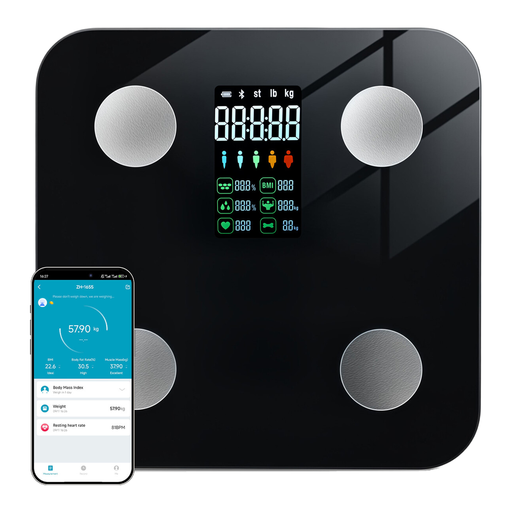
Why This Fits Their Persona: Ideal for users who want a comprehensive overview of their health data. In addition to standard metrics, the scale measures heart rate and seamlessly syncs all data to the app for detailed analysis and trend tracking.
The bright colour display shows the most important metrics (weight, body fat, heart rate) directly on the scale. This means you aren't reliant on the app for every measurement and get immediate feedback.
Integrated heart rate monitoring and a clear colour display offer added value over standard models. Its connection to the widespread Tuya app platform ensures compatibility.
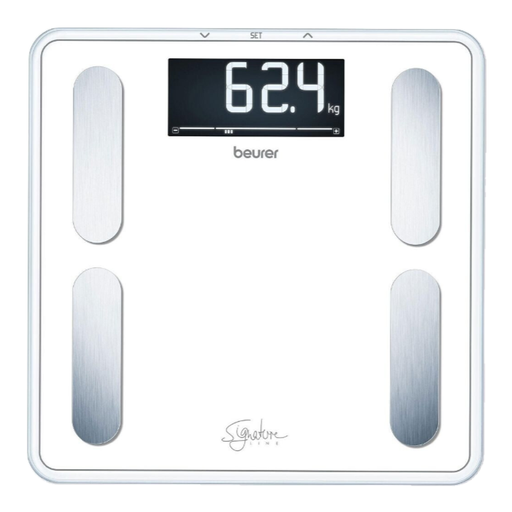
Why This Fits Their Persona: Perfect for families or users who prefer reliable analysis without mandatory app connectivity and cloud storage. The high weight capacity and storage for 10 user profiles directly on the device make it versatile and data-private.
This model bypasses the "poor app" trap, as all core functions and data storage for multiple users are handled directly on the scale. Its functionality is therefore independent of a smartphone.
High weight capacity of 200 kg and 10 user memory slots directly on the device. The large, illuminated XL display ensures excellent readability of all values.
We have compiled a complete, up-to-date list of products that fully meet these strict selection criteria and German safety regulations.
BIA technology provides estimates whose accuracy depends on many factors, such as hydration status, time of day, and skin contact. For personal use, the consistency of measurements for tracking trends is more important than absolute, clinical accuracy. To make results comparable, you should always weigh yourself under the same conditions, for example, right after waking up and after using the restroom.
Most scales with automatic user recognition identify the person based on their last measured weight. If two family members have very similar weights, mix-ups can occur. In this case, most scales or apps offer a manual correction option to assign the measurement to the correct profile.
Read the app's privacy policy before creating an account. Pay attention to where the servers are located (ideally within the EU to be subject to GDPR) and whether the data is processed anonymously. Reputable providers are transparent about what data is collected and how it is used. When in doubt, opt for a model that is fully functional even without cloud synchronisation.