Choosing the right light for you

Photographers dealing with distracting reflections

When photographing glossy resin pendants by a window, you can manage hotspots and visible reflections by adjusting the light source’s position and using diffusion. Shopify Germany recommends considering reflections and lighting when photographing glossy products.

Sellers with lots of colour options

If you want the colours of different pendants to look consistent across a series of images, keep changing daylight, adjustable white light and white balance in mind. Shopify Germany highlights the importance of timing and angle when using natural light, while Nikon Germany recommends adjusting the white balance when lighting conditions change.

Photographers working at a small table by the window

If you often move your shooting spot, the size, mounting options and power supply of your fill light are important considerations. A small battery-powered panel is easier to reposition, but has a smaller illuminated area.

What to look for when buying

When photographing resin pendants by a window, brightness isn’t the only thing that matters. Check that you can position and adjust the light to suit your needs, and compare the colours in a test shot taken under your usual conditions.

What matters What to check before buying Who it matters most to
Reflections and lighting Check for diffusion and an adjustable mount; the panel should be dimmable. If the light source appears as a bright spot reflected in the pendant, I want to be able to change the angle and lighting effect. Around 36% of consumers prioritise reflection control when buying.
Consistent colour Compare the adjustable white-light range and dimming, then check the colours in a test shot. When I photograph several resin colours, I want them to look consistent across the series, even when the daylight changes. Around 29% of consumers put colour consistency first.
Portable fill light Check the size, mounting options, power supply and stated battery life at the brightness you need. At my small table by the window, I want to be able to move the light around without having to rethink my whole setup each time. Around 21% of consumers prioritise a portable fill light when buying.
Setup and accessories Compare what’s included and the package option; check whether a tripod, mount or compatible batteries are supplied. If I want to keep my tabletop setup straightforward, I want to know in advance exactly which accessories are included. Around 14% of consumers prioritise a simple setup and minimal accessory requirements.

Common buying mistakes

  • Assuming a particularly bright panel will eliminate reflections on its own

    The light source can be clearly reflected in glossy pendants. Simply increasing the brightness won’t solve the problem.

    Try adjusting the position and diffusion first, rather than comparing panels on brightness figures alone.

    Depending on your setup, you may also need a diffuser or a suitable mount.

  • Assuming bi-colour or CRI specifications guarantee consistent pendant colours

    Window light changes, and an incorrect white balance can cause colour casts even when you’re using an adjustable light.

    Compare test shots taken in your actual window light, and check the white balance whenever lighting conditions change.

  • Overlooking package options and accessories when comparing products

    With the NEEWER NL660, whether a tripod is included depends on the package option; batteries are sold separately. The NP-F970 batteries required for the Godox LEDP260C must also be bought separately.

    Check what’s included with the specific option against your tabletop setup and power requirements.

    Depending on the model and package, a tripod or compatible batteries may mean extra time and effort to source and set up.

Brands to consider

NEEWER

The NL660 is a larger bi-colour panel suited to a more permanent tabletop setup.

  • NEEWER lists an adjustable range of 3,200 to 5,600 K and dimming. According to the manufacturer, it can be powered by a mains adaptor or separately available NP-F batteries.
  • A tripod is only included with the relevant package option. CRI and illumination figures are manufacturer specifications, not measurements taken on resin pendants.

SmallRig

The P96 is a small bi-colour battery-powered panel for portable fill-light setups.

  • SmallRig lists an adjustable range of 2,700 to 6,500 K, dimming, USB-C and a built-in battery for the P96.
  • Its compact design makes it easy to move around, but it has a smaller illuminated area. The manufacturer says actual battery life depends on how it’s used.

Jinbei

The P30Bi is a bi-colour panel that provides indirect lighting.

  • Jinbei lists an adjustable range of 2,700 to 7,500 K, dimming, and mains or battery power for the P30Bi.
  • The description of a softer lighting effect comes from the manufacturer. Check the accessories and contents for the specific option.

Godox

The LEDP260C is a larger continuous-light panel. Its manufacturer’s manual mentions macro and product photography.

  • The manual lists a colour temperature range of 3,300 to 5,600 K, as well as mains or battery power.
  • The required NP-F970 batteries must be bought separately. According to the manual, the lower dimming range isn’t available with every colour temperature setting.

Ulanzi

The VL49 RGB is a compact option for occasional fill lighting or deliberately colourful accents.

  • Ulanzi lists adjustable white light, dimming and a built-in battery.
  • Its small size and RGB features won’t solve reflection problems by themselves. Make sure you don’t confuse the VL49 RGB with other VL49 options.

Joybuy product picks

This product pick is a compact photo and video light for portable fill lighting at a small table by the window.
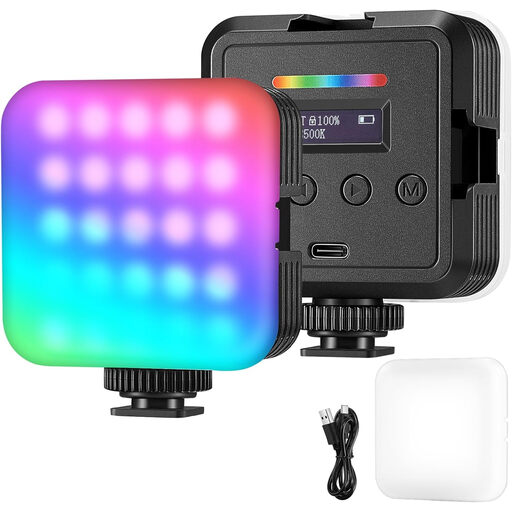
Compact RGB LED photo light for photography and video

Compact RGB LED photo light for photography and video

Its compact, portable design and battery or USB power make it easy to move around a small shooting space.

According to the product specifications, white-light, warm-light and RGB modes are available, and both brightness and colour temperature can be adjusted. Take a test shot to check reflections and colours in your window light.

View at Joybuy

Frequently asked questions

Do I really need an LED panel if I have a bright window?

Not necessarily. If the amount of light and timing work for you, try changing your position or using a diffuser or reflector first. A panel is most useful if you want to brighten shadows selectively or make your shots less dependent on the light coming through the window at any given time.

How should I position the panel and camera to photograph colourful resin pendants?

Start by using the window light as your main light source, then position the dimmed panel so its reflection doesn’t obscure the surface of the pendants. Adjust the LED’s white-light colour to suit the shooting conditions and check the white balance. Retake your test shot if the daylight changes. A Kelvin value alone can’t guarantee identical colours.

What should I consider when it comes to setup and power?

Before buying, check whether a tripod or suitable mount is included for the position you want. When using battery or mains power, only use the power supply specified by the manufacturer for that particular model.

What are my rights if an LED panel is faulty in Germany?

If you buy faulty goods new, consumers can generally assert their statutory rights against the seller within two years. The Verbraucherzentrale distinguishes these legal rights from a voluntary manufacturer’s or retailer’s guarantee. Check the terms of any guarantee for the specific product.

What does the CE marking mean, and how should I dispose of an old LED panel?

The European Union requires a CE marking only for products covered by relevant harmonised rules that require it; it isn’t an independent quality mark. The Bundesnetzagentur lists labelling and manufacturer information among the areas it monitors. In Germany, old electrical equipment must not go in household rubbish. The Umweltbundesamt recommends removing any batteries that can be taken out and handing them in separately for disposal.