For photographing glossy resin pendants on a small table, a diffuser is worth trying first if you have suitable daylight. For consistent results, a foldable LED photo box could be a good fit. A separate softbox gives you more freedom to position the light, but needs extra space. Whichever option you choose, check that it suits your subject, camera angle, power supply and accessory requirements.
Who are these solutions for?
Photographers working with reflective pendants
If bright reflections are obscuring the details of your resin pendant, it’s worth looking at light diffusion and camera angle together. Nikon describes a light tent as one way to diffuse light when photographing jewellery.
Creative people short on table space
If you’re photographing individual small pendants and want to put your setup away afterwards, a foldable photo box is worth considering. NEEWER and Hama both offer boxes for product photography.
Photographers shooting a range of products
If you want to photograph several subjects in controlled conditions or change the direction of the light, your choice will depend on whether you prefer an enclosed box or a separate light modifier. NEEWER describes both designs in its product information.
What should you look for when buying?
Existing light with a diffuser
A good fit if: you mainly shoot in suitable daylight and don’t want to set up an additional electric light just yet.
Bear in mind: a diffuser softens existing light, but doesn’t produce any of its own. Light intensity and direction therefore depend more on your surroundings.
Foldable LED photo box
A good fit if: your pendants and preferred camera angle fit inside the box, and you want an easy-to-repeat setup with built-in lighting.
Bear in mind: the interior and openings limit where you can position the subject, background and camera.
Separate continuous-light softbox kit
A good fit if: you want to position the light freely beside your subject and have room for a light and stand.
Bear in mind: the light and stand need space outside the area where you’re shooting.
Passive softbox light modifier
A good fit if: you already have a suitable light and a stable setup, and only need to add a light modifier.
Bear in mind: the connection and setup must work with your existing light source; the light modifier on its own is not a complete lighting solution.
For shiny jewellery, the walls of a light tent can diffuse the light. Nikon describes this as an option for jewellery photography, not a guarantee that every reflection will disappear. The percentages in the table show how buyers who want to photograph resin pendants on a small table rank these priorities.
| Priority |
What to check before buying |
Who is it most important to? |
| Reflections and contours |
Diffusion surface and access to the subject; options for repositioning the light. |
If you want to control bright reflections while keeping the shape and inclusions visible, this is the top priority for around 33 % of buyers. |
| Space and storage |
Check the external dimensions, interior and openings against your table space and camera angle. |
This is a priority for anyone shooting on a small table who wants to put their setup away afterwards; these buyers account for around 27 %. |
| Consistent lighting |
Check the dimming function and colour temperature of the specific model; keep your camera settings as consistent as possible for a series. |
If you want to photograph several pendants in comparable lighting conditions, this is the main priority for around 20 % of buyers. |
| Everything you need included |
Check the product listing for the light, connection, stand, cable and power adapter. |
Anyone wanting to avoid missing or incompatible parts puts a complete kit first; this applies to around 20 % of buyers. |
Common misconceptions
-
“Softbox” doesn’t automatically mean complete lighting
A passive softbox needs a compatible light source. An essential accessory may also be missing from an LED photo box.
Compare the components listed for the specific product with the equipment you already have.
With a passive softbox, you’ll also need a suitable light and a suitable setup. NEEWER notes that the LB30B doesn’t come with a power adapter.
-
Measuring just the subject isn’t enough
A box also needs to allow access for your preferred shooting angle; a separate stand needs extra space.
Measure your table and check your shooting angle against the box’s external dimensions and openings, or the space available for the stand.
-
Manufacturer claims about colour reproduction don’t guarantee the finished photo
A single CRI value alone doesn’t tell you how colours will look in the finished image.
For a series of photos, keep your lighting and camera settings as consistent as possible, and check the specifications for the specific model.
Key brands at a glance
NEEWER
NEEWER offers both compact photo boxes and a separate softbox kit for small product photography.
- NEEWER says the LB30B has built-in dimmable LEDs, front and top openings, and measures 30 × 30 × 30 cm.
- According to the manufacturer, the LB30B doesn’t include a power adapter. The SF40 kit needs space for a separate setup.
Hama
Hama’s Mini Photo Studio ToGo is a foldable LED photo box for product photography.
- For the 50 × 50 cm model, Hama specifies ten brightness levels and three colour temperature settings.
- Check that the larger box, with enough room for your preferred camera access, will fit on your table.
Rollei
Rollei’s Quick-Fold Softbox is a passive light modifier for a suitable light source you already own.
- Rollei specifies a diameter of 45 cm, a honeycomb grid and a Bowens mount.
- This light modifier isn’t a complete LED photo box or continuous-light kit. Check the connection, light source and setup before buying.
Joybuy products
The foldable LED photo boxes below are designed for small product photography. Compare their stated dimensions and lighting features with your table and the camera angle you need.
 No image available
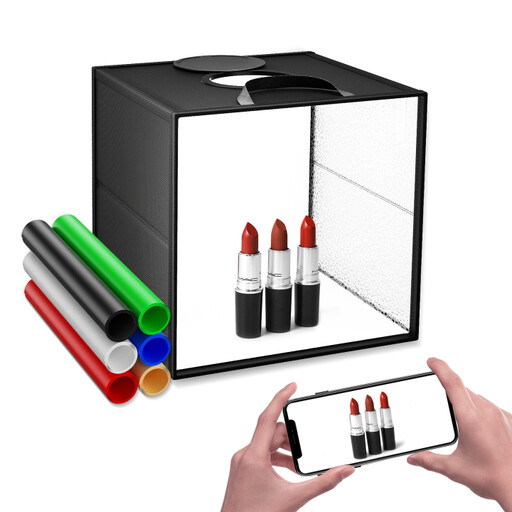
30 × 30 cm photo box with dimmable light
A foldable box for small product photography, with dimmable light and a choice of backgrounds.
30 × 30 cm; Oxford fabric; six coloured backgrounds; dimmable lighting.
View at Joybuy
 No image available
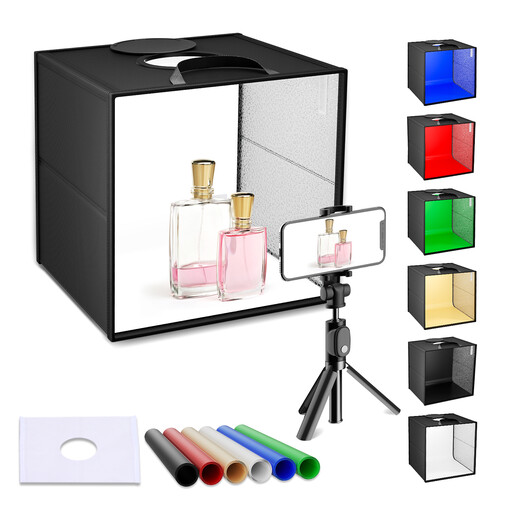
Foldable LED photo box with coloured backgrounds
A foldable LED box for product photography, with coloured backgrounds and adjustable brightness.
Foldable design; LED lighting; adjustable brightness; coloured backgrounds.
View at Joybuy
 No image available
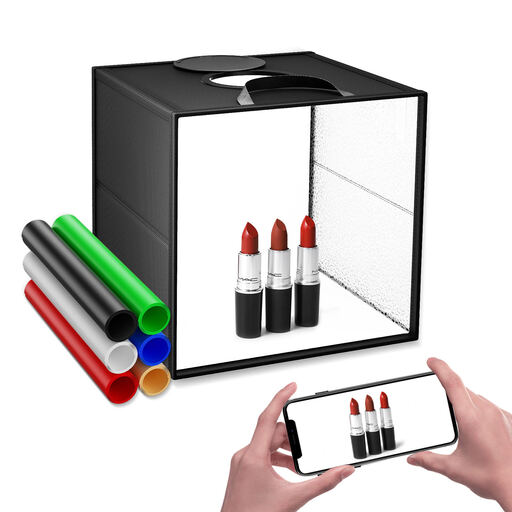
40 cm photo box with 5600K and 120 dimmable LEDs
This foldable box is a good option for product photography if you’re looking for a 40 cm design with dimmable lighting.
40 cm; 5600K; 120 dimmable LEDs; six coloured backgrounds; soft-light cloths.
Allow enough room on your table for the stated box size.
View at Joybuy
 No image available
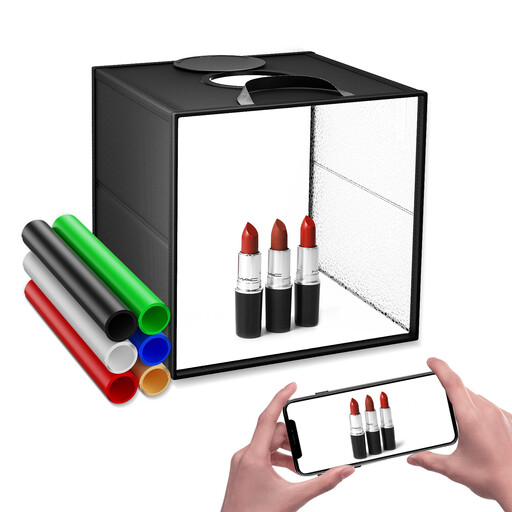
Foldable photo box with soft-light cloths
A foldable box for product photography, with soft-light cloths, coloured backgrounds and adjustable brightness.
Foldable design; coloured backgrounds; adjustable colour temperature and brightness; two shooting windows.
Allow for the space specified in the listing for the particular product.
View at Joybuy
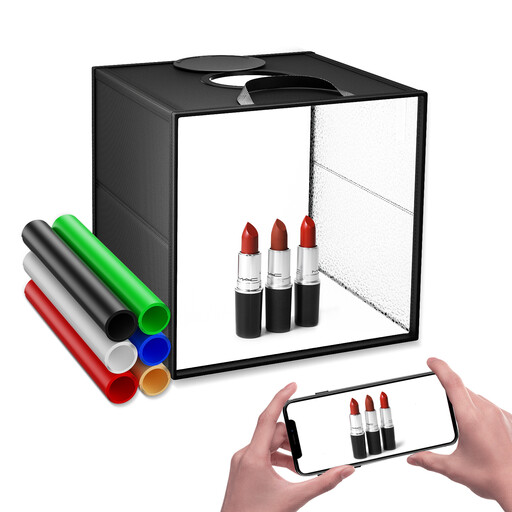 No image available
Foldable photo box with soft light and coloured backgrounds
This foldable box is designed for product photography and could suit you if you want adjustable brightness and colour temperature.
Foldable design; soft light; coloured backgrounds; adjustable colour temperature and brightness.
View at Joybuy
Frequently asked questions
Is an LED photo box the same as a softbox?
No. The NEEWER LB30B is a light tent with built-in LEDs, while the NEEWER SF40 is a separate softbox kit with a light and stand. A passive Rollei light modifier needs a compatible light source.
How can I deal with distracting reflections on resin pendants?
Start by checking the direction of the light and the image from your preferred camera angle. Nikon describes a light tent as one way to diffuse light when photographing jewellery, but it may not remove every reflection completely.
What should I bear in mind about space and power?
If you’re using a separate softbox, allow space for the stand, and check the dimensions of a photo box against your table and camera angle. The manufacturer specifies USB-A power for the NEEWER LB30B and notes that a power adapter isn’t included.
Does every softbox need a CE marking?
No. The European Commission explains that CE marking is only required where the relevant harmonised EU rules specifically call for it. A passive softbox shouldn’t automatically be treated in the same way as an electric light; check the details and usage information for the specific product.


