
Lieferung heute & morgen

Qualitätsgarantie

Willkommens-Angebote freischalten: KOSTENLOSE Lieferung | Bis zu 80 % RABATT | Kostenlose 30-Tage-JoyPlus-Testphase
App herunterladen
For many, a flexible workout that adapts to your daily routine is a key goal. A resistance band with handles offers a versatile solution for training at home, in the gym, or while travelling. It enables an effective full-body workout without the need for heavy weights or bulky equipment.
This article serves as your guide. It presents objective criteria to help you find the right resistance band with handles for your individual training goals—whether for general strength training, yoga and Pilates sessions, or for support in physical therapy.
Choosing the right equipment is crucial for your training success and safety. Three main criteria will help you make your decision.
Resistance is the force the band applies against your movement. It is often indicated by colour or by explicit labels such as "Light," "Medium," or "Heavy."
A Resistance Bands Set that includes multiple strength levels offers the greatest flexibility. It allows you to adjust the resistance based on the exercise and your progress, enabling you to design a progressive training plan.
The durability and safety of a resistance band depend heavily on its material. Most tubes with handles are made from latex or TPE (Thermoplastic Elastomers). TPE is often a great choice for individuals with latex allergies and is known for its high elasticity and tear resistance.
The handles should be ergonomically designed and non-slip. Models with foam padding typically offer superior comfort and a secure grip, even during intense, sweaty workouts. This reduces hand fatigue and allows you to focus on the target muscles.
The most common type is the single, tube-shaped band with a handle at each end. This version is an all-rounder for exercises like bicep curls, shoulder presses, or rows.
Special shapes, like the figure-8 band, are designed for targeted exercises. They are particularly well-suited for training the upper body, shoulders, and arms, as well as for specific stretches in yoga and Pilates. Consider which exercises you plan to do most often to choose the right shape for your resistance training programme.
Based on the criteria above, we have compiled a selection of products that cater to different requirements and training goals.
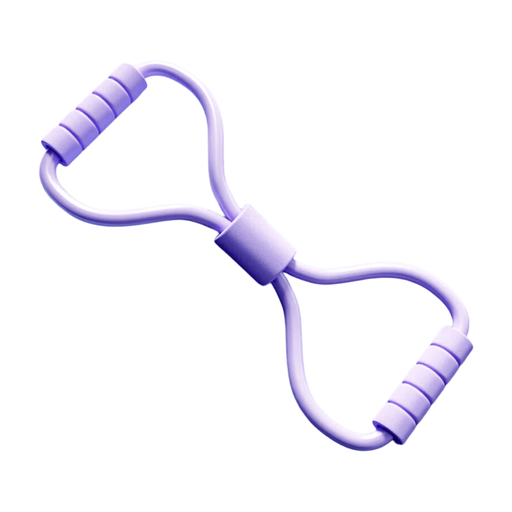
Why it stands out: The special figure-8 design allows for even tension distribution and is ideal for targeted exercises where conventional bands are less practical.
Benefits:
Who it's for: Users looking for a specialised band to train their arms, shoulders, and upper back, or to supplement their yoga and Pilates routine.

Why it stands out: This set offers excellent adaptability for progressive training, thanks to three interchangeable bands with different resistance levels (Light, Medium, Heavy).
Benefits:
Who it's for: Fitness enthusiasts of all levels who are looking for a complete Resistance Bands Set to gradually increase their training intensity and work different muscle groups with the appropriate resistance.
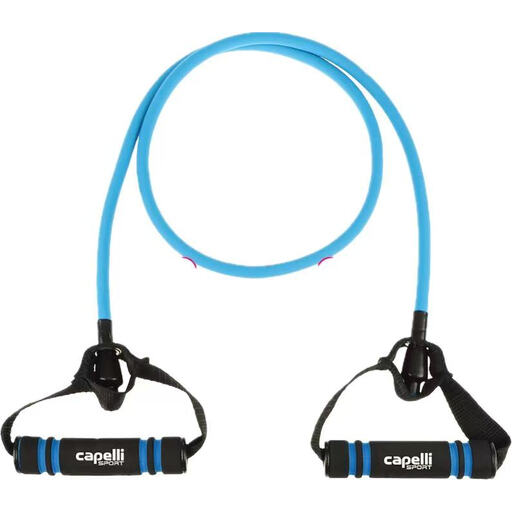
Why it stands out: A classic and versatile resistance tube with handles, its medium resistance makes it suitable for a wide range of fitness and rehab applications.
Benefits:
Who it's for: Beginners and intermediate users looking for a reliable single band for their home workouts. It's a great choice for general fitness, muscle toning, and rehabilitation programmes.
If you haven't found the right model in our selection or want to explore more options, you can find a wider range of products in our Bands with Handles category. There, you can compare different models and resistance levels to find the ideal band for your needs.
A light to medium resistance is generally recommended for beginners. This allows you to focus on clean, controlled form, which is crucial for learning effectively and preventing injury. A set with multiple strength levels is beneficial as it allows you to gradually work your way up to higher intensities.
Yes, building muscle (hypertrophy) is possible with resistance bands. The key is the principle of progressive overload. This means the muscle must be continually exposed to an increasing stimulus. This can be achieved by using a band with higher resistance, increasing the number of repetitions, or shortening the rest periods between sets. Fitness bands for strength training are specifically designed for this purpose.
To maximise the lifespan of your bands, you should inspect them for any tears or signs of wear before each use. After your workout, clean the bands as needed with a damp cloth, avoiding harsh cleaning agents. Store them in a cool, dry place and avoid direct sunlight and extreme temperatures, as this can make the material brittle.