
Lieferung heute & morgen

Qualitätsgarantie
App herunterladen
Kategorien
Resistance bands, also known as exercise or training bands, are versatile fitness tools based on the principle of progressive resistance. Instead of relying on fixed weights, these bands create tension that increases as they are stretched. This allows for joint-friendly and scalable strength training, suitable for both muscle building and for rehabilitation or warm-up exercises. Their compact and lightweight design makes them a functional solution for workouts at home, at the gym, or while traveling.
The right band for you depends on the material, resistance level, and intended use. An informed decision is based on an analysis of these technical parameters.
The material composition significantly determines the feel, durability, and application of the bands.
Thermoplastic Elastomers (TPE) or Natural Latex: These materials are characterized by high elasticity and smooth, progressive resistance. They are highly stretchable and suitable for a wide range of exercises, from light stretching to intense strength training. TPE bands are an alternative for individuals sensitive to natural latex. They are typically available as thin, closed loops (loop bands) or as long, flat therapy-style bands (similar to a TheraBand).
Fabric (Cotton-Polyester Blend): Fabric resistance bands, often called Booty Bands, are designed to be wider and more robust. Rubber threads are woven into the fabric to provide resistance. Their key advantage is their non-slip property. They do not roll up during exercises and offer high comfort against the skin. Their stretch range is less than that of latex bands, providing a more consistent, high resistance for targeted exercises of the leg and glute muscles.
Resistance bands are typically offered in various resistance levels, often indicated by color. A resistance band set offers a clear functional advantage here:
Based on technical specifications and practical utility, we have compiled a selection of resistance bands for various applications.
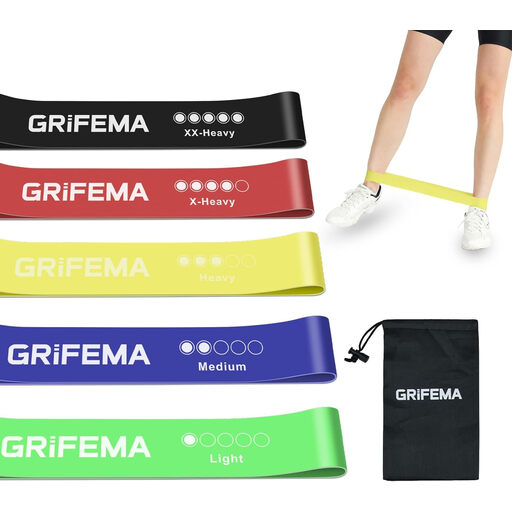
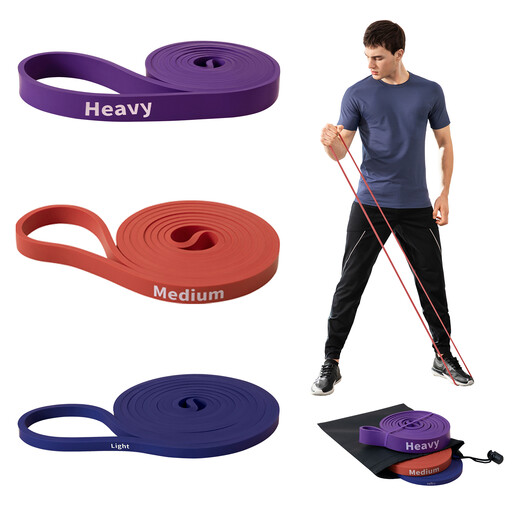
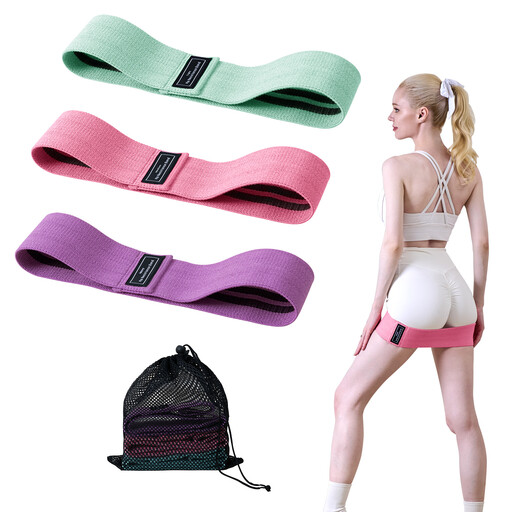
The products featured cover specific use cases. If your requirements go beyond this selection, you can find a wider range of exercise equipment in our main category. There, you can compare other options that may better suit your individual goals.
Discover more products in the Fitness & Gym Equipment category.
1. Which resistance band is suitable for beginners? For beginners, a resistance band set with several, clearly graded resistance levels is recommended. Start with the lightest band to learn proper exercise form. A set of TPE or latex loop bands offers the greatest versatility for getting started.
2. Can resistance bands effectively help with muscle building? Yes. Muscle building (hypertrophy) requires the principle of progressive overload, where the muscle is subjected to a steadily increasing resistance. Resistance bands make this possible by switching to a stronger band or by combining multiple bands. The constant tension throughout the entire range of motion can also provide an effective stimulus for growth.
3. What is the functional difference between latex and fabric resistance bands? The main difference lies in the material and the resulting performance characteristics. Latex bands are highly elastic and offer resistance that increases throughout the full range of motion, making them very versatile. Fabric bands are less stretchy, provide a more consistent and often higher baseline resistance, and are non-slip due to their wide, textile surface. They are therefore particularly well-suited for intense lower-body exercises where preventing the band from slipping is crucial.