
Lieferung heute & morgen

Qualitätsgarantie

Willkommens-Angebote freischalten: KOSTENLOSE Lieferung | Bis zu 80 % RABATT | Kostenlose 30-Tage-JoyPlus-Testphase
App herunterladen
A charger with a retractable USB-C cable can replace several separate items in your rucksack. The integrated cable stays attached to the power adapter, can be stored away after use and helps reduce cable clutter on your desk or in your hotel room. However, models vary considerably in terms of power output, cable mechanism, ports and intended use.
If you only look at a high wattage or particularly compact design, you can easily overlook important details. The following criteria will help you choose the right USB-C fast charger for your smartphone, tablet or laptop.
A rating such as 65 W or 165 W does not always indicate how much power a single device will receive. When several ports are used at the same time, the available power is automatically distributed depending on the model. A laptop may therefore receive less power than when connected on its own.
Pay attention to:
A Power Delivery charger can work with many USB-C devices, provided that the smartphone, tablet or laptop supports the relevant PD profile. Qualcomm Quick Charge, on the other hand, is a separate technology that is mainly relevant for compatible smartphones.
A USB-C port alone therefore does not automatically guarantee maximum charging speed. Check the specifications of both the device and the charger. The additional cable must also be designed to handle the desired power output.
A foldable or retractable charging cable should only be pulled out gently. Excessive force, bending or forcibly guiding the cable back can put additional strain on the mechanism and connectors. The following points are also important:
With permanently integrated cables, the cable usually cannot be replaced independently if it is damaged. An additional USB-C port can partly offset this limitation.
Depending on the model, smartphones and tablets often require less power. A fast charger for laptop and smartphone should, however, provide at least the USB-C PD output required by the laptop. 65 W is suitable for many compact laptops and tablets, while more powerful devices require a charger with a higher output.
With a 165 W laptop power bank, it is particularly important to examine the total power output carefully. For example, a product may distribute 100 W and 65 W across two USB-C ports. Whether this combination is actually available depends on simultaneous use and the manufacturer's specifications.
A charger with several USB-C ports is ideal for anyone who wants to charge a smartphone and tablet or laptop at the same time. A USB-A port can still be useful for older cables, headphones or accessories.
For use in a car, you need a USB-C car charger designed for 12–24-volt vehicle electrical systems. Alongside the maximum power output, check the number of outputs, how easily it can be positioned in the cigarette lighter socket and the cable length.
With the right construction, GaN components allow for a compact design. A 65 W GaN charger can therefore be easier to use in the office and when travelling. However, the technology does not replace the need to check the casing, ventilation and safety features.
Useful specifications include:
A 20,000 mAh power bank should also state its capacity in watt-hours. For air travel, the capacity permitted in hand luggage is crucial; a battery with 74 Wh, for example, is below the frequently relevant 100 Wh limit. The specific requirements of the airline always take precedence.
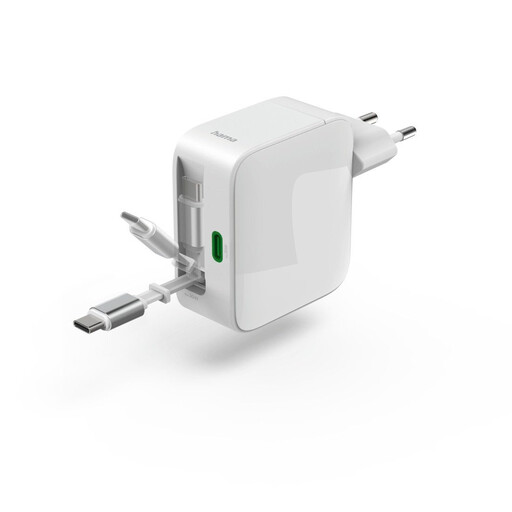
Why this product suits this profile: With 65 W, two USB-C charging options and an integrated cable, this power adapter is practical for everyday use at home, in the office or on short trips.
The power rating is backed up by specific port details: an integrated USB-C cable extending up to 70 cm and an additional USB-C port. When two devices are connected, the power is distributed automatically.
GaN construction, Power Delivery 3.0, Qualcomm Quick Charge 2.0/3.0, Europlug, plus overcurrent, overheating and short-circuit protection according to the product specifications.
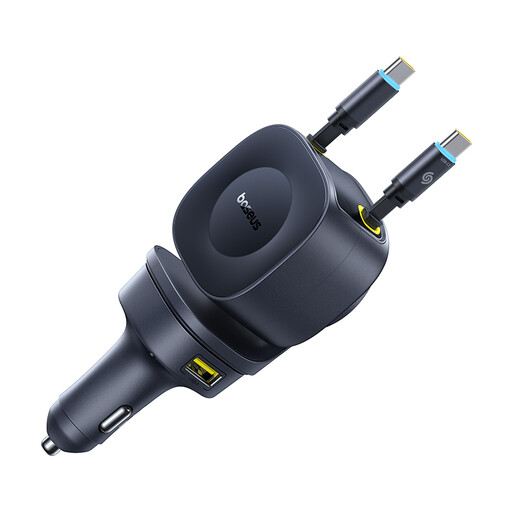
Why this product suits this profile: For commuters and business travellers, this model offers multiple outputs, a retractable cable and adjustable positioning in the vehicle.
Designed for 12–24 V DC, it prevents a standard mains charger from being used in the car. The product specifications also provide specific figures for individual and combined outputs.
Up to 60 W total output, three USB-C ports and one USB-A port, plus a housing that moves 180° vertically and 270° horizontally according to the manufacturer's specifications.
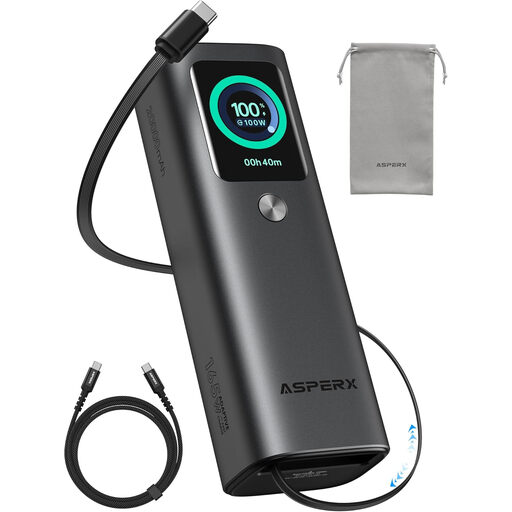
Why this product suits this profile: This power bank is designed for users who want to power a laptop, smartphone and other accessories on the go without access to a mains socket.
Alongside the total power output, the specifications state 74 Wh, two bidirectional USB-C PD ports and a specific cable length of 60 cm. This makes it easier to assess its suitability for travel and laptop use.
20,000 mAh, 165 W total power, two USB-C ports and one USB-A port, plus a TFT display; according to the product specifications, its 74 Wh capacity makes it suitable for air travel.
We've put together a complete, regularly updated list of products that fully meet these strict selection criteria and the safety regulations applicable in the EU.
This depends on the laptop's required USB-C PD profile and the charger's output power. A 65 W model may be sufficient for compatible compact laptops. More powerful devices may require more than 65 W or charge more slowly under heavy load.
There is no standard service life. It is affected by pulling force, bending angle, frequency of use and dust in the mechanism. Pull the cable out straight, do not force it back into place and do not use it beyond the specified length.
Power consumption mainly depends on the connected device, its charge level and the efficiency of the power adapter. A small amount of standby power may be consumed when idle. If it will not be used for an extended period, it is advisable to unplug the charger from the socket.