Players with an analogue console
If your console outputs Composite or S-Video and you have a recording PC, look for a grabber with the right input. The video standard and computer compatibility also need to suit your planned setup.


Start by checking your console’s video output: for Composite or S-Video, a USB analogue video grabber connected to a PC may be suitable, while a HDMI capture card needs an appropriate signal converter first if your source is purely analogue. If you don’t have a recording PC, a standalone recorder could be an alternative; check its inputs and supported storage media. If you want to play on a separate screen, the whole signal chain needs to be compatible – not just the stated recording resolution.
If your console outputs Composite or S-Video and you have a recording PC, look for a grabber with the right input. The video standard and computer compatibility also need to suit your planned setup.
An HDMI capture card may be suitable for a console with a compatible HDMI output, or with a signal converter connected first. If you want to play on a separate screen while recording, make sure the connections throughout the chain work together.
If you don’t want a recording PC in your spare room, a standalone recorder could be a good fit. The key considerations are the video input you need and a compatible storage medium.
Suitable if: Your console outputs Composite or S-Video and you have a compatible recording PC.
Trade-off: An analogue connection may save you from needing an HDMI converter, but it won’t necessarily offer HDMI passthrough for a separate screen.
Suitable if: You want to connect an analogue console signal to an HDMI recording setup, or already have a suitable HDMI output.
Trade-off: With an analogue source, you’ll need extra equipment and connections. Check compatibility with your specific console and the entire signal chain.
Suitable if: You want to record directly in your spare room without a recording PC.
Trade-off: Whether it suits your setup depends on the inputs and supported storage media of the specific model.
| Requirement | What to check before buying | Who it matters most to |
|---|---|---|
| Direct analogue connection | Check your console’s output, Composite or S-Video connection, suitable audio plugs, video standard and supported operating system. | If I want to record an analogue console on my PC without an unnecessary HDMI converter, I’ll pay particular attention to the inputs. Around 36% of consumers have this as their main requirement. |
| HDMI signal chain | Check the console’s output format, the video processor’s supported inputs and output, and the capture card’s HDMI input together. | If I want to include my analogue retro console in an HDMI recording setup, the signal conversion needs to work with both the console and the capture card. Around 29% of consumers rank this as their top requirement. |
| Recording without a PC | Check the recorder’s HDMI or Composite input, power supply and supported storage medium. | If I want to record in my spare room without a recording PC, the inputs and compatible storage medium are crucial. Around 21% of consumers prioritise recording without a PC. |
| Separate gaming screen | Check HDMI passthrough, the connections for your source and screen, and any preview settings on your PC. | If I want to play on a separate screen while recording, I’ll check the planned connection route and distinguish it from the software preview. Around 14% of consumers prioritise this requirement. |
An HDMI capture card needs a compatible HDMI signal. If your console is purely analogue, you’ll need a suitable signal converter before the card.
First check your console’s actual video output, then plan the complete signal chain.
Depending on your console, you may need an extra signal converter, suitable cables and a power supply.
Support for a particular video standard or format alone doesn’t guarantee that a specific console and cable combination will work. RetroTINK provides specific guidance on certain console signals and using S-Video cables with PAL consoles.
Check the details for your console model, output and cable, then test the specific combination.
AVerMedia explicitly excludes USB flash drives as a storage medium for the EzRecorder 330.
Before buying, check the storage medium you want to use against the specifications for the specific recorder model.
If your existing USB stick isn’t supported, you’ll need to plan for another compatible storage medium.
Specifications for an HDMI capture card and PAL recordings from an analogue grabber refer to different devices and stages of the signal chain. A high capture card resolution won’t automatically change your console’s output signal.
Check the source signal, signal conversion and actual recording format separately. Choose a capture card resolution that suits your setup.
Hauppauge offers both analogue USB recording devices and standalone HDMI recording models.
AVerMedia offers the DVD EZMaker 7 C039 analogue USB grabber and the EzRecorder 330 ER330 standalone recorder.
The Game Capture 4K S is designed for an HDMI recording and passthrough setup with a computer.
The RetroTINK-2X Pro is a video processor that could be used before an HDMI capture card; it isn’t a capture card itself.
This selection includes HDMI capture cards for a PC setup with a compatible HDMI signal. If your retro console is purely analogue, you’ll need a suitable signal converter first.
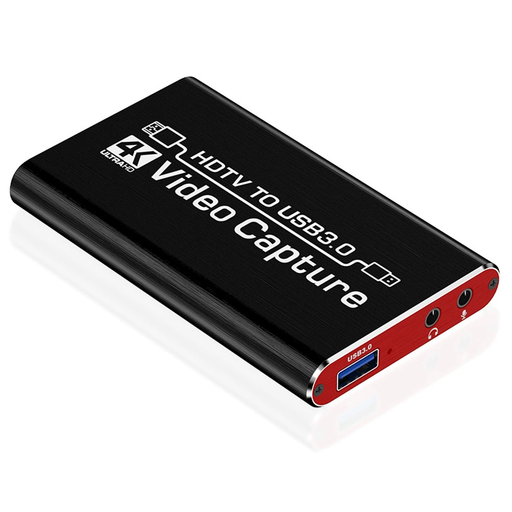 Image unavailable
For recording on a computer with a compatible HDMI signal and HDMI passthrough to a separate screen.
HDMI input up to 4K 30 Hz; recording at 1080p 60 Hz; USB 3.0.
If your console has a purely analogue output, you’ll need a suitable signal converter before the HDMI input.
 Image unavailable
For a PC setup where the console or a video processor connected first provides a compatible HDMI signal.
4K passthrough; 1080p recording; USB 3.0. Compatible with Windows, macOS and Linux according to the product description.
If your console has a purely analogue output, you’ll need a suitable signal converter before the HDMI input.
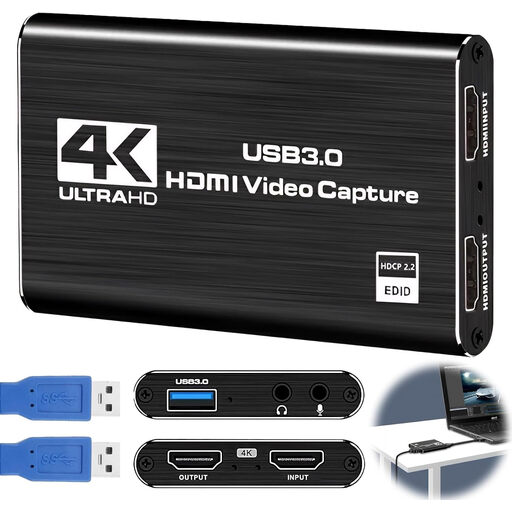 Image unavailable
For HDMI recording on a computer. Before buying, check that the microphone input and headphone output suit your planned setup.
Recording up to 1080p; 4K HDMI passthrough; USB 3.0; UVC and UAC support according to the product description. With microphone input and headphone output.
If your console has a purely analogue output, you’ll need a suitable signal converter before the HDMI input.
In OBS, add a Video Capture Device source and select the connected device. In its driver or settings, check that you’ve selected the correct Composite or S-Video input and a supported recording format. A short test recording lets you check the picture and sound together; the available options depend on the device.
If your console doesn’t provide a compatible HDMI signal, you’ll need a signal converter that suits the console before the HDMI capture card. For the RetroTINK-2X Pro, make sure you have a suitable power source and the right cables. For connecting a screen, Elgato specifies a second HDMI cable for the Game Capture 4K S. Check the connections for your specific console and cable setup.
For the AVerMedia EzRecorder 330, the manufacturer lists Micro SD, external drives and NAS, but explicitly excludes USB flash drives. Before buying, check that your chosen medium is supported and which cables and accessories are included. Check service terms with the relevant seller.
Under certain conditions, Section 53 of the German Copyright Act (UrhG) allows individuals to make individual copies for private use, but this doesn’t mean that every recording or publication is automatically permitted. Section 95a of the UrhG protects effective technological measures against circumvention under the conditions set out in that section. These provisions are included in the version of the legislation provided by the Federal Ministry of Justice and the Federal Office of Justice. Whether a specific recording can be uploaded publicly depends on the rights involved in the game, music and any other content.