
Lieferung heute & morgen

Qualitätsgarantie

Willkommens-Angebote freischalten: KOSTENLOSE Lieferung | Bis zu 80 % RABATT | Kostenlose 30-Tage-JoyPlus-Testphase
App herunterladen
In many new vehicles, high-quality ambient lighting is a premium feature that significantly contributes to the interior atmosphere. However, those who drive an older model or opted out of this extra at the time of purchase don't have to miss out on this comfort. Retrofitting car ambient lighting is an accessible way to individualise and visually enhance your own vehicle. This article serves as a guide to selecting a suitable retrofit kit and presents various options designed for functionality and ease of installation.
The market offers a multitude of solutions that differ in technology, control, and scope. To make an informed decision, several technical aspects should be considered.
The type of light generation determines the visual effects.
Operation is a key factor for user convenience. Car interior lighting with app control has become standard. Look for a stable Bluetooth connection and an intuitive app interface. Features like a music mode, where the lighting reacts to ambient sounds, brightness control, and the ability to save custom colour scenes significantly increase its utility.
Retrofit kits use different types of light sources. Classic interior car fiber optics are flexible and are wedged into the gaps of the dashboard and door panels. More modern sets use flat acrylic light bars, which often provide more uniform and brighter illumination. A complete kit should include not only strips for the dashboard but also for the doors and, ideally, an option for retrofitting footwell lighting. This ensures a cohesive overall look and is an important aspect of tuning your car's interior.
Based on the criteria mentioned, we have compiled a selection of products that are well-suited for retrofitting due to their feature set and design.

What makes it stand out: This 22-in-1 kit is a comprehensive solution for complete interior illumination. It uses bright acrylic light bars instead of traditional fiber optics and offers dual-zone control. This allows the main light bars and auxiliary lighting (e.g., footwell) to be operated simultaneously in different colours or modes. Control is managed via the "LED LAMP" app.
Advantages:
Who it's for: This kit is aimed at users looking for an all-in-one solution to equip the entire vehicle interior with dynamic and bright RGB ambient lighting.
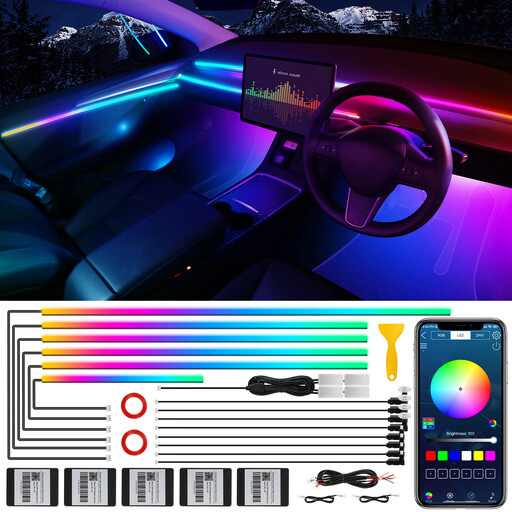
What makes it stand out: The 10-in-1 kit offers a flexible combination of app control and a physical touch button. Complex settings can be configured via the "LotusLamp X" app, while the discreetly placed button allows for quick colour changes or switching specific zones on and off. This kit also uses bright acrylic strips and Dreamcolor technology.
Advantages:
Who it's for: Ideal for users who appreciate having a quick, physical control option for basic functions in addition to comprehensive app control.
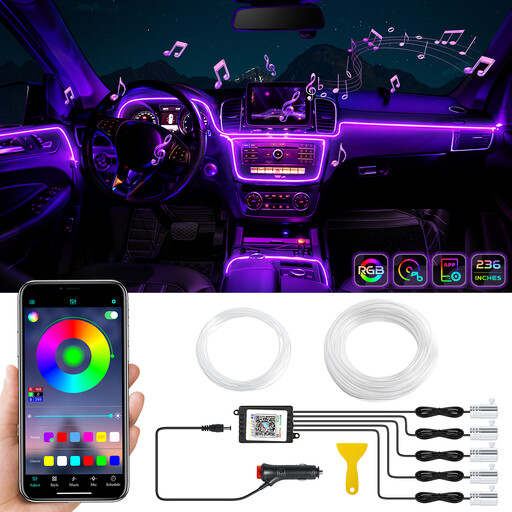
What makes it stand out: This 5-in-1 kit relies on a long, continuous interior fiber optic tube (6 metres) that can be cut to size and distributed among the five included LED light sources. This flexibility makes it a great choice for custom DIY projects. Control is handled via the "Lotus Lantern" app, which offers 29 preset modes and a choice of 16 million colours.
Advantages:
Who it's for: This kit is a great choice for DIY enthusiasts looking for a flexible and cost-effective solution for a custom lighting project.
If the configurations presented here don't exactly match your needs or if you are looking for more specific lighting solutions, you can find a wider selection of products for vehicle customisation in our Neon LED Lights category.
1. Can ambient lighting be retrofitted in any car? Yes, most retrofit kits available on the market are designed as universal solutions and are suitable for all vehicle brands and models with a 12V electrical system. The flexible fiber optics or trimmable strips can be adapted to the specific conditions of any interior.
2. How is the power for the LED interior lighting supplied? Power is typically supplied in one of two ways. The simplest method is to connect it via an included adapter to the 12V cigarette lighter socket (plug-and-play). For a permanent and hidden installation, the control units can also be wired directly to the vehicle's fuse box. However, this should be done by someone with the appropriate knowledge or by a professional workshop.