
Lieferung heute & morgen

Qualitätsgarantie

Willkommens-Angebote freischalten: KOSTENLOSE Lieferung | Bis zu 80 % RABATT | Kostenlose 30-Tage-JoyPlus-Testphase
App herunterladen
Custom interior lighting can significantly enhance the driving experience and give your vehicle a personal touch. However, the market for retrofit kits is saturated and confusing. Anyone looking to retrofit ambient lighting in their car is often faced with a flood of products making bold promises. Many of these, however, turn out to be a bad investment. This guide will help you separate the wheat from the chaff and make an informed decision.
Before you spend any money, you should be aware of the typical flaws that frequently occur with cheap retrofit kits and can quickly dampen your initial enthusiasm.
To avoid the problems mentioned above, you should check three core technical aspects before buying. These are the primary determinants of the quality, longevity, and user-friendliness of your new ambient lighting.
The technology of the light guide is crucial for achieving an even light distribution.
Also, make sure the strips can be trimmed to size so you can fit them precisely to the contours of the dashboard, doors, or centre console.
The flexibility of your system depends on the control options. A good RGB LED strip for cars offers multiple options:
The easiest and safest installation method for most users is connecting via a USB or Type-C port. These kits are universally compatible and require no interference with the vehicle's electrical system. Check the contents of the box: are all necessary cables, controllers, and an installation tool (e.g., a pry tool for fitting into gaps) included? Comprehensive kits for retrofitting footwell lighting should also include separate, sufficiently long strips for this area.
Based on the criteria above, we have identified some products that are suitable for different users and applications.
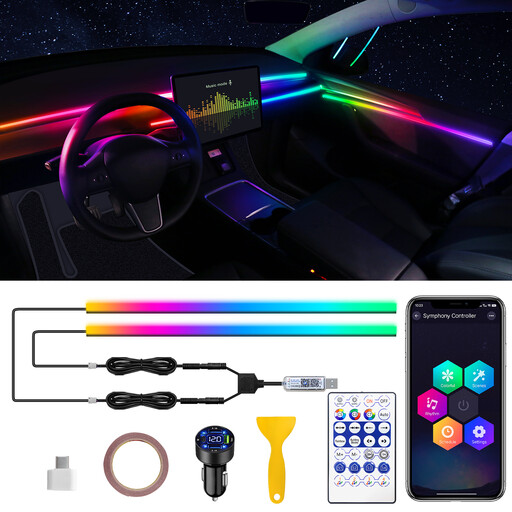
Why This Fits Their Persona: Ideal for users looking for a simple and effective upgrade for their dashboard. Thanks to the USB/Type-C connection, installation is straightforward and requires no prior experience. Perfect for trying out the concept of ambient lighting without a major commitment.
The acrylic light guide ensures even light distribution without hotspots. The simple plug-and-play approach via USB bypasses the complexity of a 12V connection.
Dreamcolor effects controllable via app; simple installation; powered by USB/Type-C.

Why This Fits Their Persona: For vehicle owners who want a complete and integrated solution for the entire interior. This 18-in-1 kit covers the dashboard, doors, footwells, and storage compartments, allowing for comprehensive personalisation.
The system uses multiple controllers to ensure consistent brightness and stable control throughout the vehicle. The acrylic strips guarantee a homogeneous look.
Comprehensive 18-in-1 set for the entire interior; dual-zone control for different colours/modes in various areas; stable app connectivity.

Why This Fits Their Persona: For tuning fans and DIY enthusiasts who want to achieve a unique and eye-catching effect. Retrofitting a starlight headliner is a challenging project that fundamentally transforms the vehicle's interior and creates a real showstopper.
This kit uses a powerful 32W light engine and 600 individual fibre optic strands to create a dense and bright star distribution. The integrated "twinkle" effect simulates a realistic sparkle.
RGBW LEDs for pure white light; twinkle function for a realistic sparkle; control via app and RF remote; high number of light points (600 pieces).
We have compiled a complete, up-to-date list of products that fully meet these strict selection criteria and safety regulations.
Retrofitting LED interior lighting is generally permitted as long as it does not compromise road safety. According to road traffic regulations, the lighting must not blind or distract the driver. Furthermore, no light should be visible from the outside that could irritate other road users or be mistaken for signal lights. The systems presented here are designed for the interior and are compliant when installed correctly.
The effort varies greatly. Simple kits with a USB connection can usually be installed in under an hour. The light strips are wedged into existing gaps on the dashboard or doors, and the cables are discreetly routed to the USB port. Comprehensive kits (e.g., 18-in-1) or a starlight headliner require significantly more time, as trim panels must be removed and cables routed throughout the entire vehicle.
Yes, most acrylic and fibre optic strips can be cut to the required length. With acrylic strips, it is important to follow the manufacturer's instructions to avoid damaging the integrated electronics. Cutting fibre optics is straightforward, as the light simply exits at the end of the fibre. It is advisable to test the function before making the final cut.