
Lieferung heute & morgen

Qualitätsgarantie

Willkommens-Angebote freischalten: KOSTENLOSE Lieferung | Bis zu 80 % RABATT | Kostenlose 30-Tage-JoyPlus-Testphase
App herunterladen
High-quality ambient lighting can significantly enhance the driving experience, adding a modern, custom touch to any vehicle. Retrofitting is an especially popular option for older models that weren't factory-equipped with this feature. However, the market for DIY kits is confusing and filled with products whose marketing promises often fall short in practice. Before making a purchase, it's crucial to understand the common pitfalls.
Many vehicle owners invest in a kit, only to find that the result doesn't meet their expectations shortly after installation. These three flaws are particularly common:
ambient lighting with app control feature is a cornerstone of modern systems. With low-quality products, however, the companion app is often buggy, constantly loses its Bluetooth connection, or has a poorly translated user interface. Promised features like dynamic color gradients then become unusable.To avoid these problems, you should carefully examine three technical aspects before buying. These largely determine the quality, longevity, and visual outcome of your new LED car interior lighting.
The type of light guide is crucial for even light distribution.
A well-designed control system significantly simplifies installation and ensures a clean final result.
footwell lighting are then connected directly to the respective sub-controller. This drastically reduces cable clutter and simplifies the power supply.The LED technology determines the variety of displayable effects.
RGB LED strip for cars can only display a single colour across its entire length at any given time.Dreamcolor car lighting, has IC chips that allow individual segments of the LED strip to be controlled independently. This enables multiple colours to be displayed simultaneously and creates dynamic effects like flowing color gradients, rainbows, or chasing light animations.Based on the criteria above, we have identified several products suitable for different user profiles and applications.
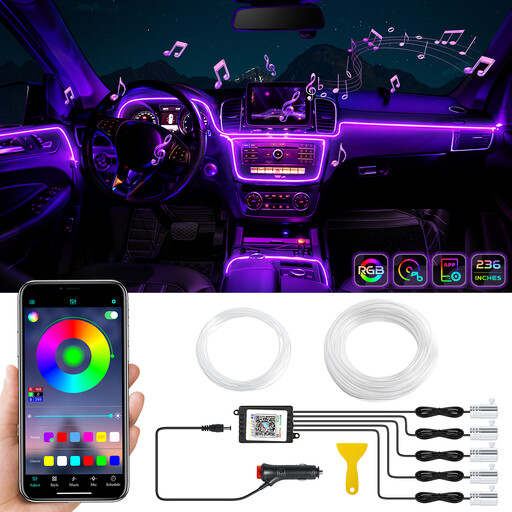
Why This Fits Their Persona: Ideal for users who want a straightforward and quick upgrade. The kit focuses on the essential elements and is flexible enough for dashboards and centre consoles, thanks to its long, cuttable light guide. Powering it via the 12V socket eliminates the need for complex modifications to the onboard electronics.
The kit bypasses the "plug-and-play" problem by using a simple power supply via the cigarette lighter. The continuous light guide, inserted into a transparent tube, ensures more uniform light distribution than simple LED strips.
Easy Installation: No direct connection to the fuse box is required. Flexibility: The 6-metre light guide can be custom-cut and distributed across up to 5 LED sources.

Why This Fits Their Persona: For vehicle owners aiming for a comprehensive and integrated solution. This 22-in-1 kit covers the dashboard, doors, door handles, storage compartments, speakers, and footwells, creating a cohesive look that rivals a factory installation.
The modular system, with one main controller and four sub-controllers, prevents cable clutter. The acrylic light guides provide bright, even illumination without hotspots. The RGBIC technology enables dynamic "Dreamcolor" effects.
Comprehensive Kit: Includes lighting for nearly all relevant areas of the interior. Dual-Zone Control: Different areas can light up in various colours or modes simultaneously.

Why This Fits Their Persona: For those who want more than just light strips and aim to create a true eye-catcher. This kit allows you to `retrofit a starlight headliner in your car`. It's the most elaborate but also the most custom form of interior lighting, transforming the vehicle's headliner into a sparkling firmament.
This kit is inherently complex, but its design with 4 separate light sources for 4 fiber bundles allows for a targeted and even distribution of "stars" across the entire headliner. The app and remote control are tailored for its specific functions (e.g., twinkling effects).
Unique Aesthetics: Creates a distinctive starlight headliner effect. 4-Zone Control: The four light sources can display different colours, enabling complex colour scenarios on the headliner.
We have compiled a complete, up-to-date list of products that fully meet these strict selection criteria and all applicable safety standards.
The installation time heavily depends on the scope of the kit and your DIY experience. A simple kit for the dashboard (e.g., powered by USB or a 12V socket) can be installed in 1-2 hours. A comprehensive 18-in-1 or 22-in-1 kit that requires removing door and centre console trim can take 4-8 hours or more. Retrofitting a starlight headliner is the most complex project and can take an entire weekend, depending on the vehicle.
Modern LED systems are very energy-efficient. A complete ambient lighting kit typically has a power consumption of less than 15 watts. For a standard car battery with 50-70 ampere-hours (Ah), the load during operation is minimal. Most kits are designed to turn on and off with the ignition or have low standby power, so they won't drain the battery during normal use.
Yes, most acrylic or fiber optic light guides are cuttable. However, it's important to follow the manufacturer's instructions. Some acrylic strips have resistors at the end. If you cut it too short and remove a resistor, the last segment of the strip may no longer light up correctly or its colour will no longer be synchronised. It is recommended to always leave a little extra length and test the cut in an inconspicuous area.