
Lieferung heute & morgen

Qualitätsgarantie

Willkommens-Angebote freischalten: KOSTENLOSE Lieferung | Bis zu 80 % RABATT | Kostenlose 30-Tage-JoyPlus-Testphase
App herunterladen
As a Joybuy Product Recommendation Officer, my role is to provide you with clear, objective information. If you're concerned about the quality of your tap water—whether due to limescale, unwanted substances, or simply the taste—a reverse osmosis system can be a solution worth considering. This article serves as a guide to help you understand how these systems work and identify the key features for making an informed choice.
Choosing the right drinking water filtration system depends on several technical factors. Here are three key points to consider in your decision.
The capacity of a reverse osmosis system is often measured in GPD (Gallons Per Day). One gallon is approximately 3.785 litres. A 600 GPD water filter can therefore purify up to 2,271 litres of water per day. This is an indicator of the flow rate—how quickly a glass of water can be dispensed. For a typical household, a value between 400 and 600 GPD is often a good benchmark for a swift water supply without long waits.
Equally important is the pure water to wastewater ratio. Modern systems operate much more efficiently than older models. A 2:1 ratio means that for every two parts of pure drinking water, only one part of wastewater is produced. This is not only better for the environment but also for your wallet.
Traditional reverse osmosis systems use a storage tank to keep purified water on hand. A tankless reverse osmosis system offers significant advantages here:
Most of these systems are designed as under-sink water filters and are connected directly to the cold water line.
A modern water filter with a faucet often offers more than just dispensing water. Smart faucets, for example, can display the filter status or water quality in real time. A key metric here is the TDS (Total Dissolved Solids) value, which indicates the total amount of dissolved solids in the water. Effective TDS reduction is a core feature of reverse osmosis.
Look for recognised certifications like those from NSF/ANSI. The NSF/ANSI 58 standard specifically relates to the reduction of TDS and various contaminants by reverse osmosis systems, while NSF/ANSI 372 confirms the use of lead-free materials.
Based on the criteria above, we have selected a product that is an excellent choice for demanding households due to its technical specifications and feature set.
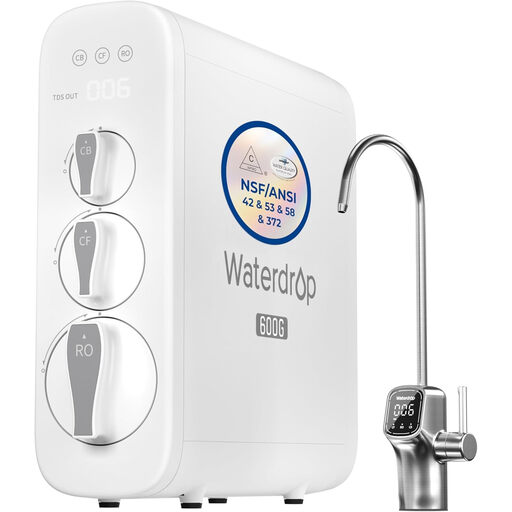
Why It Stands Out
The Waterdrop G3P600 system combines high filtration capacity with a thoughtful, space-saving design. Its tankless construction and high flow rate of 600 GPD ensure that fresh, filtered water is always available quickly. A particular highlight is the smart LED faucet, which displays the TDS value in real time and provides information on the remaining filter life.
Advantages
Who Is It For?
This system is aimed at households looking for a durable and high-performance water purification solution. It is particularly suitable for people in areas with hard water who want an effective water softener and contaminant filter in one device. This model is also an excellent choice for tech-savvy users who value smart features like the real-time TDS display.
View Details for the Waterdrop G3P600
In addition to a powerful drinking water filtration system, the right water storage can also play a role in your household. If you are looking for containers or other storage solutions, you can find more options in our category.
Discover Our Selection of Water Tanks
A classic water softener usually works on the principle of ion exchange. It exchanges calcium and magnesium ions, which are responsible for water hardness, for sodium ions. Its primary purpose is to protect household appliances and pipes from limescale buildup. A reverse osmosis system, on the other hand, forces water through a semi-permeable membrane that filters out not only limescale but also a wide range of other substances like heavy metals, chlorine, pesticides, and bacteria to a very high degree. It is therefore primarily used for producing high-purity drinking water.
A high-quality reverse osmosis system can achieve TDS reduction of over 90%. The TDS (Total Dissolved Solids) value measures the sum of all dissolved inorganic and organic substances in the water. A low TDS value (e.g., below 50 ppm) is an indicator of very pure water, which is often perceived as particularly soft and neutral in taste.
Installation requires basic DIY skills. Typically, a hole must be drilled in the countertop or sink for the additional faucet. The system is also connected to the cold water line and the sink's drain. Most systems require a power outlet under the sink. While the included manuals are often detailed, hiring a professional plumber can be a good idea to ensure a proper, leak-free installation.