
Lieferung heute & morgen

Qualitätsgarantie

Willkommens-Angebote freischalten: KOSTENLOSE Lieferung | Bis zu 80 % RABATT | Kostenlose 30-Tage-JoyPlus-Testphase
App herunterladen
RGB LED strips with colour-changing capabilities are a popular way to give any room a personal touch. Whether for atmospheric, indirect lighting in the living room, dynamic gaming room lighting, or as a TV backlight – the applications are versatile. However, the market is crowded, and not every product delivers on its promises. Before you make a decision, it's crucial to understand the typical weak points that often only become apparent after the purchase.
This guide, created by the Joybuy Product Recommendation Officer, will help you separate marketing hype from solid product features and make an informed choice.
Many buyers experience disappointments shortly after their purchase that could have been easily avoided with a little prior knowledge. Pay special attention to these three points:
self-adhesive LED tape that detaches from the wall or furniture after just a few weeks or months. Low-quality adhesive strips fail quickly, especially on rough surfaces, in corners, or when exposed to slight heat (e.g., behind a television).RGB light strips often show visible defects in light quality. The results are unevenly lit sections, a "patchy" light pattern, or inaccurate colour mixing, where, for example, a pure white cannot be displayed and instead appears bluish or yellowish.LED strip with remote is standard, but simple infrared models have a short range and require a direct line of sight. They also often offer only basic functions. The lack of a light strip with app control significantly limits the possibilities for automations, timers, or synchronisation with music.To avoid the problems mentioned above, you should carefully check three technical features before buying. These are the key determinants of the quality and longevity of your new ambient lighting.
LED density, specified in LEDs per metre, is a crucial factor for homogeneous illumination. Strips with a low density (e.g., 30 LEDs/m) often create visible light dots, or "hotspots," which can be particularly distracting for indirect lighting with colour change. For a uniform band of light, densities of 60 LEDs/m or more are recommended. The luminous flux, measured in lumens (lm), indicates the brightness. Compare this value if you plan to use the strip not just for accent lighting but also for functional light.
The control method significantly impacts user convenience.
This is an often overlooked but important difference:
gaming room lighting, RGBIC technology is often the better choice.Based on the criteria above, we have compiled a selection of products suitable for different user profiles and requirements.
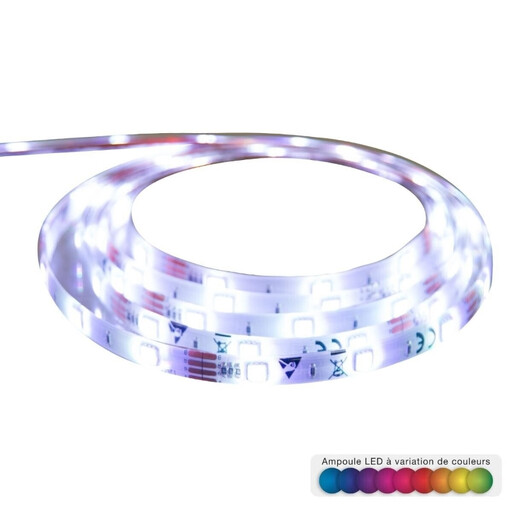
Why This Fits Their Persona: Ideal for users looking for a straightforward and cost-effective solution for their first accent lighting projects, such as behind a desk or along a shelf. The set is complete and ready to use out of the box.
This set avoids the trap of complex controls by offering a simple IR remote that is sufficient for basic colour changes and modes. It's an honest plug-and-play product without exaggerated claims.
Complete package including a mains plug and remote control; simple installation with no technical knowledge required.
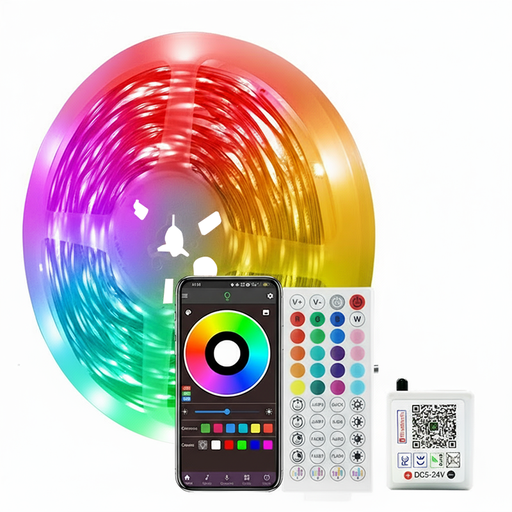
Why This Fits Their Persona: Perfect for users who want to seamlessly illuminate an entire room, a ceiling cove, or large pieces of furniture. The 20-metre length (2x10m) offers plenty of scope for ambitious decor projects.
Solves the problem of colour and brightness inconsistencies that can arise when connecting multiple short strips. The dual control via app and remote offers flexibility and bypasses the limitations of pure IR solutions.
Large total length of 20 metres for a continuous installation; flexible control via Bluetooth app with music sync and timer, as well as by remote control.
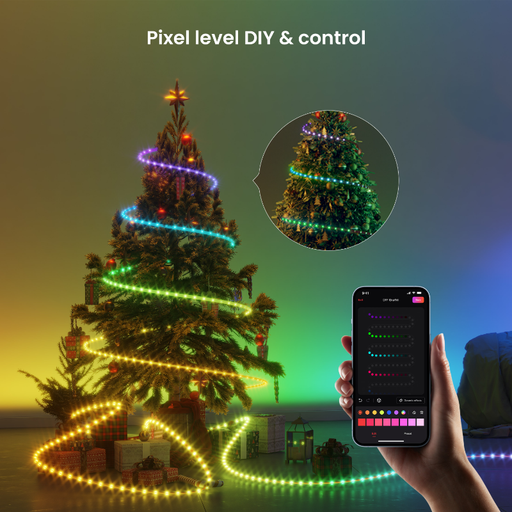
Why This Fits Their Persona: For users who value maximum customisation, dynamic lighting effects, and smart home integration. Ideal for immersive gaming setups or as sophisticated TV backlighting.
Thanks to RGBIC technology, this avoids the trap of monotonous, single-colour lighting. It allows for flowing colour gradients and complex scenes that are not possible with standard RGB strips. The smart app control is far more powerful than a simple remote.
Advanced RGBIC technology for segmented colour control and dynamic effects; compatibility with popular gaming platforms and smart home systems.
We have compiled a complete, up-to-date list of products that fully meet these strict selection criteria and UK safety regulations.
1. Can you cut LED strips? Yes, most LED strips can be cut with a standard pair of scissors at the designated markings (often indicated by a scissor symbol). Note that the cut-off section cannot typically be reused without special accessories (connectors). Only cut the strip when it is disconnected from the power source.
2. What is the lifespan of RGB LED strips? The lifespan of LEDs is usually specified in operating hours and ranges from 20,000 to 50,000 hours for quality products. With six hours of daily use, this equates to a lifespan of over nine years. Factors such as good heat dissipation and avoiding overvoltage can positively influence the lifespan.
3. Do self-adhesive LED tapes require special surface preparation? Yes, preparing the surface is crucial for optimal and long-lasting adhesion. The surface should be clean, dry, and free of dust and grease. It's best to clean the surface with a mild cleaning agent or isopropyl alcohol and let it dry completely before applying the self-adhesive LED tape. On very porous or rough surfaces, it may be beneficial to use additional double-sided tape or mounting clips.