
Lieferung heute & morgen

Qualitätsgarantie

Willkommens-Angebote freischalten: KOSTENLOSE Lieferung | Bis zu 80 % RABATT | Kostenlose 30-Tage-JoyPlus-Testphase
App herunterladen
An RGB LED strip can transform any space—from an atmospheric gaming room to subtle indirect lighting in your living area. But the market is crowded, and many products fail to deliver on their promises. Poor colour accuracy, weak adhesive, or complicated controls can quickly lead to frustration.
As a Joybuy Product Recommendation Officer, I'm here to help you separate the good from the bad. This guide will show you what to look for to avoid buyer's remorse and find an LED strip that perfectly fits your needs.
Before we dive into the technical details, let's look at the most common issues that arise with budget-friendly or poorly specified LED strips.
To avoid these problems, you should check three key features before buying. These determine the quality, functionality, and longevity of your LED strip.
The number of LEDs per metre is a critical factor for light quality. A strip with only 30 LEDs/m often creates visible light spots ("hotspots"), making it unsuitable for smooth, indirect lighting.
Also, pay attention to the technology. COB (Chip on Board) LEDs, for example, offer a continuous, dot-free band of light that provides a particularly premium look.
The control options define how flexibly you can use your RGB LED strip.
This is one of the most important, yet often overlooked, aspects.
Based on these criteria, we have selected a few products for typical user profiles.
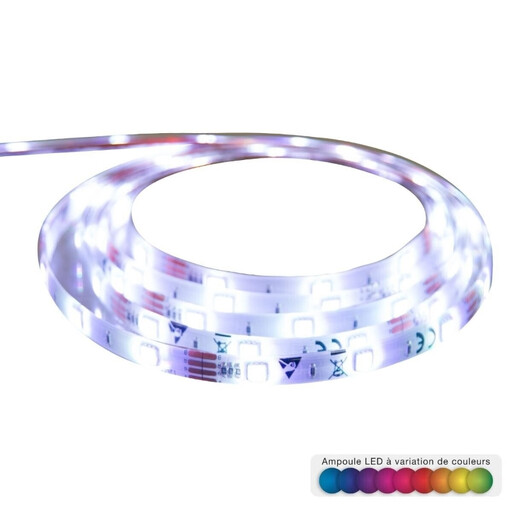
Why This Fits Their Persona: Ideal for users looking for a simple and affordable solution for basic mood lighting. Perfect for illuminating a shelf, desk, or the area behind a TV without a complex installation.
This kit comes with a matching power adapter and a simple IR remote, avoiding compatibility issues and a complicated setup.
All-in-one package with 5m length for a straightforward plug-and-play installation. The 150 LEDs (30 LEDs/m) are well-suited for basic accent lighting.
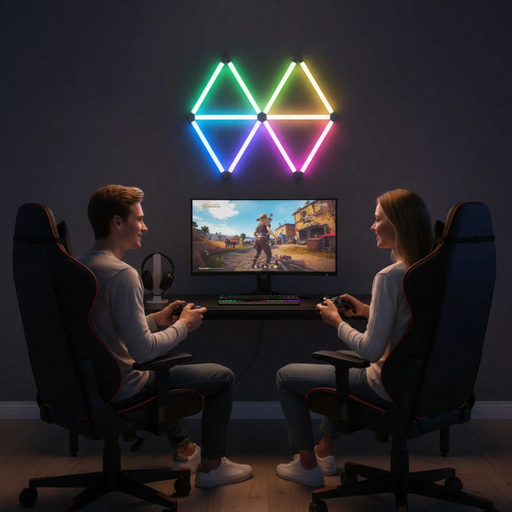
Why This Fits Their Persona: Perfect for gamers and creatives who want more than just a simple strip. These modular light bars allow for creating custom shapes and patterns on the wall that react to music and in-game audio.
Instead of a flexible strip that can peel off, these are rigid segments for wall mounting. Control via app and voice assistant is far more powerful than a simple remote.
Modular DIY design for creative wall installations. The music synchronisation and compatibility with Alexa/Google Assistant create a highly immersive experience.
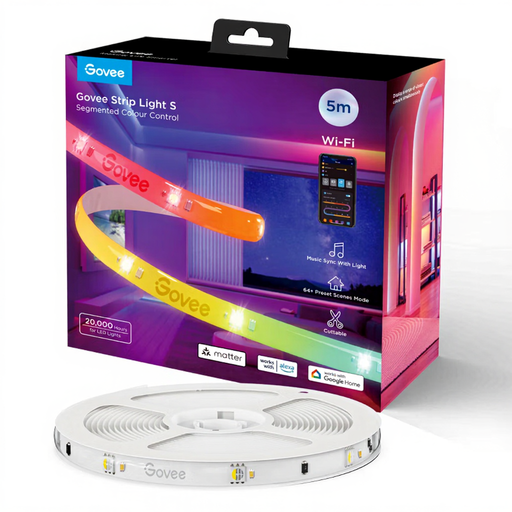
Why This Fits Their Persona: For tech enthusiasts who want seamless integration into their existing smart home (Apple, Google, Alexa) and demand the highest quality in colour and effects.
Matter certification solves the compatibility problem. The RGBIC technology delivers precise, dynamic colours instead of washed-out, uniform hues. The protective coating ensures durability and even light distribution.
Future-proof smart home integration thanks to Matter. Segmented colour control (RGBIC) for stunning visual effects and a powerful Govee Home app.
We have compiled a complete, up-to-date list of products that fully meet these strict selection criteria and all relevant safety standards.
Can you cut an RGB LED strip? Yes, most LED strips can be cut to size. Look for the designated cut lines, usually marked with a scissor icon. Only cut the strip at these markings, or you will damage the circuitry. Special connectors are available to join cut sections.
What is the difference between RGB and RGBIC? A standard RGB strip can only display one colour at a time across its entire length. An RGBIC strip has individually controllable segments, allowing it to display multiple colours simultaneously and create dynamic effects like gradients or chasing animations.
How do I permanently attach an LED strip? For maximum adhesion, the surface must be completely clean, dry, and smooth. Clean the area with a suitable agent before installation. For rough or porous surfaces (e.g., textured wallpaper), it is recommended to use additional mounting clips or an aluminium channel to house the strip. This not only improves adhesion but also helps with heat dissipation.