
Lieferung heute & morgen

Qualitätsgarantie

Willkommens-Angebote freischalten: KOSTENLOSE Lieferung | Bis zu 80 % RABATT | Kostenlose 30-Tage-JoyPlus-Testphase
App herunterladen
RGB LED strips can transform any space—from a gaming room to a living room—into an atmospheric haven. They enable dynamic TV backlighting, create an immersive gaming environment, or set stylish accents as indirect lighting. However, the market is overwhelming, and not every product delivers on its promises. Before you invest, you should be aware of three typical pitfalls that often lead to disappointment and unnecessary expense.
Many buyers focus on the number of colours or the length, overlooking critical quality flaws that severely limit the product's usefulness.
app-controlled LED strip feature, but the accompanying software is often buggy, constantly loses its Bluetooth connection, or offers only limited settings.To avoid these problems, you should pay attention to a few technical parameters that determine the quality and longevity of your lighting.
The brightness and uniformity of the light depend directly on the LED density, which is the number of light-emitting diodes per metre. A higher density (e.g., 60 LEDs/m) ensures more uniform illumination and is particularly important for visible indirect lighting. The LED type is also relevant. 5050 SMD LEDs are a common standard for RGB strips as they combine three chips in one housing and allow for good colour mixing.
The method of control determines the convenience. A simple remote is practical, but an app-controlled LED strip via smartphone offers more possibilities. There are two main technologies here:
smart home lighting and compatibility with voice assistants like Alexa or Google Assistant. Models with Matter certification also offer future-proof compatibility across different smart home systems.For advanced users, there are enhanced technologies:
gaming room decor.music sync, where the lights pulse to the beat of the music. Models with an integrated microphone in the controller react more accurately to ambient sounds than those that use the smartphone's microphone.Based on these criteria, we have identified some products that offer a suitable solution for different needs and budgets.
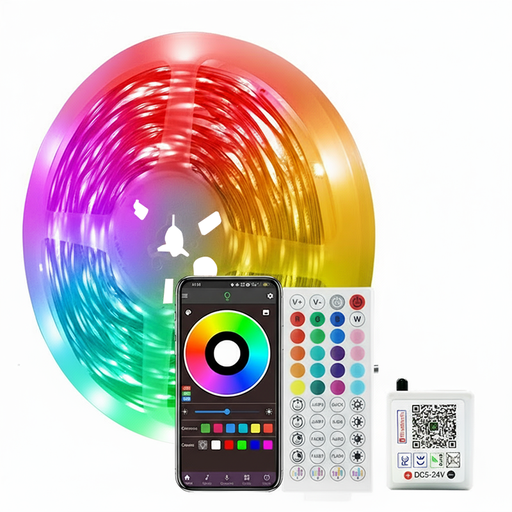
Why This Fits Their Persona: Ideal for first-time projects or straightforward room lighting without breaking the bank. The 10-metre length is sufficient for many standard applications, such as outlining a desk or as TV backlighting.
Offers dual control via app and remote, reducing reliance on a potentially unstable app. The self-adhesive backing is designed for smooth, clean surfaces.
Generous 10-metre length; dual control methods for more flexibility.
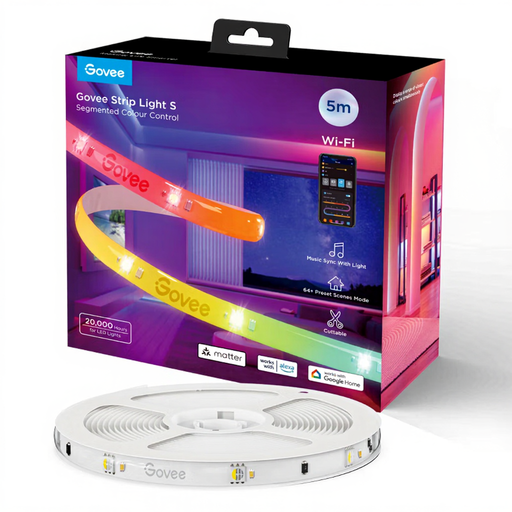
Why This Fits Their Persona: Perfect for users seeking seamless integration into existing smart home systems like Apple Home, Google Home, or Alexa. The RGBIC technology enables impressive, flowing light effects.
The RGBIC technology provides segmented control, preventing spotty colour display. Matter certification ensures stable and future-proof connectivity across various platforms.
Matter support for universal compatibility; RGBIC technology for multi-coloured, dynamic effects.
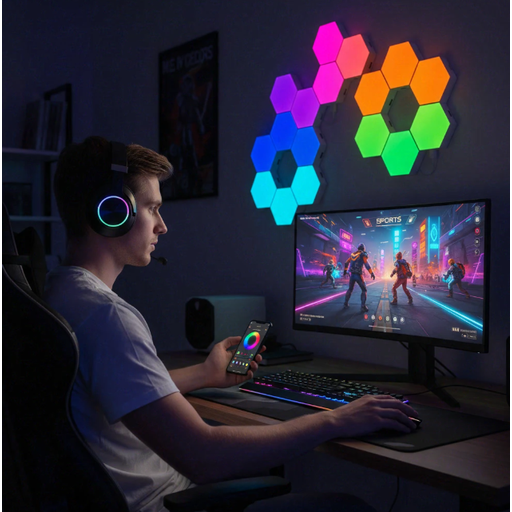
Why This Fits Their Persona: For anyone looking for more than just an LED strip. These modular LED wall panels allow for custom geometric designs and become the focal point of any gaming room decor.
As modular wall panels, they bypass the problem of conventional adhesive strips. The mounting is designed for a secure attachment to the wall. The app and remote control are tailored for synchronising the modules.
Modular design for high creativity; music sync for an immersive gaming experience.
We have compiled a complete, up-to-date list of products that fully meet these strict selection criteria and German safety regulations.
The lifespan of RGB LED strips is usually specified in operating hours and is between 30,000 and 50,000 hours for many models. This depends heavily on the quality of the LEDs and heat dissipation. Continuous use at maximum brightness can shorten the lifespan.
Yes, most LED strips can be cut at the designated markings (often indicated by a scissor icon). It is important to cut only at these points to avoid damaging the functionality. A section that has been cut cannot usually be reconnected without special accessories.
A standard RGB strip can only display a single colour along its entire length at one time. RGBIC (Red Green Blue Independent Control), on the other hand, has integrated chips that allow different segments of the strip to be controlled independently. This allows multiple colours to be displayed simultaneously and dynamic effects such as rainbow gradients or chasing effects to be created.