
Lieferung heute & morgen

Qualitätsgarantie

Willkommens-Angebote freischalten: KOSTENLOSE Lieferung | Bis zu 80 % RABATT | Kostenlose 30-Tage-JoyPlus-Testphase
App herunterladen
An RGB LED strip can completely transform a room—from atmospheric TV backlighting to dynamic game room decor. But the market is flooded with products whose marketing promises often fall flat in practice. Many buyers get frustrated with uneven light, peeling adhesive strips, or buggy apps. As your Joybuy Product Recommendation Officer, I'll help you spot these pitfalls and make an informed decision.
Before you spend any money, you should be aware of the typical flaws that can appear in cheap or over-hyped products.
To avoid the problems mentioned above, you should check three technical parameters before buying. These determine the quality and longevity of your lighting experience.
The quality of the light is directly related to the number of LEDs per meter. A higher density ensures more even and brighter illumination without distracting hotspots.
The method of control should fit your habits.
Measure your installation area carefully before you order.
Here are some products that represent a smart choice for specific user profiles based on their objective features.
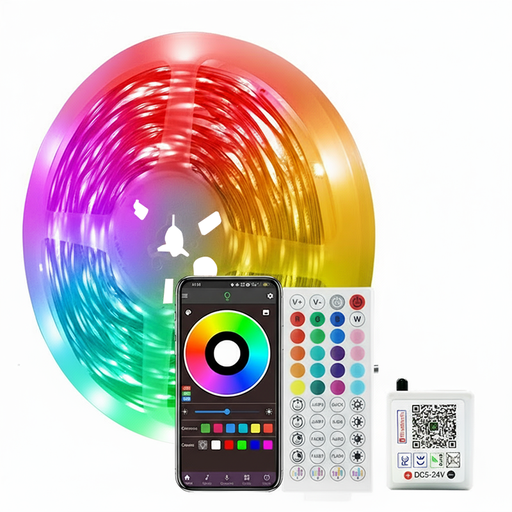
Why This Fits Their Persona: At 5 meters long, this strip is ideal for typical beginner projects like lighting a desk, a bed, or a medium-sized TV. It offers a full feature set without making you pay extra for unused length.
This model avoids the "app trap" by offering dual control. Both the 40-key remote and the Bluetooth app provide full control. If one method fails, the other still works.
Flexible control via app and remote. It offers useful extra features like music sync and a timer function, which are not a given in this price range.
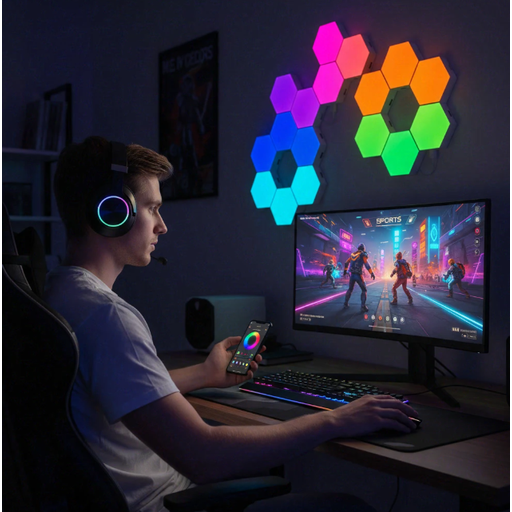
Why This Fits Their Persona: For unique game room decor, modular panels are a creative alternative to a classic LED strip. The hexagonal elements can be arranged on the wall in any pattern, creating a custom work of light art.
These panels bypass the problem of weak adhesive on long strips. Each lightweight panel is attached individually, which distributes the load and ensures a more stable hold. Power is supplied modularly via USB connections.
Fully modular DIY design for creative freedom. The integrated music sync reacts to the beat of games or music, creating a particularly immersive experience.
Why This Fits Their Persona: Anyone looking to outfit an entire room with seamless indirect lighting needs a lot of length. At 30 meters on a single roll, this kit is ideal for installation along ceilings, in coves, or behind large furniture walls.
This kit solves the problem of uneven lighting when connecting multiple short strips. Since it all comes from one roll, the colour temperature and brightness are consistent over the entire length. The included power supply is rated for the full 30 meters.
An enormous 30-meter length for large projects without splicing. Control is flexible via the app or the included IR remote, ensuring reliable operation.
We have compiled a complete, up-to-date list of products that fully meet these strict selection criteria and safety regulations.
1. How long does an RGB LED strip last? The lifespan of LEDs is measured in hours and is typically between 30,000 and 50,000 operating hours for most quality products. With eight hours of daily use, this equates to a lifespan of over 10 years. The actual durability heavily depends on heat dissipation. Mounting on metal profiles can extend the lifespan, while installation in tight, unventilated spaces can shorten it.
2. Can you cut and reconnect an LED strip? Yes, most LED strips can be cut with simple scissors at the designated markings (often a scissor icon and copper contacts). The cut-off piece can be reused with special solderless connectors or by soldering, provided you have a suitable power supply and controller for the remaining piece.
3. Do LED strips use a lot of power? No, LED technology is very energy-efficient. The exact consumption depends on the length and LED density. A typical 5-meter RGB strip consumes between 15 and 30 watts, depending on the brightness and colour. This is significantly less than a traditional incandescent bulb. The exact power consumption in watts (W) is usually stated on the product or its packaging.