
Lieferung heute & morgen

Qualitätsgarantie

Willkommens-Angebote freischalten: KOSTENLOSE Lieferung | Bis zu 80 % RABATT | Kostenlose 30-Tage-JoyPlus-Testphase
App herunterladen
An RGB LED strip can transform any space—from a gaming room to a living room. But the market is flooded with products whose marketing claims often fall short. Many buyers are frustrated by weak adhesive, inaccurate colours, or buggy app control. As your Joybuy Product Recommendation Officer, I'll help you recognise these pitfalls and make an informed decision that suits your project.
Before you spend any money, it's crucial to understand the most common problems that arise with cheap or poorly designed LED strips. These three flaws often only become apparent after installation.
It's easy to call an LED strip self-adhesive. The reality is often different. Many manufacturers skimp on the adhesive, causing the strips to peel away from walls, TVs, or furniture after just a few weeks—especially on warm days or slightly rough surfaces. Constant readjustment is not only annoying but can also damage the strip itself.
Inconsistent colour reproduction is a frequent annoyance. Cheap RGB chips often can't produce a pure white; it appears bluish or pink instead. Furthermore, on lower-quality strips, dark spots are often visible between the individual LEDs, making the indirect lighting look patchy and unprofessional.
An LED strip with a remote and app promises convenience but can become a test of patience. Common issues include unreliable Bluetooth connections, poorly programmed apps that crash, or a remote that only works at close range. Features like music sync often respond sluggishly or not at all to the beat.
To avoid the problems mentioned above, you should pay attention to a few technical specifications. These define the quality and longevity of your LED strip.
Measure the desired area accurately before buying. Common lengths are 5m, 10m, or 20m. Check if the strip can be cut at the marked points. This is crucial for a clean installation, for example, with TV backlighting. Some models, like Neon LED Strips, are more flexible but not always cuttable. Check the product description carefully for these details.
A Smart LED Strip should integrate seamlessly into your daily life.
Here are some recommendations tailored to specific user profiles and use cases, all of which meet the quality criteria mentioned.
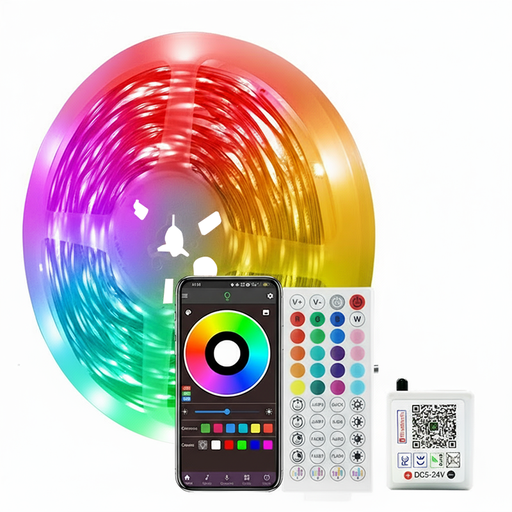
Why This Fits Their Persona: Ideal for users looking for a straightforward and affordable solution to decorate a room. The 10-metre length is sufficient for most standard rooms or for creating accents along furniture.
Offers reliable dual control via an app and a 40-key remote, bypassing the pitfall of faulty operation. The flexible FPC board ensures more even light distribution than no-name products.
Great value for 10 metres. Includes a music sync mode and timer function.
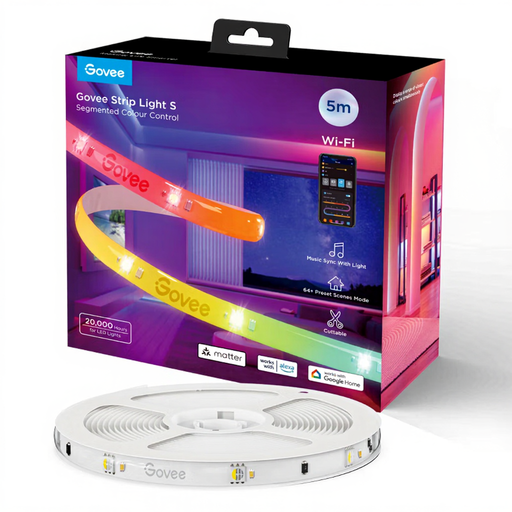
Why This Fits Their Persona: Perfect for demanding users who want dynamic lighting effects for their gaming setup or seamless smart home integration. Matter support ensures compatibility with all major platforms.
Solves the problem of uneven colours and limited effects with its RGBIC technology. The Govee Home App is renowned for its stability and extensive feature set, avoiding the pitfall of poor software.
Segmented colour control for multi-colour effects. Wi-Fi connectivity and Matter certification for future-proof smart home integration.
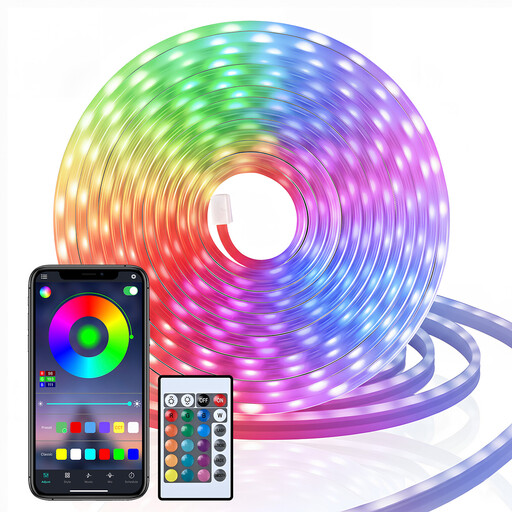
Why This Fits Their Persona: For anyone seeking a unique look. This Neon LED Strip produces a continuous, diffused light and is excellent for creating custom shapes, lettering, or outlines on walls and furniture.
The silicone casing completely solves the problem of visible LED dots and patchy lighting. The result is a uniform, high-quality light strip that looks professional.
Highly flexible material for creative shapes. Even, dot-free, neon-style light. Controllable via app and remote.
We have compiled a complete, up-to-date list of products that fully meet these strict selection criteria and all relevant safety regulations.
1. How much power does an RGB LED strip use? Power consumption is generally low and depends on the length, LED density, and set brightness. A typical 5-metre strip consumes between 15 and 30 watts at full brightness. Compared to traditional light bulbs, LEDs are very energy-efficient. You can find the exact specifications in the technical data for each product.
2. Can you cut and reconnect an LED strip? Yes, most LED strips can be cut with a simple pair of scissors at the designated markings (often indicated by a scissor icon). To reconnect sections, you will need special connectors, which are sold separately. Make sure to choose the correct connector for the width and number of pins on your strip.
3. What is the difference between RGB and RGBIC? The main difference is in the control. With an RGB strip, all LEDs always light up in the same colour. You can change the colour of the entire strip, but you cannot create multi-colour effects. An RGBIC strip has additional control chips that allow different sections of the strip to light up in different colours. This enables dynamic effects like colour gradients, chasing lights, or rainbow patterns.