
Lieferung heute & morgen

Qualitätsgarantie

Willkommens-Angebote freischalten: KOSTENLOSE Lieferung | Bis zu 80 % RABATT | Kostenlose 30-Tage-JoyPlus-Testphase
App herunterladen
The right lighting can completely transform a room's atmosphere. An RGB LED strip, in particular, offers the flexibility to switch between focused task lighting and a relaxed ambience at the touch of a button. However, the market is flooded with products whose marketing promises often don't align with reality. As your Joybuy Product Recommendation Officer, I'll help you recognise the typical pitfalls and make an informed decision that fits your needs.
Before you invest in a new LED light strip for your room, you should be aware of the most common problems that often only become apparent after the purchase.
To avoid these problems, you should check three technical features before buying. These are the primary determinants of the quality and longevity of your new lighting.
The density, specified in LEDs per metre, is crucial for uniform illumination. A low density (e.g., 30 LEDs/m) often creates an unsightly "spotting effect" where individual light sources are visible. For a homogenous band of light, 60 LEDs/m or more is recommended. The LED type, often 5050 RGB, refers to the size and capability of the diodes and is an established standard for good brightness and colour mixing.
Modern LED strips offer various control options.
This is a critical distinction, especially for LED gaming lights.
Here are some recommendations tailored to specific user profiles and requirements.
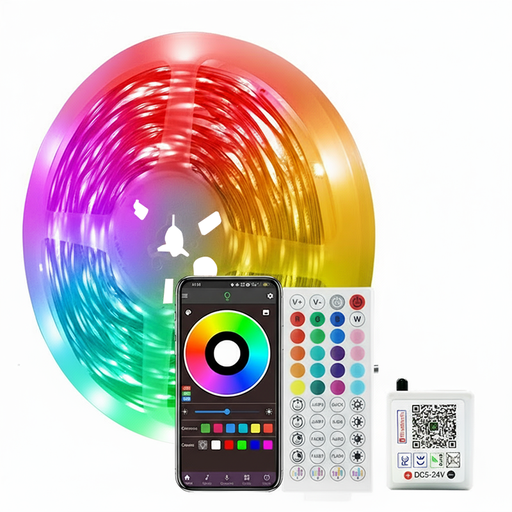
Why This Fits Their Persona: Ideal for users looking to equip their bedroom or living room with a solid starter package. The 10-metre length is sufficient for most standard rooms and offers a cost-effective entry point into the world of smart lighting.
The dual control via app and a 40-key remote provides a reliable backup if the app connection ever fails. This ensures functionality is always maintained.
Excellent value for money; Includes music sync and timer functions.
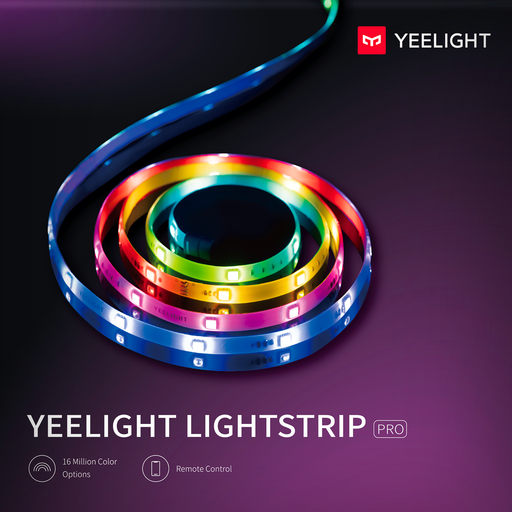
Why This Fits Their Persona: Engineered for demanding setups. The RGBIC technology enables dynamic, multi-colour effects that integrate perfectly into a gaming environment. Compatibility with gaming platforms like Razer Chroma and Overwolf takes the experience to the next level.
Yeelight is an established brand in the smart home space, which suggests a polished app and reliable colour reproduction. The RGBIC technology ensures precise and vibrant gradients instead of pale, uniform colours.
Addressable RGBIC LEDs for smooth colour gradients; Extendable and compatible with popular smart home and gaming ecosystems.
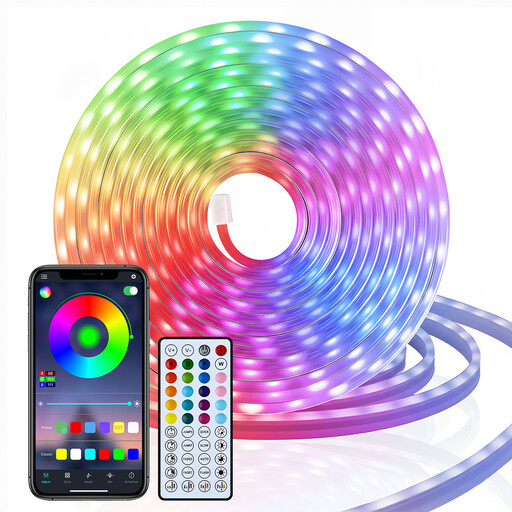
Why This Fits Their Persona: For creatives seeking not just a light strip, but a design element. Its high flexibility and silicone casing allow for shaping letters or outlines, creating a diffused neon look with no visible light dots.
The silicone diffuser layer ensures a perfectly uniform light distribution, completely avoiding the cheap-looking "spotting effect." It also protects the LEDs and increases the strip's durability.
Uniform neon effect for a high-end look; Highly flexible for creative DIY projects and custom shapes.
We have compiled a complete, up-to-date list of products that fully meet these strict selection criteria and UK safety regulations.
Yes, most LED strips can be cut with a standard pair of scissors at the designated markings (often indicated by a scissors icon). It is important to cut only at these points to avoid damaging the strip's functionality. Cut-off sections cannot typically be reused without special connectors.
A standard RGB light strip can only display one single colour across its entire length at a time. While you can change the colour, it will always be uniform. RGBIC strips, on the other hand, have integrated chips that allow different segments of the strip to be controlled independently. This means multiple colours can be displayed simultaneously, enabling dynamic effects like colour gradients or animations.
The connection is usually made via Bluetooth or Wi-Fi. Ensure that Bluetooth is enabled on your smartphone and that you are near the strip. Open the manufacturer's specified app and follow the instructions to add a new device. The strip is typically detected automatically. For a Wi-Fi connection, you will also need to enter your home network's name and password. Note that most devices only support 2.4 GHz networks.