Photographing distant subjects
If you often photograph wall details from a distant position you can’t move from, optical telephoto range is especially important.


For photographing wall details from a fixed position at a distance, a camera with a generous optical telephoto range is the best place to start. Be sure to check the maximum aperture at the telephoto end, too. For wider views or shooting in lower light, a shorter, faster zoom may be a better fit. A stabilised prime lens works if you can deliberately choose your angle of view, but it can’t replace optical zoom.
If you often photograph wall details from a distant position you can’t move from, optical telephoto range is especially important.
As the light fades, you’ll need to weigh up maximum aperture, sensor size and your preferred angle of view if you want to shoot handheld.
If you’re walking from one viewpoint to the next, it’s important to choose a camera you’ll be happy to carry. Its fixed or variable angle of view still needs to suit your subjects.
| Your priority | What to look for | Who should pay particular attention |
|---|---|---|
| Distant wall details | Check the optical rather than digital zoom and the full-frame equivalent focal length for stills. Also consider the maximum aperture at the telephoto end you need. | If you’re fixed on the opposite bank, you’ll need optical telephoto range for wall details. Shoppers whose main priority is distant subjects are likely to account for around 33%. |
| Low-light photography | Check the maximum aperture at the focal length you need, as well as image stabilisation specifically stated for stills and the conditions under which it applies. | If you want to photograph gates and stretches of wall handheld as the light fades, the combination of a fast lens and stabilisation matters. Shoppers with this as their main priority are likely to account for around 27%. |
| Wide views and perspective | Compare the wide-angle end of a zoom, or a fixed full-frame equivalent angle of view, with the framing you want and the room you have to move around at the location. | If you want to show an entire wall rather than a single stone, the angle of view needs to suit your perspective. Shoppers whose main priority is composition are likely to account for around 20%. |
| Lightweight for getting around | Compare weight figures on a like-for-like basis, for example with the battery and memory card included. Also check the focal length range you need. | If you’re walking between viewpoints, you’ll want a camera you can take with you without compromising too much on framing. Shoppers whose main priority is portability are likely to account for around 20%. |
Manufacturers may list optical, intelligent and digital zoom separately. With the Panasonic TZ99, the full-frame equivalent also depends on the aspect ratio and whether you’re shooting stills or video.
Compare the optical focal length range for the type of photo you plan to take at the same aspect ratio, rather than comparing zoom ratios alone.
The stated feature may apply only to certain models and shooting modes. Panasonic limits the TZ99’s stated five-axis HYBRID O.I.S.+ feature to video other than 4K; Fujifilm specifies certain conditions for the X100VI’s stabilisation figures.
Check the stills and video functions separately, and consider the maximum aperture at your preferred telephoto setting, too.
Model suffixes can indicate different versions. Canon lists an IXUS 285 HS A with a changed microSD storage format, while a travel zoom list names the IXUS 285 HS. The TZ99 also has a different prefix in retailer listings and on the manufacturer’s site.
Before buying, check the full model name, storage format, what’s included and the regional version.
A different memory card or equipment configuration may mean you need to buy additional accessories.
The TZ99 and TZ300 offer different travel zoom ranges: at a 4:3 aspect ratio, the TZ99 covers 24 to 720 mm, while the TZ300 covers 24 to 360 mm. Panasonic Germany lists a 1-inch type sensor for the TZ300.
Sony Germany lists a 1-inch type sensor, a 24–200 mm zoom, a viewfinder and optical image stabilisation for stills for the RX100 VII.
According to Canon Germany, the PowerShot G7 X Mark III offers a 24–100 mm zoom and a maximum aperture of F1.8–2.8.
The GR IV is a compact APS-C camera with a fixed 28 mm full-frame equivalent focal length and sensor-shift stabilisation.
According to Fujifilm, the X100VI combines an APS-C sensor, a fixed 35 mm full-frame equivalent focal length and sensor-shift stabilisation.
Joybuy camera options for compact photography and handheld architectural views. Depending on the model, check whether its angle of view, zoom and intended stills or video functions suit your subject.
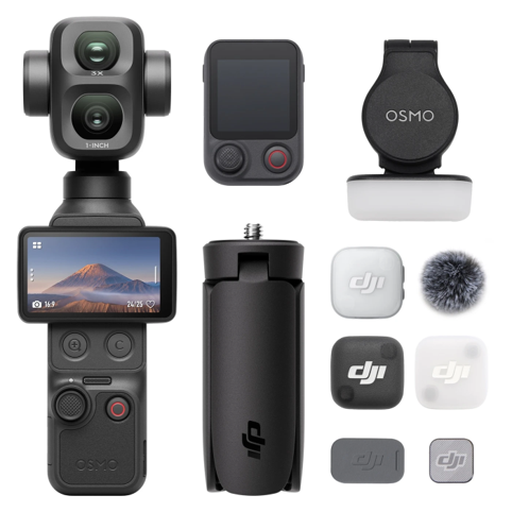 No image available
This compact pocket vlogging camera is an option if a handheld set-up is important to you. Check the specific angle of view and zoom for stills if you want to photograph distant wall details.
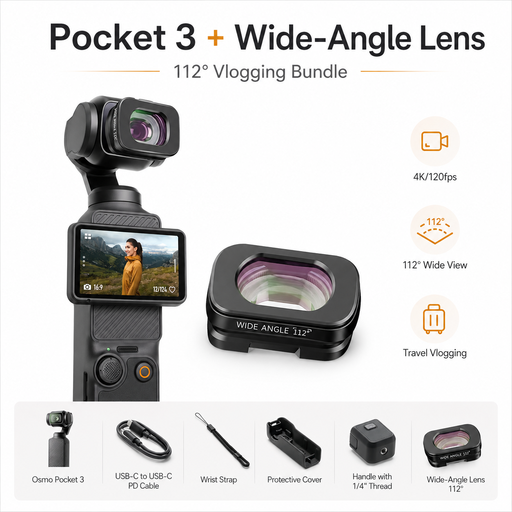 No image available
This bundle pairs the Osmo Pocket 3 with a wide-angle lens for broader views from close range.
The product lists a 112° angle of view and a 1-inch CMOS sensor. Check whether the wide-angle view suits the framing you want.
 No image available
The variable zoom lens is an option if you want to switch between different compositions.
This version is listed with a 16–50 mm lens, so your framing is limited to that focal length range.
 No image available
The stated optical zoom may be useful if you want to bring distant details closer; compare the actual focal length range with your position.
The product name also lists 4K and 64 MP. Those figures alone don’t tell you whether the camera is right for the shots you want to take.
 No image available
The stated optical zoom gives you a variable framing option; check whether its range is enough for the distance to your subjects.
The product name also lists two lenses, 5K and 64 MP. Before choosing, compare the specific stills features and the angle of view you need.
First, choose a position and check whether the wide-angle end captures the full view you want. According to their manufacturers, the zoom cameras mentioned here start at a 24 mm full-frame equivalent for the relevant stills settings; the Ricoh GR IV and Fujifilm X100VI have fixed angles of view equivalent to 28 mm and 35 mm respectively.
Check the manual for your exact model to find out which memory card and charging method it requires, as model suffixes can matter. Keep the lens clean and, after changing location, take a test shot to check the focus. This information doesn’t provide a blanket assurance that any of the cameras mentioned can withstand rain without protection.
Your statutory rights relating to faults are against the seller and are separate from any voluntary guarantee. Many online purchases of goods generally come with a 14-day right to cancel; check the details of your order and any exceptions that may apply.
Under certain conditions, § 59 UrhG permits photographs of works permanently situated on public paths, roads or squares; for buildings, this applies only to their exterior. It doesn’t give you the right to enter restricted areas: for managed properties, the General Directorate for Cultural Heritage Rhineland-Palatinate requires visitors to use designated access routes and follow the site rules. If people are identifiable, the taking and publication of the photos must be considered separately; the Rhineland-Palatinate State Commissioner for Data Protection and Freedom of Information notes that consent or another legal basis is required for photographs of people. Whether additional rules apply to a particular castle depends on the site.