Occasional rhubarb cooks
If you want to prepare some rhubarb for a shared meal, first check whether your existing freezer has enough room. The Federal Centre for Nutrition describes freezing chopped rhubarb as one option.


If you only need to freeze one portion of rhubarb for a shared dinner, you probably won’t need a new chest freezer. First, check whether your existing freezer has enough room. If you regularly freeze larger harvests or batches of food, compare the usable capacity, freezing capacity, annual energy consumption and space available for the specific model. The consumer advice centre warns against buying an appliance that’s too large for your needs. A figure in kg/24 h is not the time it takes to freeze a particular portion through.
If you want to prepare some rhubarb for a shared meal, first check whether your existing freezer has enough room. The Federal Centre for Nutrition describes freezing chopped rhubarb as one option.
If you regularly freeze your harvest or larger batches, you’ll need enough storage space. Compare the freezing capacity of the specific model with the amount you plan to store. The consumer advice centre recommends choosing an appliance size to suit your actual needs.
If you’re considering an extra chest freezer, make sure its external dimensions suit the space where you plan to put it. The stated annual energy consumption is also an important figure to compare, as freezers run continuously.
A good fit if: you’re preparing just a small portion for one meal and have room in your freezer.
Consider: You’ll avoid buying another appliance, but you’ll need to factor in the available space and your recipe’s timings.
A good fit if: you regularly freeze smaller batches and have limited space for an appliance.
Consider: Compare the usable capacity and freezing capacity with the amount you plan to store, as well as the annual energy consumption.
A good fit if: you regularly freeze larger harvests or several meals at once.
Consider: More storage space means a larger footprint, so choose a size that suits your ongoing needs.
The right choice depends on what matters most to you: freezing a single portion, storing seasonal supplies, keeping running energy use down or finding a suitable place for the appliance.
| Priority | What to check when buying | Who it matters to |
|---|---|---|
| Do you need another appliance? | Check the available space in your existing freezer and how much you plan to freeze. Only compare chest freezers if you have an ongoing need. | If you only want to freeze rhubarb for one meal, first check how much room is free in your existing freezer. Around 33% of consumers prioritise this occasional need to freeze a single portion. |
| Space and freezing capacity | Compare the amount you regularly store with the usable capacity in l and freezing capacity in kg/24 h. Consider baskets if you’ll be storing lots of small packs. | If you regularly freeze a harvest or larger batches, you’ll need suitable storage space and want to be able to find your packs easily. Around 27% of consumers prioritise seasonal supplies. |
| Energy consumption | Compare the stated annual energy consumption in kWh with the capacity. The consumer advice centre recommends not choosing an appliance that’s larger than necessary. | If an additional chest freezer will be running continuously, you’ll want to factor in its energy consumption when choosing a size. Around 20% of consumers focus primarily on keeping ongoing energy use low. |
| Where to put it | Check the external dimensions and the permitted ambient temperature for the specific model, especially if you’re placing it in an unheated room. | If space is limited or the room is unheated, the dimensions and permitted ambient temperature must suit the location. Around 20% of consumers prioritise whether the appliance is suitable for the place where it will be installed. |
An appliance that’s much larger than you need takes up space and runs continuously. The consumer advice centre recommends choosing an appliance size to suit your needs.
First, check how much room is free in your existing freezer and consider whether you’ll regularly be adding more supplies.
An extra chest freezer takes up space and adds to your ongoing energy consumption.
The stated freezing capacity is the amount the specific model can freeze in a day. It doesn’t tell you how long it will take to freeze a particular portion of rhubarb through for dinner.
If you’re short on time, don’t rely on this figure alone when planning to use freshly frozen pieces.
Permitted ambient temperature figures apply to the specific model. Gorenje states that the FH30EAW has FreezeProtect down to −15 °C; Liebherr lists FrostProtect down to −15 °C for the CFc 1875 Plus.
If you plan to keep the freezer in a garage or unheated cellar, check the temperature limits for the exact model.
The GT100-E-040E is a useful model to compare if you’re looking for a compact chest freezer.
According to the manufacturer, the HCE200C offers 196 l of storage space for households that regularly need to store supplies.
The FH30EAW is a larger model. The manufacturer lists FastFreeze, baskets and suitability for cold locations among its features.
According to the manufacturer, the CFc 1875 Plus is worth comparing if you need storage space and plan to put the appliance in an unheated room.
According to the manufacturer, Beko’s chest freezer range includes both more compact and larger models.
With a capacity of 198 l, the RCC199WH2 (E) is a useful model to compare if you need a medium amount of storage.
The models below range from compact chest freezers for smaller additional supplies to larger appliances for regular storage. Compare the dimensions and energy consumption listed with the space you have and what you actually need.
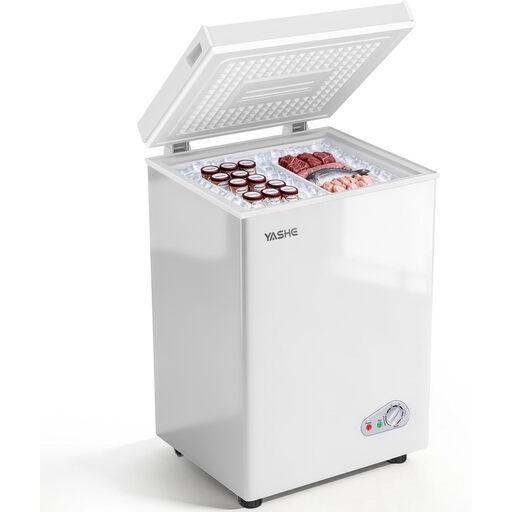 No image available
A compact option for regularly storing smaller batches. Two removable baskets make it easier to organise portioned packs.
100 l freezer capacity; six temperature settings; two removable baskets; stated annual energy consumption: 185 kWh.
 No image available
The 141 l capacity gives you room for extra supplies, and you can switch the appliance between fridge and freezer modes.
141 l capacity; energy efficiency class E; seven thermostat settings; one removable basket; stated annual energy consumption: 179 kWh.
 No image available
The 95 l capacity gives you extra space for smaller supplies, while a removable basket helps keep separate packs within easy reach.
95 l capacity; energy efficiency class E; seven thermostat settings; one removable basket; dimensions: 550 × 475 × 848 mm; stated annual energy consumption: 165 kWh.
 No image available
The larger capacity is designed for bigger stocks of food. Before buying, check that the dimensions suit the space where you plan to put it.
291 l capacity; energy efficiency class E; dimensions: 1100 × 597 × 872 mm; one removable basket; LED lighting; stated annual energy consumption: 226 kWh.
 No image available
With a capacity of 197 l, this model suits regular storage needs. The removable basket helps you keep everything organised.
197 l capacity; energy efficiency class E; dimensions: 816 × 554 × 848 mm; one removable basket; stated annual energy consumption: 197 kWh.
No. According to the Federal Centre for Nutrition, briefly blanching rhubarb is one option, but it isn’t essential. Cut the stalks into pieces and pack them in an airtight container. Remove the leaves and the leaf bases before preparing the rhubarb.
You can’t work out a reliable freezing time for your portion size and appliance from a figure in kg/24 h. If you’re short on time, use fresh or already-frozen rhubarb in your recipe rather than assuming it will freeze in a particular amount of time.
The consumer advice centre recommends −18 °C for freezers. Keep packs easy to find and leave the lid open for as little time as possible. Also follow the manual for your specific model when it comes to care and defrosting.
Compare the stated annual energy consumption in kWh and take your electricity tariff and the delivery and service terms into account. If a new appliance is faulty, you have statutory rights against the seller. These are separate from any voluntary manufacturer’s guarantee.
Electrical appliances mustn’t go in household rubbish. Take them to an authorised collection point, such as a local recycling centre or a retailer that’s obliged to take them back. The take-back requirement depends, among other things, on the size of the retailer and, for large old appliances, whether you’re buying an equivalent new one. The amendment to the Electrical and Electronic Equipment Act came into force on 1 January 2026. Check with the retailer when you buy if you’d like your old appliance collected.