For rice cakes, your appliance should have a dedicated steam-cooking function; steam assistance for baking is no substitute. Check the internal dimensions against your mould, allowing enough room for steam to circulate. If you have a suitable fitted space, a built-in model may be an option; without one, consider a freestanding steam combination oven or a hob-top steamer. Cooking time and preparation depend on the type of rice cake.
Who is this guide for?
Families who steam their own rice cakes
If you want to make rice cakes, check that the appliance has a dedicated steam-cooking function and that your mould will fit inside. Bosch Hausgeräte Deutschland distinguishes steam ovens from ovens with steam assistance; Maangchi’s Baekseolgi recipe uses a steamer and a 20 cm cake ring.
Families cooking several portions
Check the mould, usable internal dimensions and, where relevant, the number of cooking levels before relying on the stated capacity in litres. CASO Design, Panasonic and AEG give specifications for different appliances and configurations.
Households without a fitted space
If you don’t have a suitable fitted space, a freestanding appliance or a hob-top steamer may be a better option. Panasonic gives the external dimensions for the NN-CS89LB; also check the space available on your worktop and the internal dimensions for your mould.
What should you look for when buying?
Built-in steam oven
A good fit if: you have a suitable fitted space and want to steam and bake in one built-in appliance.
Bear in mind: the dimensions of the fitted space and installation requirements limit your options; the stated capacity alone won’t tell you whether your mould will fit.
Freestanding steam combination oven
A good fit if: you don’t have a fitted space and have enough worktop room for an appliance with a steam-cooking function.
Bear in mind: the internal dimensions may limit your choice of mould; extra features such as a microwave don’t replace checking the steam-cooking function.
Hob-top steamer
A good fit if: you steam rice cakes occasionally or want to check which mould and portion size work with your recipe.
Bear in mind: you’ll need a suitable pan, steamer insert and space on the hob; it won’t offer oven functions.
Check the steam-cooking function first, then the mould and space requirements. Other cooking modes should only influence your decision if you’ll actually use them.
| What to consider |
What to check before buying |
Who will find this important? |
| Dedicated steam cooking |
Look for a separate ‘steam cooking’ mode in the specifications for the complete model, not just steam assistance for baking. |
If I want to steam rice cakes, I need a clearly specified steam-cooking function; around 33% of consumers put this feature first. |
| Mould and portions |
Check the mould’s diameter and height against the usable internal dimensions and suitable cooking levels. |
If you’re planning to make a particular mould and portion size for a family meal, you’ll want to check the usable space in advance; around 27% of consumers focus on moulds and family-sized portions. |
| Kitchen space |
For a built-in appliance, check the fitted space and installation diagram; for a freestanding appliance, check the worktop space and placement requirements. |
If I don’t have a suitable fitted space or need to plan my worktop layout, the appliance type matters too; around 20% of consumers base their choice first on kitchen space. |
| Cleaning and water care |
Compare tank access, removable accessories and care instructions for the tank and cooking compartment. |
If you steam food often, you’ll want the tank, accessories and cooking compartment to be easy to manage after each use; around 13% of consumers prioritise care and maintenance. |
| Other cooking modes |
Check steam cooking separately from fan cooking, grilling or microwaving, and only factor in the functions you need. |
If you want to make other dishes as well as rice cakes in the same appliance, the right extra functions matter; around 7% of consumers put versatility first. |
Avoid common buying mistakes
-
Confusing steam assistance with steam cooking
Adding steam while baking and having a dedicated steam-cooking function are two different operating modes. For rice cakes, the complete model should be clearly specified as having the appropriate steam-cooking function.
Check the operating modes in the manual or model specifications before making a decision. CASO Design lists steam cooking separately from a steam assistant for baking on the SteamMaster E 56.
-
Looking only at the cooking compartment capacity
A capacity in litres won’t tell you whether your mould will fit in terms of width and height, or whether there’ll be enough space around it for steam to circulate.
Measure your mould and check it against the internal dimensions and details of suitable accessories. Don’t estimate the number of portions based on the stated capacity alone.
If your mould doesn’t fit, you may need a different suitable mould or have to plan for several batches.
-
Treating built-in and worktop appliances as interchangeable
A built-in appliance must fit the space and meet the installation requirements; a freestanding appliance needs a suitable place to stand.
Choose based on the fitted space or worktop area available, then check the manual for the specific model.
-
Reading the energy label as a measure of steam-cooking consumption
For domestic ovens, the European Commission lists energy consumption for conventional and fan-assisted cooking. These figures don’t tell you how much energy it takes to cook a rice cake recipe using steam.
Use label information only for the operating modes it specifies, and don’t compare different modes with one another.
A guide to the brands
CASO Design
The SteamMaster E 56 is a built-in steam oven with a clearly specified steam-cooking function, making it an option if you have a suitable fitted space.
- CASO Design specifies a steam-cooking temperature range of 50–100 °C, a 45 l cooking compartment, a removable 1.2 l tank and a perforated tray for this model.
- Check the installation dimensions and whether your mould will fit separately; the manufacturer’s specifications aren’t an independent cooking test.
Panasonic
The NN-CS89LB combines steam cooking and a microwave, and may be an option if you don’t have a standard oven space.
- Panasonic specifies a 31 l capacity, two steam power levels and steam cooking on two levels.
- The stated internal dimensions of 410 × 320 × 240 mm limit your choice of mould; they don’t guarantee a particular rice cake result.
AEG
The TP9SB83FAT built-in oven with SteamPro is designed for households looking to combine steam cooking and baking.
- AEG specifies a 70 l capacity, a removable 0.95 l tank, and perforated and non-perforated cooking containers for this model. The manufacturer describes SteamPro as a range with 100% steam.
- These specifications apply to the model named and come from the manufacturer; check the installation dimensions and accessories for the specific product listing.
Siemens
The HS736G1B1 built-in steam oven may be worth considering if you have a suitable 60 × 60 cm appliance space.
- Siemens specifies a Dampffunktion Plus steam function and appliance dimensions of 595 × 594 × 548 mm.
- Check whether your mould will fit using the usable internal dimensions; the model specifications don’t include a tested rice cake recipe.
Miele
According to Miele, the compact DGC 7440 HC Pro combines steam cooking, baking and roasting, making it relevant if you’re planning for a compact built-in appliance.
- Miele specifies HydroClean and provides care instructions for the appliance.
- The manufacturer’s specifications don’t guarantee that a particular family-sized portion will fit or that it will cook better than with other brands.
Steamers at Joybuy
The Joybuy products featured here are standalone steamers and hob-top steamers, offered as alternatives to steam ovens. For each model, check that your mould and intended portion size are suitable for the usable levels and dimensions.
 No image available
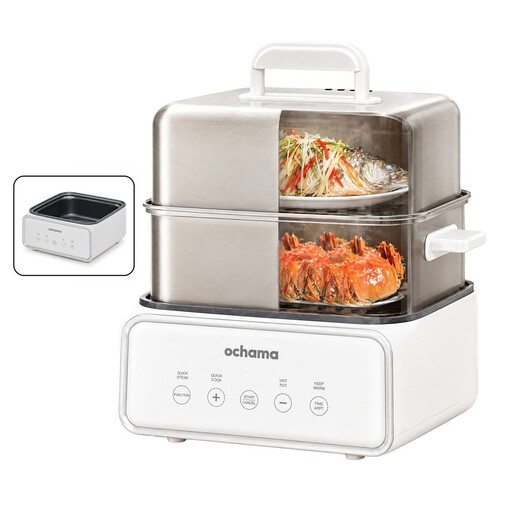
ochama Electric Steamer, 1500W, 12L
A standalone electric steamer to consider if you’re looking for an alternative to a built-in steam oven.
The product name specifies 1500W, 12L and a two-tier steaming chamber. Use on a flat, heat-resistant surface; accessible surfaces may become hot.
View at Joybuy
 No image available
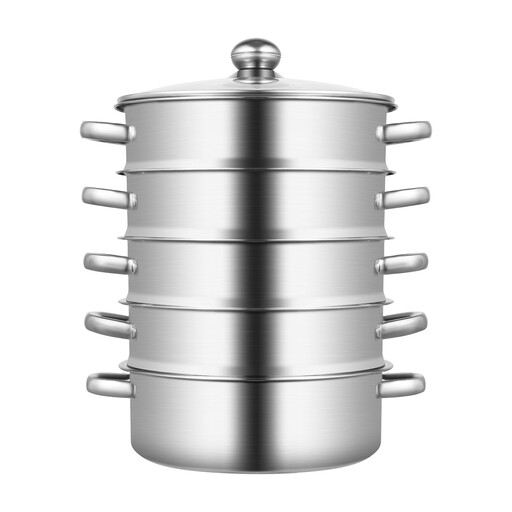
5-Tier Stainless Steel Steamer, 26 cm
A hob-top steamer for making rice cakes without a separate electric appliance.
The product name specifies 26 cm, four steaming racks and a pot. It needs a compatible hob; the product details list gas, induction and electric hobs.
View at Joybuy
 No image available
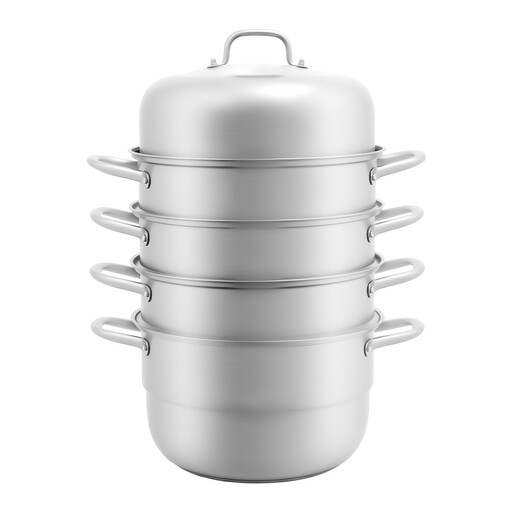
304 Stainless Steel Steamer Pot, 5-Tier, 9L
A multi-tier steamer pot for households that want to steam on the hob and make use of several levels.
The product name specifies 9L, five levels and three steaming chambers. Check that it’s suitable for your hob; the product details list gas, induction, ceramic and electric hobs.
View at Joybuy
 No image available
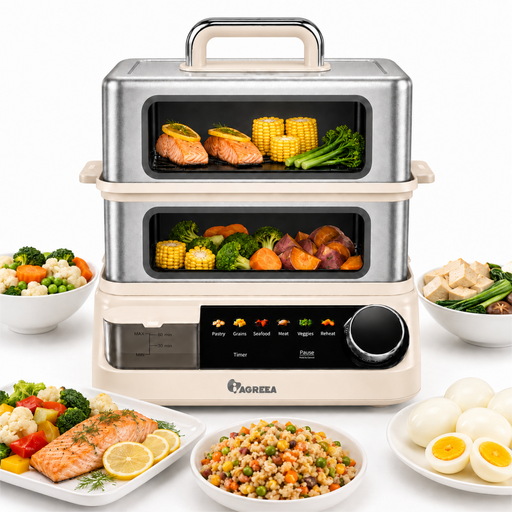
IAGREEA 14L Electric Food Steamer, 2000W, MS-22ZG21-Q
A freestanding electric steamer to consider if you want a dedicated steam-cooking solution instead of a built-in appliance.
The product name specifies 14L, 2000W, two stainless steel trays and an external 2.5 l water tank. The model number is MS-22ZG21-Q.
Use on a stable, flat, heat-resistant surface; accessible surfaces may become hot.
View at Joybuy
 No image available
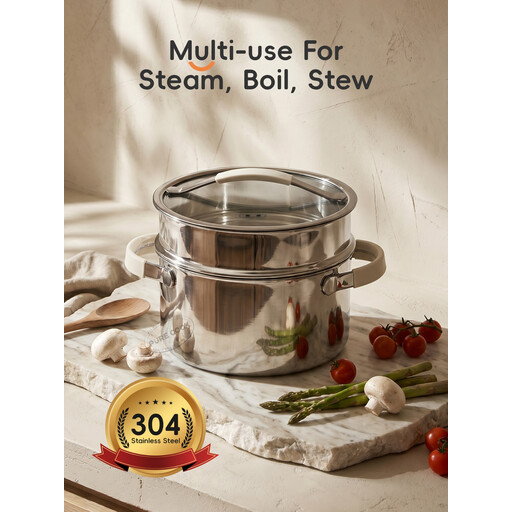
PURECOOK Steamer Pot 304 Tri-Ply Stainless Steel, 24 cm, 5300 ml
A hob-top steamer pot for anyone who prefers a steam-cooking solution without a built-in appliance.
The product name specifies 24 cm and 5300 ml. Check that it’s suitable for your hob; the product details list gas, induction and ceramic hobs.
View at Joybuy
Frequently asked questions
Is an oven with a steam boost enough for steamed rice cakes?
Not as proof that it’s suitable for steaming rice cakes. Check whether the complete model lists a dedicated steam-cooking function. For the SteamMaster E 56, CASO Design distinguishes steam cooking from a steam assistant that adds steam while baking.
Can I use the same cooking time for all rice cakes?
No. Cooking time and preparation depend on the type of rice cake and the recipe. Maangchi’s Baekseolgi recipe uses rice flour, a 20 cm cake ring and a cooking time of 30 minutes in the steamer described; this time isn’t a tested setting for the appliances featured here.
What should I measure before fitting or positioning an appliance?
For a built-in appliance, compare the installation diagram with the fitted space; for a freestanding appliance, check the external dimensions against the space you’ve set aside. Also check the internal dimensions against your rice cake mould.
How should I care for the appliance and leftovers after steaming?
Follow the model’s care instructions for the water tank, accessories and cooking compartment. The German Federal Institute for Risk Assessment notes that Bacillus cereus spores can survive heating; chilling food quickly or keeping it sufficiently hot can prevent them from germinating.
What do energy labels and CE marking tell me when buying in Germany?
For domestic ovens with the relevant label, the EU energy label includes consumption figures for conventional and fan-assisted cooking, not for steaming a rice cake recipe. Germany’s Federal Network Agency describes CE marking as a declaration made by the manufacturer on its own responsibility; it isn’t an independent quality mark for cooking results.
Are a manufacturer’s guarantee and statutory rights the same thing?
No. Your statutory rights apply in relation to the seller; a guarantee is a voluntary offer subject to its own terms. For the specific product listing, also check what applies to delivery, installation and accessories.


